

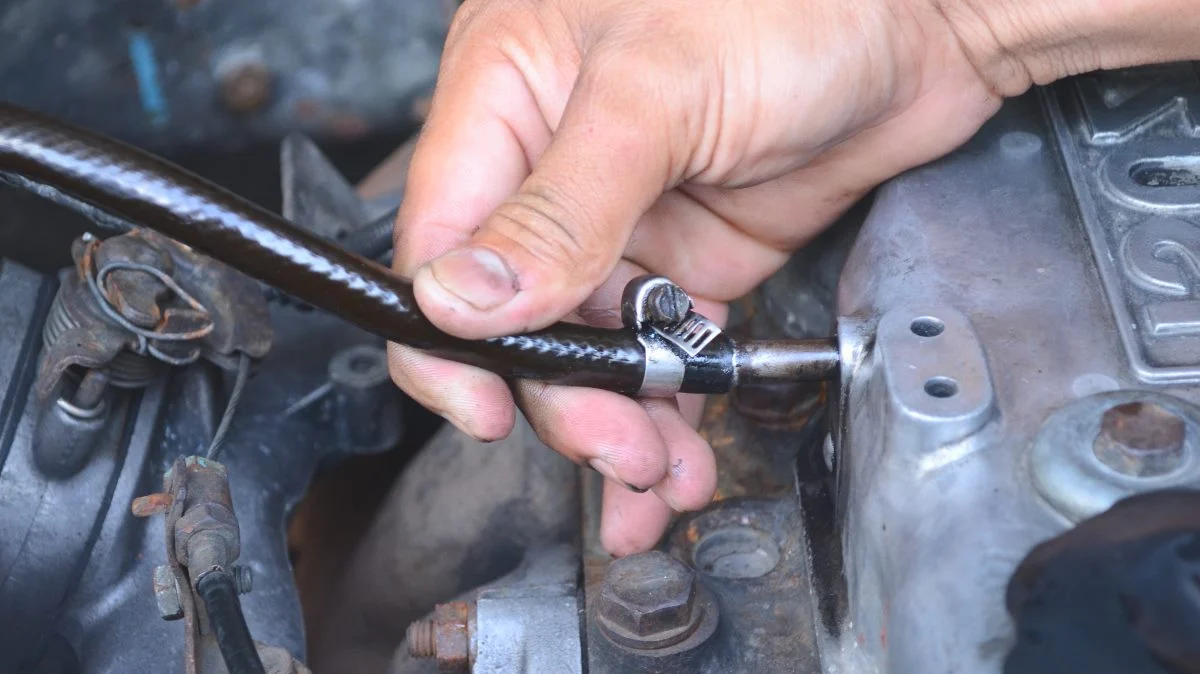
Code P0174 is a signal from the PCM indicating that the air-fuel mixture has become too lean on bank 2. Simply put, the engine is receiving more air than necessary or less fuel than required for proper combustion. Let’s explore why this happens, what symptoms appear, and how to systematically identify and fix the cause.
“When I see P0174 on the scanner, the first thing I check is for air leaks and the condition of the MAF sensor. These two causes cover the majority of cases — the PCM isn’t lying; it’s just reporting a discrepancy between the expected and actual mixture composition.” – Daniel Brooks, DecodeAuto
Information is general and does not replace professional consultation. Vehicle diagnostics and repairs require specialized knowledge and tools. Always follow safety procedures when working with the fuel system and exhaust.
Page contents
What does code P0174 (DTC P0174) mean: lean fuel mixture
P0174 is a DTC (Diagnostic Trouble Code) stored by the PCM when the air-fuel ratio exceeds the stoichiometric value of 14.7:1 on bank 2. Stoichiometry is the ideal ratio at which fuel burns completely without leftover oxygen or unburned hydrocarbons. If the upstream oxygen sensor on bank 2 consistently detects excess oxygen in the exhaust and the long-term fuel trim (LTFT) exceeds +20–25%, the PCM sets code P0174.
What actually happens: the engine control module analyzes the signal from the upstream oxygen sensor, compares the actual oxygen content with the reference, and tries to compensate for the fuel deficit by increasing injector pulse width. When the correction reaches its limit but the mixture remains lean, P0174 is triggered.
It is important to understand: this code does not mean the oxygen sensor is faulty. On the contrary, it worked correctly by detecting the real mixture condition. The problem lies in the causes that led to the lean condition.
What is “Bank 2” and how to locate it?
Bank 2 refers to the cylinder bank that does not contain cylinder number one. In V-type engines (V6, V8), banks are located on opposite sides of the engine block: bank 1 includes cylinder #1, bank 2 is the opposite row. For example, in a GM 6.2L V8, bank 1 is the driver side (cylinders 1-3-5-7), bank 2 is the passenger side (2-4-6-8).
Note: bank layout may vary depending on the manufacturer. VW/Audi, Ford, and Toyota may have their own cylinder numbering standards. Always consult your vehicle’s service manual — on some V engines, bank 2 may be on the driver side rather than the passenger side.
In inline four-cylinder engines, the concept of banks does not apply — all cylinders belong to a single bank, so P0174 does not occur on such engines. If you have an inline six with two oxygen sensor circuits, check the manufacturer’s manual: sometimes the second circuit is informally called bank 2, although this is not a classic bank division.
To accurately identify bank 2 on your vehicle: locate cylinder #1 (usually marked on the valve cover or in the service manual), the opposite side is bank 2. The upstream oxygen sensor for bank 2 (Bank 2 Sensor 1) is located in the exhaust manifold before the catalytic converter on that side.
Mini table of bank 2 location on popular engines:
| Engine | Bank 1 (with cylinder #1) | Bank 2 | Note |
|---|---|---|---|
| GM 6.2L V8 | Driver side (1-3-5-7) | Passenger side (2-4-6-8) | Typical for American V8s |
| Ford 5.4L V8 | Passenger side | Driver side | Check service manual |
| Toyota 2GR-FE V6 | According to manual (cylinder 1) | Opposite side | Verify in service information |
| BMW N62 V8 | Driver side | Passenger side | Verify in service manual |
Always verify with the service manual for your specific model.
Main symptoms of code P0174
Symptoms accompanying code P0174
When the PCM registers P0174, the first thing the driver notices is the Check Engine light on the dash. Next, unstable idle may occur: the engine hunts at idle and sometimes stalls at traffic lights. Power loss and hesitation during acceleration become especially noticeable when overtaking or merging onto highways — the engine struggles as if it’s suffocating.
Interestingly, fuel consumption may either increase or decrease. The PCM tries to compensate for the lean mixture by adding fuel, which sometimes leads to higher fuel consumption. In other cases, insufficient fuel reduces combustion efficiency — the vehicle runs worse but uses less fuel.
Difficulty starting when cold is another typical sign. In the morning, the engine cranks longer than usual and may misfire during the first seconds after startup. If the lean condition is severe, misfires may occur — a serious signal that diagnostics are needed.
Important: symptoms may not appear immediately. Sometimes the PCM partially compensates for the lean condition, and the driver only notices the Check Engine light without obvious changes in vehicle behavior. However, this does not mean the code can be ignored — consequences can build over time.
Symptom checklist (what to check first):
- Check Engine light is constantly on → connect scanner, read LTFT/STFT
- Only Check Engine light without behavior changes → start by scanning fuel trims and MAF
- Unstable idle → air leak (high priority)
- Power loss under load → fuel system (medium priority)
- Blinking Check Engine + knocking → STOP immediately, active misfires
| Symptom | Most likely cause | Priority for check |
|---|---|---|
| Engine stalls at idle or unstable idle | Major air leak after MAF, vacuum leak | High |
| Power loss, poor acceleration | Clogged injectors, low fuel pressure | Medium |
| Check Engine light on without other symptoms | Faulty MAF, slow O2 sensor response | High |
| Hard start, misfire | Intake manifold gasket leak, PCV valve issue | High |
How serious is code P0174? Is it safe to keep driving?
If the vehicle behaves steadily — does not stall, does not lose power abruptly, and the Check Engine light is not blinking — a short drive to the nearest repair shop or garage is usually not critical. However, planning a long trip with an active P0174 is not advisable.
Here is what is important to understand: a lean mixture can burn at a higher temperature than stoichiometric. Exhaust valves and the exhaust system may heat up more than usual. If this continues for several hundred miles (several hundred kilometers), the risk of valve burning or seat damage increases. Cylinder head repair is a major expense and time-consuming, unlike replacing a sensor or hose.
The catalytic converter also suffers. Prolonged operation with a lean mixture can contribute to catalyst overheating and damage. A clogged catalyst results in power loss, further overheating, and additional repair costs.
Dangers of ignoring code P0174: risk of catalytic converter damage
Ignoring P0174 can lead to a chain reaction: lean mixture → exhaust overheating → catalyst degradation → increased backpressure → engine performance deterioration → possible misfires → further overheating. This cycle can quickly increase repair costs.
Real-world example: a vehicle ran about 1,240 miles (2,000 km) with active P0174 and mild misfire symptoms. The owner assumed it would resolve after refueling. The result was a burned exhaust valve on cylinder three (bank 2), melted catalyst honeycombs, and the need to replace the cylinder head along with the catalyst. Total repair cost exceeded $1,500, although the original cause was a $15 vacuum hose crack.
Another risk is increased NOx emissions. Lean mixtures burn hotter, promoting nitrogen oxide formation. The vehicle may fail emissions testing if required in your area.
If you notice a blinking Check Engine light or knocking (metallic pinging under acceleration), stop driving immediately. A blinking light indicates active misfires that can damage the catalyst within a few miles (a few kilometers).
Main causes of code P0174: from air leaks to sensors
Code P0174 is not a failure of a specific part but the PCM’s response to an air-fuel imbalance. Causes can be multiple and often combined. Below is a prioritized list based on common diagnostic scenarios.
Start simple: visual inspection and intake system check. If no obvious leaks are found, proceed to sensors and fuel system. The logic is to rule out cheap and accessible causes first, then move to more complex components.
| Cause | Signs | How to check | Likelihood |
|---|---|---|---|
| Air leak | Unstable idle, hissing noise during engine operation | Smoke machine, carburetor cleaner spray | Very high |
| Dirty/faulty MAF sensor | Incorrect airflow readings, code P0101 | Scanner (compare idle and 2500 rpm readings), cleaning | High |
| Faulty O2 sensor Bank 2 S1 | Slow response to mixture changes, code P0153 | Oscilloscope waveform, heater check | Medium |
| Low fuel pressure | Power loss under load, hard start | Fuel pressure gauge on rail | Medium |
| Clogged injectors on bank 2 | Uneven cylinder operation, misfires | Injector balance test, cleaning/replacement | Medium |
| PCV valve issue | Air leak through crankcase ventilation | Visual inspection, vacuum test | Low |
| Exhaust leak before O2 sensor | False oxygen sensor readings | Visual inspection of flanges, gaskets | Low |
| Stuck open EVAP purge valve | Lean condition at idle, unstable RPM | Pinch purge hose, monitor STFT | Medium |
| Leaky brake booster | Air leak through brake booster check valve | Pinch hose to booster, check valve | Low |
1. Unmetered air leak
An air leak occurs when air enters the intake tract without passing through the mass airflow sensor (MAF). The PCM calculates fuel based on MAF readings, but more air actually reaches the cylinders, causing a lean mixture.
Typical leak points:
- Vacuum hoses: rubber ages and cracks, especially at bends and connections. PCV system hoses, brake booster hoses, purge valve hoses are all suspects.
- Intake boot: between air filter and throttle body. Rubber boots lose elasticity over time and develop microcracks.
- Intake manifold gaskets: plastic manifolds’ gaskets can harden and lose sealing. In V engines, leaks may occur only on one side — specifically bank 2.
- Injector sealing rings: rare but possible — worn rings allow air to enter around the injector.
How to check: visually inspect all hoses and joints for cracks. Start the engine and listen — leaks often produce a characteristic hissing sound. For precise diagnosis, use a smoke machine: introduce smoke into the intake with the engine off; smoke escapes at leak points. If no smoke machine is available, spray carburetor cleaner around suspect areas on a running engine — if RPM changes, a leak is found.
Repair: replace cracked hoses, tighten or replace intake manifold gaskets. This is one of the most common and inexpensive causes of P0174 — the key is to find it.
2. Faulty mass airflow sensor (MAF)
The mass airflow sensor measures the amount of air entering the engine. The PCM uses this data to calculate injector pulse duration. If the MAF is dirty or faulty, it reports lower airflow than actual — the PCM thinks there is less air and supplies less fuel, resulting in a lean mixture.
How MAF gets dirty: dust and oil vapors (especially if the air filter is old or an oiled performance filter is used) accumulate on the sensing element — a hot wire or film element. Even a thin layer changes heat transfer, causing the sensor to read inaccurately.
Signs of MAF malfunction:
- Idle readings differ from normal (for most V6 engines, normal is 2–5 g/s at idle, 15–25 g/s at 2500 rpm; always check your model’s manual as values vary by engine size and calibration).
- Sudden jumps or freezing of readings during RPM changes.
- Code P0101 (MAF Circuit Range/Performance) alongside P0174.
Rule of thumb for MAF g/s relative to engine size (approximate ranges):
| Engine size | MAF at idle (g/s) | MAF at 2500 rpm (g/s) | Note |
|---|---|---|---|
| 2.0–2.5L 4-cyl | 1.5–3.5 | 10–18 | Check manual |
| 3.0–3.5L V6 | 2–5 | 15–25 | Typical range |
| 4.0–5.0L V8 | 3–7 | 20–35 | Depends on configuration |
| 5.5L+ V8/V10 | 4–9 | 30–50 | Check service information |
Always consult official service information or diagnostic databases.
Diagnosis: connect a scanner, observe current MAF readings in grams per second at idle and during smooth acceleration to 2500 rpm. If values are significantly low or do not change smoothly, the sensor is suspect.
Repair: first try cleaning the MAF with a dedicated MAF cleaner (do not use brake cleaner or carburetor cleaner — they can damage the sensing element). Disconnect the sensor, spray cleaner on the hot wire in short bursts from 4–6 in. (10–15 cm) away, let it dry, then reinstall. If cleaning fails, replace the sensor.
Warning: never clean the MAF with brake cleaner! Use only specialized mass airflow sensor cleaners. Brake cleaner is aggressive and can damage the sensor element.
Important: do not touch the sensitive element with your hands or tools — this can destroy the sensor.
3. Fuel delivery issues: injectors and pump
Fuel shortage can be caused by low rail pressure, a clogged fuel filter, or dirty injectors on bank 2. If injectors do not spray enough fuel, the mixture becomes lean — the PCM records P0174.
Fuel pump and pressure:
Normal pressure for multi-point injection (MPI) engines is typically 43–65 psi (3–4.5 bar / 300–450 kPa) at idle (check your model’s manual as values vary by injection system and manufacturer). If pressure is low, the pump may be worn or the filter clogged. Pressure is checked with a gauge connected to the fuel rail test port.
Signs: power loss during overtaking, hard start, hesitation on sudden throttle. If pressure drops under load but holds at idle, the pump may be failing.
Clogged injectors:
Deposits (resins, varnish) on injector nozzles worsen spray quality. Fuel sprays as a stream rather than a mist, reducing mixture quality. If injectors on bank 2 are clogged, P0174 appears (if both banks are affected, P0171 and P0174 appear simultaneously).
Diagnosis: check injector balance with a scan tool if available. Significant performance deviation of one or more injectors indicates clogging. Additionally, perform a compression test: if compression is normal but the cylinder is weak, the issue is fuel or ignition.
Repair: replace the fuel filter if serviceable and overdue for replacement. Check pressure with a gauge; if low, replace the pump or pressure regulator. Injectors can be cleaned with fuel additives or by ultrasonic cleaning on a bench. If cleaning fails, replace them.
| Fuel system component | Symptom | Test | Normal/Threshold |
|---|---|---|---|
| Fuel pump | Power loss under load | Fuel pressure gauge on rail | 43–65 psi (3–4.5 bar) (MPI) – check manual |
| Fuel filter | Hard start, hesitation | Measure pressure before/after filter | Pressure drop >4 psi (>0.3 bar) – replace |
| Injectors | Uneven cylinder operation | Balance test, oscilloscope | Deviation >10% from average |
| Pressure regulator | Unstable pressure | Vacuum gauge + pressure gauge | Must hold 43–65 psi (3–4.5 bar) with vacuum released |
4. Faulty oxygen sensor (O2 sensor)
Important: P0174 does not necessarily mean the oxygen sensor is faulty. The PCM stored the code because the sensor correctly reported a lean mixture. However, sometimes the sensor itself malfunctions — responding slowly to exhaust changes or providing shifted signals.
Narrowband vs. wideband O2/A/F sensors:
Modern vehicles often use wideband air-fuel ratio sensors (A/F sensor, also called wideband O2). They operate differently from traditional narrowband oxygen sensors:
- Narrowband O2 (0.1–0.9 V): voltage switches rapidly several times per second between 0.1 V (lean) and 0.9 V (rich), producing a sawtooth pattern. Normal operation shows oscillations between 0.1 and 0.9 V.
- Wideband A/F: outputs a linear signal (current or voltage) proportional to the exact lambda ratio, without a sawtooth pattern. Typical range is 0–5 V or ±2 mA current depending on manufacturer. Do not expect a 0.1–0.9 V sawtooth on an A/F sensor.
If you have an A/F sensor (wideband), rely on lambda readings on the scan tool or current/voltage per your model’s manual. Do not apply narrowband criteria — this will mislead diagnosis.
Signs of O2 Bank 2 Sensor 1 degradation (narrowband):
- Slow switching between rich and lean (normal is several times per second; faulty is once every 2–3 seconds).
- Voltage stuck at one point (for example, steady 0.45 V instead of oscillating 0.1–0.9 V).
- Code P0133 (O2 Sensor Circuit Slow Response, Bank 1 Sensor 1) or P0153 for bank 2.
Signs of A/F sensor degradation (wideband):
- Slow response to lambda changes (refer to the service manual for expected response time).
- Incorrect lambda readings during propane/vacuum tests.
- Codes related to the sensor heater circuit may also be present.
Diagnosis: connect a scan tool with graphing function or use a multimeter to observe the waveform.
For narrowband O2: on a warmed-up engine at idle, voltage should oscillate rapidly between 0.1 and 0.9 V. Introduce propane into the intake (rich mixture) — voltage should rise quickly. Create a vacuum leak (lean mixture) — voltage should drop just as quickly.
For wideband A/F: check response to mixture changes via the lambda or current/voltage graph. Normal response times should be verified in the service manual.
Another test: check the sensor heater circuit with a multimeter. A cold sensor does not work properly; the PCM relies on the heater to reach operating temperature quickly. If the heater is faulty, a heater-circuit code may set.
Repair: if the sensor is slow or unresponsive, replace it. OEM sensors for popular models cost $60–200; aftermarket units are cheaper but may vary in quality. Important: install the same sensor type (zirconia or titania, narrowband or wideband) as original.
5. EVAP purge valve as a cause of P0174
The EVAP purge valve controls the flow of fuel vapors from the charcoal canister into the intake manifold. If the valve sticks open, extra air can enter the intake without being properly accounted for, which can contribute to a lean condition at idle on some vehicles.
Symptoms of a stuck-open EVAP purge valve:
- Lean condition mainly at idle (mixture may be normal under load).
- Unstable idle RPM, occasional stalling.
- High LTFT at idle, normalizing at 2500 rpm and under load.
Test by pinching the purge hose:
- Start the engine and let it idle.
- Connect a scanner and monitor STFT/LTFT on bank 2.
- Pinch the hose from the canister to the intake manifold.
- If STFT/LTFT drop sharply (mixture normalizes), the purge valve may be stuck open.
Repair: replace the EVAP purge valve. Cost: $30–80 plus 0.3–0.5 labor hours.
6. Systems without MAF (Speed-Density / MAP)
Some vehicles use a speed-density system where a manifold absolute pressure sensor (MAP) replaces the MAF. The PCM calculates airflow based on MAP, intake air temperature (IAT), and coolant temperature (ECT).
What to check in a speed-density system with MAP:
- MAP (kPa or V): at idle, manifold pressure should be relatively low (typically 20–40 kPa or about 0.5–1.5 V); under load, it rises toward atmospheric pressure (~100 kPa).
- An air leak can cause MAP readings outside manual specs at idle.
- Compare MAP readings at idle and 2500 rpm with reference values for your model.
- Check ECT/IAT plausibility: incorrect temperatures cause wrong air density calculations.
Air leak test for MAP systems:
- Use a scanner to monitor MAP and LTFT at idle.
- Create a vacuum leak (disconnect a hose) → MAP should increase, LTFT should rise.
- If MAP does not change as expected, the sensor may be faulty or there may be another issue.
Repair: replace the MAP sensor or fix leaks based on test results.
7. Other causes: PCV, exhaust leaks before sensor, software issues
Crankcase ventilation system (PCV):
The PCV valve and hoses can cause air leaks. A stuck-open valve or cracked hose can act like a vacuum leak. Check PCV hoses for cracks and the valve for sticking (it should rattle when shaken on many designs, though not all).
Brake booster and check valve:
A leaky vacuum brake booster can draw air through the check valve. Symptom: lean condition worsens when pressing the brake pedal.
Brake booster test:
- Pinch the hose to the brake booster with the engine running.
- Monitor STFT/LTFT.
- If trims drop, the check valve or booster is leaking.
Exhaust leaks before oxygen sensor:
If the exhaust manifold gasket is burned or a flange is not sealed, fresh air mixes with exhaust before the upstream O2 sensor. The sensor detects excess oxygen and reports a lean mixture to the PCM, although the actual cylinder mixture may be normal. Check visually for soot marks around joints and listen for hissing with the engine running.
Outdated PCM software:
Rarely, manufacturers release Technical Service Bulletins (TSBs) with fuel system calibration updates. If your vehicle is covered, reflashing may resolve P0174 without physical repairs. Check TSBs through the manufacturer or with an authorized dealer.
How to find the cause of P0174: step-by-step diagnostics
Information is general and does not replace professional consultation. Incorrect diagnostics can cause vehicle damage or injury.
Diagnosing P0174 involves sequentially ruling out causes from simple to complex. Skipping steps and replacing sensors immediately risks wasting money.
Step 1: OBD-II scanner diagnostics
Connect a scanner and read all active and stored codes. If only P0174 is present, focus on bank 2. If P0171 appears alongside it, check common systems (MAF, fuel pump, general air leaks). Record freeze-frame data (conditions when the code appeared): RPM, temperature, load.
Evaluate fuel trims:
- STFT (Short Term Fuel Trim) – short-term correction, changes several times per second.
- LTFT (Long Term Fuel Trim) – long-term average of STFT over time.
Normal range: LTFT and STFT within ±5–10% under stable conditions. If LTFT on bank 2 exceeds +20–25% at idle, 2500 rpm without load, or at 50% load, a lean condition is confirmed.
Fuel trim matrix “Fuel trims → likely cause” (reference logic):
| Mode | LTFT B2 | STFT B2 | Likely cause | Next step |
|---|---|---|---|---|
| Idle | +25% | +15-20% | Vacuum leak/PCV/EVAP purge/intake B2 | Smoke machine, pinch purge hose |
| Idle → normal at 2500 rpm | +25% idle, +5% at 2500 | Normalizes | Vacuum leak at low RPM | Check hoses, PCV |
| Idle and under load | +25% idle, +25% load | Consistently high | Fuel delivery/injectors B2 | Fuel pressure, injector balance |
| P0171+P0174 simultaneously | Both banks +20-25% | Both high | Common MAF/pump/general leak | MAF, fuel pressure, intake |
| Only under load | Normal idle, +25% load | Rises with acceleration | Pump/filter/regulator | Fuel pressure under load |
Use this table as a diagnostic roadmap, not a definitive diagnosis.
Step 2: Visual inspection
Open the hood and inspect:
- Intake boot and hose – cracks, delamination.
- Vacuum hoses – especially those connected to the intake manifold and PCV valve.
- Manifold gaskets – signs of oil or soot leaks.
- Clamps and connections – all should be tight.
Step 3: Air leak check
Smoke machine method: remove intake boot, seal intake openings, introduce smoke. Smoke escapes at leak points.
Carburetor cleaner method: spray around joints and hoses on a running engine. If RPM changes, a leak is found.
Step 4: MAF check
Remove the sensor and inspect the sensing element. If dirty, clean it. Connect a scanner and compare MAF readings at idle and 2500 rpm with specifications (usually in the manual). If deviation exceeds 15–20%, replace the sensor.
Step 5: Fuel pressure check
Connect a pressure gauge to the rail test port. Start the engine and record idle pressure. Normal: 43–65 psi (3–4.5 bar) (check your model). Apply load (turn on lights, A/C, rev engine) — pressure should not drop more than about 4 psi (0.3 bar). A larger drop indicates a pump or regulator issue.
Step 6: Oxygen sensor check
Connect a scanner with graphing function or a multimeter. Observe Bank 2 Sensor 1 switching at idle. Normal: rapid oscillations 0.1–0.9 V (narrowband) or a linear lambda signal (wideband A/F). Slow or stuck readings indicate sensor wear.
Step 7: Test drive with logging
Drive 15–20 minutes while logging fuel trims in various modes (idle, acceleration, steady speed). If LTFT remains high in all modes, the problem is constant. If it fluctuates, the issue is intermittent (for example, a leak only under certain load).
Freeze frame: how to read it and what it indicates:
Freeze frame is a snapshot of engine parameters at the moment P0174 was recorded. It typically includes:
- RPM
- ECT (coolant temperature)
- LTFT/STFT bank 2
- MAF g/s
- Load
Mini interpretation examples:
- Code set at idle (RPM ~700), ECT >176°F (>80°C), LTFT +25% → vacuum leak or EVAP purge.
- Code set at 3000 RPM, Load >50%, LTFT +25% → fuel pump/filter failing under load.
- Code set at ECT <140°F (<60°C), LTFT +15% → possible cold-start leak or faulty ECT sensor affecting mixture calculation.
How to fix code P0174: repair and replacement
Information is general and does not replace professional consultation. Repairs can be dangerous if performed incorrectly.
Once the cause is identified, proceed with repairs. Do not close the hood immediately after part replacement — verify the result.
Fixing air leaks:
Replace cracked vacuum hoses, tighten clamps, and replace intake manifold gaskets if hardened. If the intake boot is torn, replace it entirely. Hose costs range from $10–30, manifold gaskets $20–80 depending on model.
Cleaning or replacing MAF:
Try cleaning first with specialized cleaner (CRC MAF Cleaner, Liqui Moly, or equivalent). If cleaning fails, replace the sensor. OEM costs $80–250, aftermarket $40–120. Note: after MAF replacement, PCM adaptation may be required (often occurs automatically after several drive cycles).
Fuel system:
Replace the fuel filter if serviceable and overdue. Cost $15–40. Check pressure after replacement. If low, replace the pump ($150–500+) or pressure regulator ($30–100). Injectors can be cleaned on a bench ($50–150 per set) or replaced ($50–200 each).
Oxygen sensor:
If the sensor is slow or unresponsive, replace it. OEM $60–200, aftermarket $30–100. Note: bank 1 and bank 2 sensors may differ in wiring on some vehicles.
PCV and exhaust:
Replace the PCV valve and hoses ($10–50). Fix exhaust leaks by tightening flanges or replacing manifold gaskets ($20–80).
How to properly clear code P0174 after repair
Simply erasing the code with a scanner is not enough — you must ensure the cause is fixed and the PCM has accepted the changes.
Procedure:
- Connect a scanner and clear active codes (Clear DTC).
- Start the engine and let it idle for 2–3 minutes.
- Perform a drive cycle: warm the engine to operating temperature, then drive 15–20 minutes in mixed conditions (city + highway, steady RPM + accelerations). The PCM should complete all monitors, including O2 sensor and fuel system.
- Check monitor status on the scanner: all should be “Ready.”
- Scan for codes again. If P0174 does not return, the repair is successful.
Fuel trim monitoring:
After the drive cycle, check LTFT and STFT on bank 2 in real time. Values should return to ±5–10%. If LTFT remains high, the cause is not fully resolved or there is an additional issue.
Important: after MAF replacement or battery disconnection, the PCM may reset adaptive tables. The vehicle may behave slightly differently for the first 30–60 miles (50–100 km) while the PCM relearns. This is normal.
Permanent DTC and monitor readiness:
Some modern vehicles (2010+ model years) use permanent codes (Permanent DTC). Permanent P0174 cannot be cleared by a simple scanner reset — it clears only after successful completion of the fuel system monitor without new faults and several drive cycles. This prevents code clearing before inspection.
How to check monitor readiness:
- Connect a scanner → go to the “I/M Readiness” (Inspection/Maintenance) section.
- All monitors should show “Complete” or “Ready.”
- If the fuel system monitor is “Not Ready,” perform another drive cycle.
Approximate cost of repairing code P0174
Costs vary greatly depending on the cause and region:
| Service/Component | Parts | Labor | Total |
|---|---|---|---|
| OBD-II scanner diagnostics | – | $30–60 | $30–60 |
| MAF cleaning + minor vacuum repair | $10–30 (cleaner/hoses) | $50–80 | $60–110 |
| Vacuum hose/manifold gasket replacement | $20–80 | $100–200 | $120–280 |
| O2 sensor Bank 2 S1 replacement | $60–200 | $50–100 | $110–300 |
| Fuel pump replacement | $150–400 | $100–200 | $250–600 |
| Injector cleaning on bench | – | $50–150 | $50–150 |
| EVAP purge valve replacement | $30–80 | $30–50 | $60–130 |
| Brake booster check valve inspection/replacement | $20–50 | $30–50 | $50–100 |
The cheapest scenario is an air leak through a hose costing $10 plus one hour of labor. The most expensive is replacing the pump + sensor + injectors, which can exceed $600–1,000.
Regional specifics (approximate):
- USA/Canada: labor rate $80–150/hr, OEM parts more expensive, aftermarket cheaper.
- Europe: labor €70–120/hr, OEM parts 20–30% more expensive due to VAT.
- Some regions: labor rates and parts availability vary widely; compare local shop rates and choose parts based on verified quality.
Related trouble codes
If other codes appear alongside P0174, they narrow down the search:
- P0171 (System Too Lean, Bank 1) – lean mixture on bank 1. Both codes together indicate a common issue: MAF, fuel pump, or general air leak.
- P0172/P0175 (System Too Rich, Bank 1/Bank 2) – rich mixture. Opposite of P0174, indicating excess fuel or sensor errors.
- P0101–P0104 – MAF fault codes (Circuit Range/Performance, Low/High Input). If P0101 + P0174, check and replace the MAF first.
- P0133/P0153 – slow oxygen sensor response on bank 1/bank 2. If P0153 + P0174, Bank 2 Sensor 1 may be worn.
- P0300 – Random/Multiple Cylinder Misfire Detected. Lean mixture can cause misfires.
- P0420/P0430 – Catalyst System Efficiency Below Threshold (Bank 1/Bank 2). Prolonged lean operation can degrade the catalyst.
Logic: if codes point to MAF, O2, or the fuel system, start there. If codes are scattered (for example, P0174 + P0300 + P0430), there is likely one root cause with secondary effects.
Common mistakes in diagnosing and repairing P0174
- Replacing the oxygen sensor immediately without checking other systems. P0174 does not mean the O2 sensor is faulty — it correctly detected a lean mixture. Check air leaks and the MAF first.
- Ignoring air leaks. Even a tiny crack in a vacuum hose can cause a lean mixture. Many technicians rely only on scanners, neglecting visual inspection and smoke testing.
- Cleaning the MAF with inappropriate chemicals. Brake cleaner or carburetor cleaner can damage the MAF sensor element. Use only specialized cleaners.
- Clearing the code without fixing the cause. This is like taping over the Check Engine light — the code returns within 6–30 miles (10–50 km).
- Not checking the EVAP purge valve and brake booster. These components are often overlooked but can cause leaks.
- Confusing narrowband O2 and wideband A/F sensors. Wideband sensors do not produce a 0.1–0.9 V sawtooth signal, leading to wrong conclusions.
- Ignoring speed-density systems without MAF. If your vehicle uses MAP instead of MAF, diagnostic logic differs — check MAP readings and ECT/IAT plausibility.
Sources:
Materials are based on publicly available information and practical experience. For accurate diagnostics of a specific vehicle model, consult official manufacturer service manuals (Toyota Service Manual, Ford TSBs, GM Service Information, etc.), SAE standards (SAE J1979 – OBD-II PIDs, SAE J2012 – Diagnostic Trouble Code Definitions), and specialized diagnostic platforms (RepairPal, Edmunds, AutoZone Repair Guides).
Frequently asked questions
What is the difference between P0174 and P0171?
P0174 indicates a lean mixture on bank 2, while P0171 indicates a lean mixture on bank 1. Both codes mean the air-fuel mixture is lean, but they differ by engine bank. If both codes appear simultaneously, it points to a problem common to the entire engine: a faulty MAF, a weak fuel pump, or a general intake leak. If only one code appears, look for a cause specific to that bank: a clogged injector, a gasket leak on that bank, or an oxygen sensor issue.
Can P0174 appear due to poor quality fuel?
Yes, but indirectly. Poor-quality fuel with low octane or high water content does not directly change the air-fuel ratio, but it can contribute to clogging of the fuel filter or injectors, or reduce pump performance. Under load, fuel pressure drops, the mixture becomes lean, and P0174 appears. If you refueled at a questionable station and the code appeared after 60–120 miles (100–200 km), try changing the fuel, adding a fuel system cleaner, and replacing the filter if applicable.
Why does the P0174 code not clear after repair?
If you cleared the code with a scanner but it returns after 6–30 miles (10–50 km), it means the cause is not eliminated or only partially fixed. Possible reasons: 1. You fixed one cause but there is another. For example, you replaced the MAF but an air leak remains. 2. Permanent DTC: on vehicles from 2010+, the code can be permanent. It does not clear until the PCM completes several drive cycles without errors. 3. PCM adaptive tables are not reset. After repairing the MAF or fuel system, the PCM may use old adaptations. Reset adaptations with a scanner or disconnect the battery for 10–15 minutes if appropriate for the vehicle. What to do: – Check LTFT/STFT in real time after repair. – Complete a full drive cycle (15–20 minutes of mixed driving). – Check monitor status—all should be Ready. – If the code returns, recheck diagnostics; another cause may have been missed.