

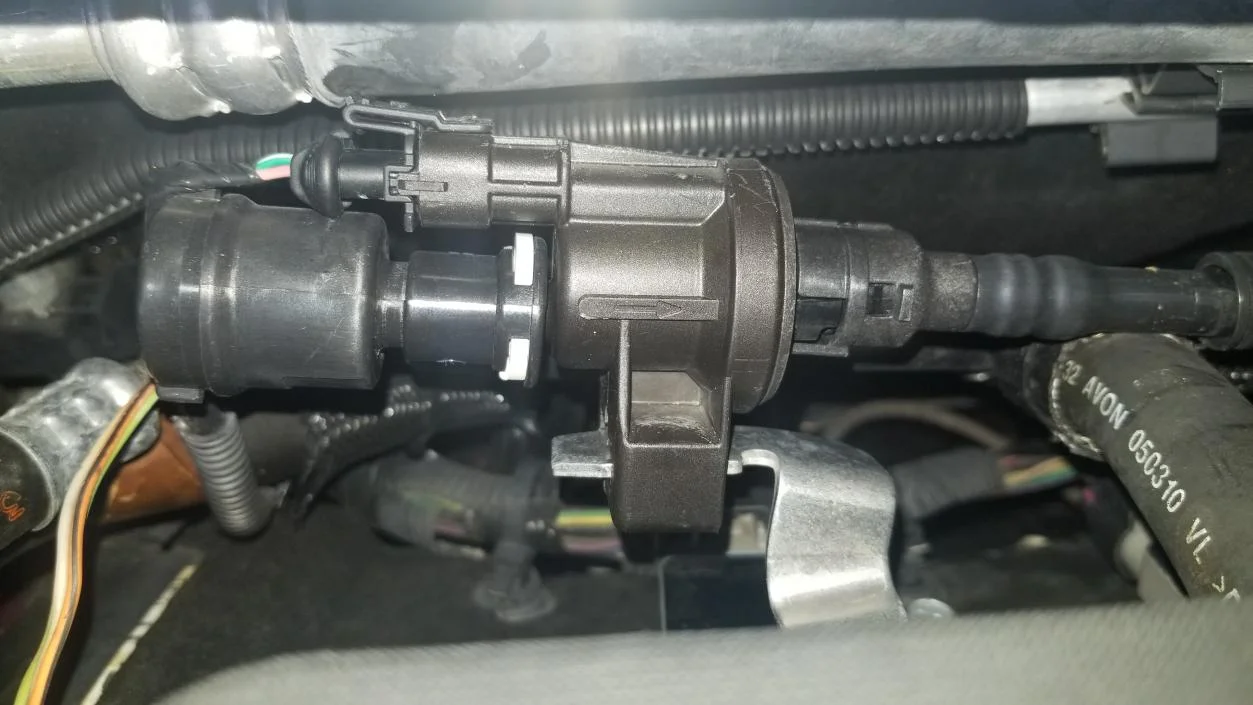
DTC P0442 indicates a small leak in the evaporative emission control system (EVAP), typically equivalent to about 0.04 in. (1 mm). The engine control module (ECM) detects this during a leak test by creating a vacuum or pressure in the system, monitoring changes via the fuel tank pressure sensor, and if readings exceed allowable limits, it stores the code and turns on the Check Engine light. Fuel vapors that should be burned in the engine escape into the atmosphere, violating emissions regulations and potentially causing a failed inspection.
“P0442 is not a verdict but a signal of a minor leak. In most cases, the issue is resolved by simply checking the gas cap or inspecting the hoses. The key is to understand the EVAP test logic to avoid replacing parts blindly.” – Daniel Brooks, DecodeAuto
Page contents
Briefly: what to do immediately
- Check the gas cap—tighten it until you hear the characteristic clicks (usually 3–5). If the seal is cracked or the threads are worn, replace the cap with an OEM part.
- Read the code with an OBD-II scanner—record freeze-frame data, clear the code, and perform 2–3 drive cycles (city + highway). If the code returns, the leak is real.
- Inspect EVAP hoses and valves—look for cracks, loose clamps, fuel traces at connections, damage from rodents or road debris. If you cannot find anything yourself, get a smoke test at a repair shop.
Symptoms of P0442
Main symptoms and signs of malfunction
The primary symptom is the Check Engine light on the dashboard. In most cases, the vehicle operates normally: performance remains unchanged, and the engine runs smoothly. However, additional signs may appear.
A faint smell of gasoline around the vehicle—especially near the rear wheel or in the garage after parking. Fluctuating idle speed after filling the tank. Rarely, drivers notice difficulty starting immediately after refueling—this occurs if the purge valve is stuck open, causing excessive fuel vapors to enter the intake.
It is important to understand that P0442 detects a small leak (typically about 0.04 in. or 1 mm), so symptoms are subtle. A large leak may trigger code P0455, while a very small leak may trigger P0456.
| Symptom | Likelihood | First check |
|---|---|---|
| Check Engine light on | High | Read code with scanner, check gas cap |
| Gasoline smell near vehicle/interior | Medium | EVAP hoses, seals, charcoal canister |
| Fluctuating idle after refueling | Low | Purge valve |
| Difficulty starting | Low | Purge valve, fuel tank pressure sensor (FTP) |
How the EVAP system works and its purpose
The evaporative emission control system (EVAP) prevents gasoline vapors from escaping into the atmosphere. When the vehicle is parked or fuel heats up in the tank, vapors rise and are routed through hoses to the charcoal canister. Inside the canister is activated carbon that temporarily traps the vapors.
When the engine starts and certain conditions are met (coolant temperature above 140–158°F (60–70°C), RPM above idle), the ECM opens the purge valve. Through this valve, fuel vapors are drawn into the intake manifold, mixed with air, and burned in the cylinders. Simultaneously, the ECM controls the vent valve: it closes to seal the system and create a vacuum, then opens to allow fresh air into the canister to regenerate the carbon.
The fuel tank pressure sensor (FTP) continuously monitors pressure/vacuum in the system. The ECM periodically runs a leak test by closing the vent valve, opening the purge valve, and observing FTP readings. If pressure drops slower than calibrated or does not reach the target value, a leak is detected and code P0442 is stored.
This system is critical for emissions compliance and stable engine operation—excess vapors in the intake can cause a rich mixture and fluctuating idle.
Main causes of code P0442
Below is a prioritized list of causes, from the most common and simple to rare. Start diagnostics from the top to save time and money.
| Cause | Likelihood | Where to look / how to check |
|---|---|---|
| Loose or damaged gas cap | Very high | Visual: cracks, seal wear, no clicks when tightening |
| Cracks or holes in EVAP hoses | High | Under hood and near tank: microcracks, abrasion on brackets, rodent damage |
| Faulty purge valve | Medium | Click test with 12 V, vacuum leak test |
| Faulty vent valve | Medium | Scanner activation, airflow/closure check |
| Leak detection pump (LDP) | Medium/Low | Visual (cracked housing), electrical (power/ground), scanner activation |
| Cracks in charcoal canister housing | Medium | Under vehicle inspection: housing cracks, fuel smell near rear wheel |
| Seals/O-rings at connections | Medium | Visual + smoke test |
| Fuel tank pressure sensor (FTP) | Low | Compare readings to reference, wiring check |
| Crack in fuel tank/filler neck | Low | Smoke test, underbody inspection |
| Wiring issues with valves/sensor | Low | Connector corrosion check, circuit continuity test |
| ECM software updates/TSB | Rare | Check dealer campaigns |
1. Loose or damaged gas cap
The gas cap is the number one cause. If the seal is cracked, threads worn, or the cap is not fully tightened, the system loses its seal. Modern caps have a ratchet mechanism: when properly installed, 3–5 clicks are heard. Lack of clicks or weak resistance when tightening indicates wear.
What to check:
- Cracks on the cap body or sealing ring
- Dirt/fuel residue on threads or seal (clean with a cloth)
- Seal deformation (hardened, lost elasticity)
- Proper installation: tighten until it clicks
If the cap is older than 5–7 years or visibly damaged, replace it with an OEM part. Aftermarket caps may not provide proper sealing due to incorrect seal dimensions.
2. Cracks and damage to vacuum hoses
EVAP hoses lose elasticity over time—especially in hot climates or when exposed to sunlight. Typical damage locations:
- At canister and valve fittings (crack from vibrations)
- Areas rubbing against body brackets or suspension parts
- Quick-connect fittings (seal ring wear)
- Sections damaged by rodents or road debris
How to check:
- Inspect all hoses under the hood (from purge valve to intake) and under the vehicle (from tank to canister).
- Look for microcracks, rubber softening, fuel traces, and rodent bite marks.
- Check clamps: loose clamps are a common leak cause.
- Squeeze hoses gently—if they crumble or leave finger marks, replace them.
Replace damaged sections with fuel-resistant hoses of the same diameter. Use new spring or worm-drive clamps.
3. Purge valve malfunction
The purge valve is an electromagnetic solenoid that opens/closes the path for fuel vapors from the canister to the intake. It can:
- Stick open—vapors constantly enter the intake, the leak test fails, and idle may fluctuate.
- Stick closed—vapors do not purge, the canister can become saturated, and tank pressure may rise.
- Stick intermittently—the valve operates with a delay or does not fully open/close.
Quick check:
- Remove the valve (usually under the hood near the intake manifold).
- Apply 12 V to the valve terminals—you should hear clear clicks, and the valve should open.
- Without power, try blowing air through the ports—the valve should be sealed (no airflow).
- On a running engine, connect a vacuum gauge to the canister port—vacuum should appear when the valve is activated with a scanner.
If the valve does not click, leaks air, or fails tests, replace it.
4. Cracks in charcoal canister housing
The canister (activated carbon container) is usually located under the vehicle near the rear wheel or tank. The housing can crack due to:
- Impact from stones or curbs
- Corrosion of mounts (canister sags and gets damaged)
- Mechanical stress from improper installation
Signs: persistent gasoline smell near the rear wheel, especially after refueling or parking in the sun.
How to check:
- Lift the vehicle or inspect from underneath.
- Look for housing cracks, dust/dirt marks around the canister.
- Check canister hoses—they should not be deformed.
Repairing the housing is ineffective (plastic/composite does not hold a seal for long); replacement of the entire canister assembly is recommended.
5. Faulty canister vent valve
The vent valve controls fresh air intake to the canister for carbon regeneration. The ECM closes it during the leak test and opens it for ventilation. Signs of failure:
- Valve does not allow air through (stuck closed)—tank pressure rises, and refueling may be difficult (the fuel nozzle often clicks off).
- Valve stuck open—leak test fails, and code P0442 appears.
- Valve makes noise or sticks.
Diagnostics:
- Activate the valve using a scanner command (“Close Vent Valve”).
- Check if airflow is blocked—try blowing air through the vent hose.
- Check power and ground at the valve connector with a multimeter.
If faulty, replace the valve.
6. Leak detection pump (LDP)
The EVAP leak detection pump is an additional component found on some brands (often Chrysler/Jeep/Dodge, BMW, VAG). It creates test pressure to detect leaks. Signs of LDP failure:
- Humming/noise at engine start (pump tries to build pressure)
- Code P0442 combined with other EVAP codes
- Visual: cracked pump housing, damaged fittings
How to check:
- Visual inspection of the LDP housing (usually near the canister or tank) for cracks.
- Check power and ground at the pump connector with a multimeter.
- Activate the pump with a scanner (if supported)—listen for operation, check for unusual noise or leaks.
- Smoke test to detect leaks through the LDP housing.
If faulty, replace the pump.
7. Fuel tank pressure sensor (FTP)
The FTP sensor measures pressure/vacuum in the tank and sends data to the ECM. If the sensor falsely reports pressure or its readings are unstable, the ECM may detect a leak that does not exist.
Check:
- Connect a scanner and view FTP live data (typical range depends on OEM calibration; look for smooth changes without spikes).
- Run an active EVAP test—the readings should change smoothly.
- Inspect sensor wiring and connector for corrosion or breaks.
- Compare readings with a known-good sensor or reference values from the OEM service manual.
If faulty, replace the sensor.
8. Fuel filler neck and tank
A rare but possible cause: rust or cracks in the filler neck or plastic tank, or leaking hose fittings. This is usually checked with a smoke test: smoke is introduced through the filler neck and leaks are observed.
9. EVAP wiring and connectors
Moisture and corrosion on valve and FTP sensor connectors can cause faults. Check visually, clean with contact cleaner, and replace connectors with heat-shrink protection if needed.
10. ECM software updates and TSBs
Some brands (for example, GM and Ford) have technical service bulletins (TSBs) for ECM calibration updates or replacement of the gas cap with a revised version. Check dealer campaigns—sometimes the issue is resolved by an ECM reflash.
| Cause | Check | Confirmation | Next step |
|---|---|---|---|
| Gas cap | Visual: cracks, clicks | No clicks/cracked seal | Replace with OEM |
| EVAP hoses | Inspection under hood/tank | Microcracks, softening | Replace sections + clamps |
| Purge valve | Apply 12 V, listen for clicks | No clicks/leak | Replace valve |
| Canister | Underbody inspection | Housing cracks, smell | Replace assembly |
| FTP sensor | Live data, active test | Spikes in readings | Replace sensor |
Step-by-step P0442 diagnosis: how to find the leak yourself
Important: This information is general and does not replace professional consultation. Follow safety precautions when working with the fuel system.
- Confirm the code with an OBD-II scanner. Record freeze-frame data (conditions when the code set: temperature, speed, fuel level). Clear the code, perform 2–3 drive cycles (city + highway, fuel level per OEM service manual, usually 30–85%), and check if the code returns. If it does, the leak is real.
- Visual inspection.
- Check the gas cap: tighten until it clicks, inspect the seal for cracks.
- Inspect all EVAP hoses under the hood and under the vehicle: look for microcracks, fuel traces, loose clamps, rodent or road-debris damage.
- Inspect the canister (under the vehicle) for housing cracks.
- Active tests with a scanner (if supported).
- Run the EVAP test: monitor pressure/vacuum via FTP sensor live data.
- Activate purge and vent valves—listen for clicks, watch FTP readings change.
- Smoke machine (ideal method for leak detection).
- Introduce smoke into the system through the service port or a removed hose.
- Locate leaks by smoke escaping at connections, canister fittings, valves, or filler neck.
- Isolate system branches one at a time (clamp hoses) to pinpoint the leak location.
- Manual valve testing.
- Purge valve: apply 12 V, check for clicks and sealing when closed.
- Vent valve: activate with scanner, check airflow closure/opening.
- If unable to find the leak yourself, seek professional service for pressure/vacuum testing and FTP sensor checks.
Alternatives without active tests:
- Isolate sections with simple clamps (“pinch-off”): block hoses one by one, monitor FTP readings.
- Basic valve checks: visual/auditory during engine start, seal test by mouth (carefully) or with a hand vacuum pump.
Safety precautions:
- Do not work near the fuel system with open flames.
- Wear gloves and safety glasses.
- Ventilate the area during smoke testing.
Repair and clearing code P0442
To fix P0442, start with simple solutions:
- Replace a worn gas cap with a new OEM part ($10–$40).
- Replace a cracked hose section with fuel-resistant hose of the same diameter and install a new clamp ($5–$30 per hose plus clamps).
- Replace the purge or vent valve with a new unit ($25–$120 depending on vehicle).
- Replace the canister assembly ($80–$300 plus labor).
- Replace the leak detection pump (LDP) if faulty ($30–$100 plus labor).
After parts replacement:
- Clear the code with a scanner (avoid disconnecting the battery terminals unnecessarily, as this resets ECM adaptations).
- Perform a drive cycle to complete the EVAP monitor: cold start, 5–10 minutes of city driving, 10–20 minutes on the highway at 37–56 mph (60–90 km/h), fuel level per the OEM service manual.
- Check monitor status with a scanner: EVAP monitor should show “Ready” (complete).
If unsure about diagnostics, a repair shop can assess costs and perform repairs.
| Cause | Solution | Difficulty | Time | Estimated cost (USD) |
|---|---|---|---|---|
| Gas cap | Replace with OEM | Low | 5 minutes | 10–40 |
| EVAP hoses | Replace sections, clamps | Low | 20–40 minutes | 5–30 |
| Purge valve | Replace valve | Medium | 30–60 minutes | 25–120 + labor 40–80 |
| Vent valve | Replace valve | Medium | 30–60 minutes | 30–100 + labor 40–80 |
| LDP pump | Replace pump | Medium | 30–60 minutes | 30–100 + labor 40–80 |
| Canister | Replace assembly | High | 1–2 hours | 80–300 + labor 100–200 |
| FTP sensor | Replace sensor | Medium | 30–60 minutes | 50–150 + labor 40–80 |
| Smoke test (diagnostics) | Professional test | – | 30–60 minutes | 20–80 |
Prices are approximate for the USA, 2026. Confirm by VIN and region.
How to properly clear the code and complete the EVAP monitor
- Clear the code with a scanner; avoid disconnecting battery terminals unnecessarily (resets adaptations).
- Perform the drive cycle: cold start, city/highway, fuel level 30–85%.
- Check monitor readiness before inspection.
“Do not clear codes before inspection—allow monitors to complete, or you will get a ‘Not Ready’ status and fail the test.” – Daniel Brooks, DecodeAuto
Is it safe to drive with code P0442?
Yes, short-term driving is possible—P0442 usually does not affect safety or drivability. The engine runs smoothly, and the brakes and steering function normally. However:
- Fuel vapors escape into the atmosphere, violating emissions regulations.
- Gasoline smell may be present inside or near the vehicle (especially in a garage after parking).
- Failed inspection—most US states will not pass a vehicle with an active Check Engine light during emissions testing.
- If the purge valve is stuck open, difficult starting after refueling and rough idle may occur.
Recommendation: fix the issue within 1–2 weeks. Delaying repair may worsen the leak and damage more expensive EVAP components (charcoal canister, valves).
Estimated cost of diagnostics and repair
| Service/Part | Price (USD) | Time | Notes |
|---|---|---|---|
| Scanner diagnostics | 20–50 | 15–30 minutes | Code reading, freeze-frame, live data |
| EVAP smoke test | 50–80 | 30–60 minutes | Professional leak detection |
| Gas cap (OEM) | 10–40 | 5 minutes | Aftermarket may not seal properly |
| Purge valve | 25–120 | 30–60 minutes | +40–80 USD labor |
| Vent valve | 30–100 | 30–60 minutes | +40–80 USD labor |
| Leak detection pump (LDP) | 30–100 | 30–60 minutes | +40–80 USD labor |
| EVAP hoses + clamps | 5–30 | 20–40 minutes | Depends on length/number of sections |
| Charcoal canister | 80–300 | 1–2 hours | +100–200 USD labor; OEM is usually more expensive than aftermarket |
| Fuel tank pressure sensor | 50–150 | 30–60 minutes | +40–80 USD labor |
Prices are approximate for the USA, 2026. In high labor cost regions (California, New York), labor may be 20–40% higher. Confirm by VIN and location.
Disclaimer: Prices are for reference only. Final cost depends on vehicle make, region, service type (dealer/independent), and parts availability.
Difference between P0442, P0455, and P0456
| Code | Description (leak size) | Typical causes | Symptoms |
|---|---|---|---|
| P0442 | Small leak (typically ~0.04 in. / ~1 mm) | Gas cap, microcracks in hoses, seals, LDP | Check Engine, faint gasoline smell |
| P0455 | Large leak (>0.04 in. / >1 mm) | Loose/missing cap, large crack in hose/canister, open valve | Check Engine, strong gasoline smell, failed EVAP test |
| P0456 | Very small leak (<0.020 in. / <0.5 mm) | Microcracks in seals, worn O-rings | Check Engine, usually no smell |
The main difference is leak size, which the ECM determines by vacuum decay rate during the EVAP test. P0442 is a small leak that often requires a smoke test for precise location. P0455 is large and often visible. P0456 is a very small leak that may require sensitive smoke testing or professional diagnostic equipment.
Related codes:
- P0440 – general EVAP system malfunction (no leak size specified)
- P0441 – incorrect purge flow (often faulty purge valve or clogged hose)
Note: If the code appears immediately after refueling, first check the vent valve and filler neck (ORVR system – Onboard Refueling Vapor Recovery).
Drive cycle and EVAP monitor readiness
To complete the EVAP test and set the monitor to “Ready,” perform the following cycle:
| Step | Conditions | Notes |
|---|---|---|
| Refueling | Fuel level per OEM manual, overnight parking () | A full or nearly empty tank can block the test; see vehicle manual |
| Cold start | Coolant temperature near ambient (~68°F / 20°C) | Do not warm up the engine before driving |
| City driving | without hard acceleration | Speed 19–37 mph (30–60 km/h), smooth acceleration |
| Highway driving | 37–56 mph (60–90 km/h), at a steady speed | No cruise control on the first cycle |
| Braking/acceleration | Several cycles (simulate city driving) | 2–3 stops at traffic lights, acceleration to 37 mph (60 km/h) |
| Readiness check | After cycle, connect scanner | EVAP monitor should be “Ready” |
Why it matters: EVAP monitor does not complete instantly—the ECM requires stable temperature, proper fuel level, and no abrupt loads. If the monitor shows “Not Ready,” perform 1–2 more cycles.
Important: Specific drive cycle conditions may vary by make—refer to your vehicle’s manual.
Brand-specific features and TSBs
| Brand | Risk component | TSB/Advice | Where to check |
|---|---|---|---|
| GM | Canister vent valve | TSB 09-06-04-028D: water in vent valve on 2007–2010 trucks; valve replacement and installation modification | GM dealer, TSB database |
| Ford | Fuel tank pressure sensor | Sensitive sensor; check tank connectors, contact corrosion | Ford dealer, Ford forums |
| Toyota | Canister cracks from impacts | Canister near rear wheel prone to stone damage; inspect from below | Toyota dealer, ToyotaNation forum |
| VAG (VW/Audi) | Quick-connect fitting leaks | Check EVAP hose quick-connect seals | ELSA, ETKA, VWVortex forums |
| Hyundai/Kia | Gas cap wear | TSB for cap replacement with modified version (check by VIN) | Hyundai/Kia dealer, TSB database |
| Stellantis (Chrysler/Jeep/Dodge) | LDP/ESIM/NVLD leak detection systems | False triggers due to clogged LDP filter/float; check/replace pump | Stellantis dealer, ESIM/NVLD forums |
A technical service bulletin (TSB) is an official manufacturer notice to dealer service departments describing a known non-safety issue and a step-by-step repair procedure. Unlike recalls, TSBs do not require mandatory free repairs for all owners and generally concern non-safety defects. Repairs may be covered under warranty or performed for a fee.
Where to find TSBs:
- Official dealer websites (by VIN)
- Public TSB databases (AllData, Mitchell1)
- Owner forums
Sources: OEM service manuals (Toyota EVAP system diagnostics, GM service manual – EVAP system description and operation, Ford workshop manual – EVAP leak detection, VAG ELSA/ETKA – EVAP system diagnostics).
Common diagnostic mistakes
- Replacing parts without smoke test confirmation—many replace purge valves or canisters without confirming the cause, resulting in wasted money and recurring codes.
- Ignoring microcracks in hoses and fittings—a 0.020–0.04 in. (0.5–1 mm) crack is easily missed visually but sufficient for P0442.
- Misinterpreting FTP sensor data—sensor readings depend on temperature and fuel level; compare with OEM reference values for your model.
- Clearing codes before monitor completion—clearing codes and immediately going for inspection results in “Not Ready” monitors and failed tests.
- Incorrect gas cap installation—tightening “by feel” without clicks does not ensure a proper seal.
- Skipping inspection for rodent damage—bite marks on hoses are common in areas with rodent activity.
Prevention: how to avoid recurrence
- Tighten the gas cap until it clicks (3–5 times) after every refueling. Keep the seal clean—wipe it off monthly.
- Do not overfill the tank after the nozzle clicks off. Excess fuel can enter the canister and damage the charcoal.
- Periodically inspect hoses and clamps (every 6–12 months): look for cracks, rubber softening, loose clamps, rodent damage.
- Avoid impacts to the underbody near the canister—especially on unpaved roads.
- Use quality fuel to help extend canister life.
- Monitor corrosion of the filler neck—if you live in a region with salted roads, rinse the area annually.
Disclaimer: The information in this article is for educational purposes only, does not replace professional diagnostics, and is not a repair manual. For complex issues or lack of experience, consult a certified repair shop.
Frequently asked questions
Will the Check Engine light turn off by itself if I just keep driving?
Sometimes — after several ignition cycles (usually 3–10 trips), if the leak is temporary (for example, the cap was not tightened properly and you fixed it). But if the leak is real (a crack in the hose, a faulty valve) — the code will remain and the light will stay on. The best way: use an OBD-II scanner to clear the code after repair.
Is it okay to drive for a long time with P0442 without repair?
It is not recommended. Although the code does not affect safety, you violate emissions regulations, risk failing inspection, and may notice a gasoline smell inside the cabin. If the purge valve is stuck open, you may notice fluctuating RPM and difficult starting. Fix the fault within 1–2 weeks.
Do I need to replace the gas cap immediately if the code appears?
If the seal is cracked, there are no clicks when tightening, or the cap is older than 6–7 years — yes. Replacing the cap is the cheapest solution ($10–$40), and it eliminates P0442 in many cases. Always use an OEM part to ensure a proper seal.
Will disconnecting the battery terminals help reset the code?
It will temporarily turn off the Check Engine light, but the EVAP monitor will not complete — the status will be "Not Ready." This can result in a failed inspection. Additionally, ECM adaptations (idle, fuel trims) are reset, and the vehicle may run rough for several days. Use an OBD-II scanner for a proper reset.
What should I do if the code returns after replacing parts?
1. Check the quality of installation (tightened clamps, correct valve orientation). 2. Perform a smoke test to find other leaks. 3. Make sure the EVAP monitor is complete (status "Ready") — on some vehicles, a repeated code may be due to an incomplete test. 4. If everything is checked, consult a repair shop for diagnosis of the FTP sensor and wiring.