

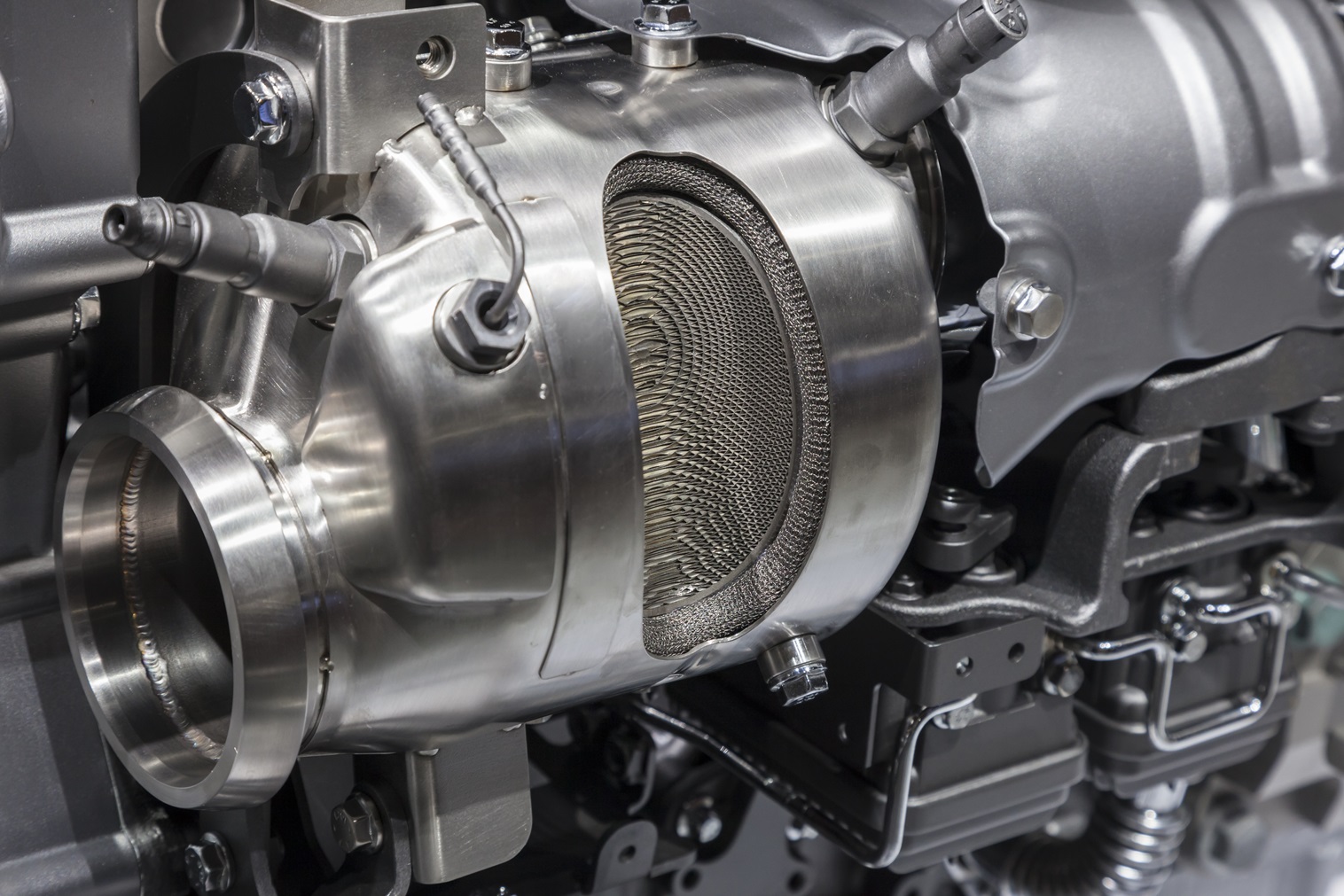
Error code P0430 is a diagnostic trouble code (DTC) indicating that the catalytic converter efficiency on bank 2 of the exhaust system has fallen below the acceptable threshold. The official description reads: “Catalyst System Efficiency Below Threshold (Bank 2).” This means the powertrain control module (PCM) has detected insufficient exhaust gas purification on the engine side opposite cylinder number 1.
“P0430 is not always a death sentence for the catalytic converter. Before replacing this expensive part, start by checking for exhaust leaks and the condition of oxygen sensors — this will save you money and prevent repeated visits to the repair shop,” said Daniel Brooks, automotive diagnostics engineer.
How the PCM detects P0430: The control module continuously compares signals from the upstream and downstream oxygen sensors on bank 2. The upstream sensor, located before the catalytic converter, shows rapid voltage fluctuations (0.1–0.9 V) reflecting changes in the air-fuel mixture. The downstream sensor, positioned after the catalytic converter, normally outputs a stable signal around 0.45 V, confirming that the converter effectively neutralizes pollutants (hydrocarbons HC, carbon monoxide CO, nitrogen oxides NOx).
When the downstream sensor begins to mimic the rapid fluctuations of the upstream sensor, the PCM determines that the catalytic converter on bank 2 may have lost its ability to oxidize and reduce harmful gases. At this point, code P0430 is stored, the Check Engine light illuminates, and freeze frame data are stored (engine RPM, coolant temperature, vehicle speed, fuel trims STFT/LTFT).
Conditions for catalyst monitor activation: The PCM initiates the catalytic converter efficiency test only when several conditions are met:
- The engine is warmed up to operating temperature (usually coolant temperature above 167°F (75°C)).
- The catalytic converter has reached its operating temperature (752–1112°F (400–600°C)).
- The engine management system is running in closed loop mode (oxygen sensor feedback active).
- Stable load and speed (no sudden acceleration).
- No active misfire codes (P030x) or critical fuel system codes (P0171–P0175).
- Fuel level is at least one-quarter full (to avoid sensor reading fluctuations due to fuel level changes).
If any of these conditions are not met, the catalyst monitor remains in “Not Ready” status, and the PCM does not perform the test. This explains why after clearing codes, the code may not return immediately—the monitor requires a complete drive cycle to finish the test.
There are several causes for P0430: catalytic converter wear, a faulty downstream O2 sensor, exhaust leaks before the converter, misfires, or fuel mixture issues. Therefore, blindly replacing the catalytic converter without diagnostics is a common and costly mistake.
Page contents
Brief checklist for P0430 (initial steps)
When the Check Engine light comes on and the scanner shows P0430, proceed step-by-step.
- Read codes with an OBD-II scanner and record freeze frame data—the conditions when the code occurred (engine RPM, coolant temperature, vehicle speed, fuel trims STFT/LTFT). Check readiness monitor status—if the catalyst monitor is not “Ready,” the code may have been set prematurely.
- Inspect the exhaust system for leaks before the catalytic converter: check pipe seams, flanges, and exhaust manifold gaskets. Leaks before the converter introduce unmeasured oxygen, skewing sensor readings.
- Analyze oxygen sensor data (before and after the converter) on a warmed-up engine—compare live data graphs. If the downstream sensor shows rapid fluctuations similar to the upstream sensor, the problem lies either with the catalytic converter or the sensor itself.
- Scan for related codes: P030x (misfires), P0171–P0175 (lean or rich mixture). If multiple codes are present, start by fixing misfires and mixture issues—they can damage the catalytic converter.
- Check fuel trims (STFT and LTFT): if the combined correction on both banks exceeds ±10–15%, this indicates air leaks (lean mixture) or fuel pressure/injector problems (rich mixture). Address the root cause before evaluating the catalytic converter.
- Inspect oxygen sensor connectors and wiring—corrosion or breaks can distort signals.
- Only after these steps decide on replacing the catalytic converter or sensor.
This sequence avoids the common error of replacing the catalytic converter when the issue is a faulty sensor or leak, which would cause P0430 to persist even after costly repairs.
Main symptoms of P0430
Symptoms depend on the underlying cause of the code. Often, the only noticeable sign is the illuminated Check Engine light. However, sometimes the vehicle behaves differently.
- Check Engine light is on constantly or intermittently—the primary symptom.
- Loss of power and sluggish acceleration—the engine fails to reach normal RPM, especially during acceleration. This is typical of a physically clogged catalytic converter, where exhaust backpressure hinders cylinder scavenging.
- Increased fuel consumption—the PCM compensates by adjusting the mixture (LTFT), which can lead to higher fuel use.
- “Rotten egg” smell (hydrogen sulfide) from the exhaust—a characteristic sign of an ineffective catalytic converter unable to neutralize sulfur compounds in the exhaust.
- Unstable idle, engine hesitation, or stalling—if caused by misfires or leaks before the converter.
- Activation of limp mode (power-limiting failsafe mode)—rare, usually with severe converter clogging or multiple related codes.
Note: these symptoms may not all appear simultaneously. Sometimes P0430 is stored without noticeable changes in vehicle behavior and is only detected during scanning.
How serious is P0430 and can you keep driving?
Short-term driving is possible if there is no engine overheating or misfires. However, treating P0430 as “just a warning light” is a mistake.
In the short term, expect increased fuel consumption and higher exhaust emissions. The vehicle may fail an emissions inspection, and a lit Check Engine light often prevents an OBD-II emissions test from passing. Exhaust gases without an effective catalytic converter contain far more harmful substances (CO, HC, NOx) than intended by emissions standards.
Long-term neglect leads to:
- Destruction of the catalytic converter: melting or crumbling of ceramic substrates. When exposed to temperatures above 1600°F (870°C)—which can occur during misfires or consistently rich mixtures—the ceramic substrate cracks and melts. The active layer of platinum, palladium, and rhodium deactivates, and the cells clog with molten substrate.
- Increased exhaust backpressure: a clogged converter impairs cylinder scavenging, causing the engine to lose power and overheat.
- Overheating of exhaust valves and, if equipped, damage to the turbocharger due to elevated exhaust temperatures.
- Ceramic particles entering other exhaust components (muffler, resonator) or, in extreme cases, back into cylinders—rare but documented in cases of completely disintegrated converters.
If P0430 is caused by misfires or a rich mixture, the catalytic converter can fail rapidly. Unburned fuel combusts inside the converter, heating it to critical temperatures and melting the active layer.
Information is general and does not replace professional consultation.
Cause #1: Catalytic converter failure or reduced efficiency
What happens to the catalytic converter
Over time, the catalytic converter loses its ability to neutralize pollutants. Inside are ceramic cells coated with an active layer of platinum, palladium, and rhodium. This layer catalyzes oxidation of carbon monoxide (CO) and hydrocarbons (HC), as well as reduction of nitrogen oxides (NOx).
Degradation occurs through several scenarios:
- Cell breakage and crumbling—mechanical damage, impacts from road debris, vibrations. Physical shocks cause ceramic cracking, and fragments clog flow channels.
- Ceramic melting—overheating due to misfires, where unburned fuel combusts inside the converter. Above 1600°F (870°C), the ceramic substrate melts or cracks, and the active layer sinters and loses catalytic properties. The converter may glow “cherry red” at idle—a clear sign of critical overheating.
- Soot clogging—poor-quality fuel or consistently rich mixtures cause carbon deposits. Cells lose flow capacity, backpressure rises, and efficiency drops.
- Active layer poisoning—oil (through worn valve seals or rings) or coolant (via a blown head gasket) deactivates the platinum group metals. Phosphorus from oil and silicon from coolant form stable compounds that block catalytic reactions.
When efficiency falls below an acceptable threshold, the ceramic structure no longer provides adequate purification. The PCM compares upstream and downstream O2 sensor readings and sees their graphs converge—a sign of a “dead” converter. Increased backpressure further worsens cylinder scavenging, reducing power and increasing fuel consumption.
In severe cases, ceramic particles travel downstream, damaging the muffler or turbocharger (if present).
Cause #2: Malfunctioning oxygen sensor (O2 sensor)
How sensor faults mimic P0430
The downstream oxygen sensor, located after the catalytic converter, sends a voltage signal to the PCM, which uses it to assess converter efficiency. Normally, the downstream sensor shows a relatively stable voltage of 0.6–0.9 V (sometimes around 0.45 V depending on sensor type and manufacturer), while the upstream sensor rapidly switches between 0.1 and 0.9 V.
If the downstream sensor is faulty—“lazy” (slow response), contaminated with soot or oil, has damaged wiring, or corroded connectors—it may begin to show fluctuations similar to the upstream sensor. The PCM interprets this as a lack of catalytic converter response and sets P0430.
Typical signs of a faulty sensor:
- Low signal amplitude—the voltage does not reach normal levels (e.g., fluctuates narrowly between 0.3–0.5 V).
- “Stuck” at a fixed value—constant 0.45 V without changes even during rapid mixture enrichment or leaning.
- Slow response—the sensor reacts to mixture changes with a delay of several seconds, which the PCM may interpret as low converter efficiency.
- Signal noise—due to broken shielding, insulation damage, or poor connector contact.
Differentiation method: on some dual-bank models, you can swap downstream O2 sensors between banks (if design allows). If the code “moves” with the sensor (e.g., after swapping, P0430 changes to P0420 for the other bank), the problem is with the sensor, not the converter.
It is important to compare the signal shapes of both sensors on a warmed engine in live data mode and check wiring integrity under load (wiggle connectors and harness—the fault may show up).
Other causes: air leaks, exhaust leaks, and additional faults
Why unmetered air and leaks cause P0430
Air leaks in the intake manifold introduce unmetered air, distorting upstream O2 sensor readings. The PCM sees a lean mixture and increases fuel delivery (LTFT rises), but the actual mixture remains suboptimal. Similarly, exhaust leaks before the catalytic converter (burned exhaust manifold gasket, cracked seam, loose flange) mix outside air into the flow. The downstream O2 sensor detects excess oxygen, and the PCM may interpret this as low converter efficiency.
The result is false P0430 triggers or accelerated converter degradation due to abnormal operating conditions.
Other related causes:
- Misfires (codes P0300–P030x)—unburned fuel enters the exhaust, combusts in the converter, overheating it above 1600°F (870°C), melting ceramic and distorting sensor signals.
- Rich or lean mixtures (codes P0171–P0175)—incorrect air-fuel ratio changes exhaust composition. With LTFT > +15% (lean), check for air leaks, a faulty MAF, or low fuel pressure. With LTFT < -10% (rich), inspect injectors, the fuel pressure regulator, and MAF sensor contamination.
- Injector leaks or coolant leaks—can contaminate the converter. Coolant entering via a blown head gasket poisons the active layer with silicon; oil poisons it with phosphorus.
- Sensor wiring issues—breaks, connector corrosion, poor ground, or shielding damage cause signal interference.
- PCM software updates (Technical Service Bulletins, TSBs)—rarely, manufacturers release PCM calibration updates to fix false P0430 triggers. Check for TSBs by VIN before replacing parts.
Address these root causes before evaluating the catalytic converter. Replacing the converter with leaks or misfires present will cause the new part to fail quickly.
Step-by-step diagnosis of P0430
Diagnosis begins by ruling out simple causes and gradually moves to more complex ones.
Step 1. Scanner diagnostics
Connect an OBD-II scanner, read codes, and record freeze frame data (conditions when the code was recorded: engine RPM, coolant temperature ECT, vehicle speed VSS, fuel trims STFT/LTFT). Check for related codes: P0171/P0174 (lean mixture), P0172/P0175 (rich mixture), P030x (misfires). If multiple codes are present, start by fixing misfires and mixture problems.
Freeze frame and fuel trim analysis:
- If STFT (short-term fuel trim) + LTFT (long-term fuel trim) on bank 2 > +15%, this indicates air leaks, a faulty MAF, or low fuel pressure. Use a smoke machine to detect intake leaks.
- If STFT + LTFT < -10%, check injectors (leaks), fuel pressure regulator, and MAF contamination.
- If trims are normal (±5%) but P0430 is active, focus on the catalytic converter and downstream O2 sensor.
Check readiness monitors:
Verify the catalyst monitor status for bank 2. If “Not Ready,” the monitor has not completed its test. Perform a drive cycle (see below) to set readiness and confirm the code.
Step 2. Exhaust system inspection
Inspect for leaks before the catalytic converter: burned exhaust manifold gaskets, cracked seams, loose flanges. Listen for hissing sounds on a warmed engine—leaks produce characteristic noises. Use a smoke machine to detect leaks.
Warning: exhaust system work and propane testing should be done on a cooled or moderately warm exhaust. Follow safety precautions—catalytic converters can remain hot (above 752°F (400°C)) long after engine shutdown. Avoid contact with hot surfaces; wear gloves and safety glasses.
Step 3. Oxygen sensor analysis
On a warmed engine (coolant temperature 185–203°F (85–95°C)), check voltage graphs of upstream and downstream sensors in live data mode. The upstream sensor should show rapid fluctuations (0.1–0.9 V), the downstream a smoothed signal of 0.6–0.9 V (or about 0.45 V for some sensor types). If the downstream sensor mimics the upstream in shape and amplitude, this indicates a problem with the catalytic converter or the downstream sensor.
Enrichment/lean test:
Briefly introduce propane into the intake manifold (enriching the mixture) or create a vacuum leak (leaning the mixture). The upstream sensor should respond immediately; the downstream sensor with a short delay and smaller amplitude. A fast downstream response indicates a “dead” catalytic converter.
Safety warning: propane testing should be brief (no more than 5 seconds) at idle or 1,500 RPM. Avoid propane accumulation in the engine bay—risk of ignition. Perform in a well-ventilated area or outdoors.
Step 4. Catalytic converter evaluation
Exhaust backpressure measurement:
Attach a pressure gauge at the O2 sensor port (use an M18×1.5 threaded adapter). Measure backpressure at idle, 1,500 RPM, and 2,500 RPM:
- Idle: < 3 psi (~20 kPa) — normal.
- 1,500 RPM: ≤ 1.5–2.0 psi (~10–14 kPa) — normal.
- 2,500 RPM: ≤ 2.5–3.0 psi (~17–21 kPa) — normal.
Exceeding these values can indicate a clogged catalytic converter.
Temperature test:
Use a pyrometer (non-contact infrared thermometer) to measure temperature at the converter inlet and outlet at a steady 2,000–2,500 RPM. Normally, the outlet is 90–180°F (50–100°C) hotter than the inlet (exothermic reactions inside the converter). A low temperature difference (less than 54°F (30°C)) may indicate little or no catalytic activity.
Step 5. Electrical inspection
Check O2 sensor connectors, verify ground resistance (between sensor ground and battery negative should be <0.5 ohm), heater power supply (~12 V with ignition on), and wiring integrity. Corrosion, breaks, or poor contacts distort signals and cause false codes.
Mode $06 (Service $06) check for catalyst monitor:
Some scanners can read Mode $06 data—Test ID (TID) and Component ID (CID) for the catalyst monitor. Typical parameters:
- TID $01 (Catalyst Bank 2): Min/Max/Value—compare with manufacturer threshold values (usually in diagnostic manuals). If Value approaches Max, the converter may be near failure.
- Oxygen Storage Capacity (OSC): indicates the converter’s oxygen storage ability. Low OSC supports converter degradation.
If Mode $06 is unavailable, skip this step—live data analysis and tests from Steps 3–4 are usually sufficient.
| Parameter | Normal range | What to check |
|---|---|---|
| Upstream O2 (voltage) | 0.1–0.9 V, rapid fluctuations | Scanner/oscilloscope graph |
| Downstream O2 (voltage) | 0.6–0.9 V (or ~0.45 V), stable | Comparison with upstream sensor |
| Exhaust backpressure (idle) | < 3 psi (~20 kPa) | Pressure gauge at O2 sensor port |
| Backpressure (1,500 RPM) | ≤ 1.5–2.0 psi (~10–14 kPa) | Pressure gauge at O2 sensor port |
| Backpressure (2,500 RPM) | ≤ 2.5–3.0 psi (~17–21 kPa) | Pressure gauge at O2 sensor port |
| Temperature difference inlet/outlet | 90–180°F (50–100°C) at operating RPM | Pyrometer, measurement on warmed engine |
| STFT + LTFT (total fuel trim) | ±10% (±15% acceptable) | Scanner, live data |
Advanced interpretation of O2 graphs and efficiency tests
How to read oscillograms
The upstream oxygen sensor normally shows high-frequency switching between rich and lean mixtures at 1–2 Hz (1–2 switches per second). The downstream sensor, located after the catalytic converter, displays a smoothed, stable signal of 0.6–0.9 V (or ~0.45 V).
If the upstream and downstream sensor signals become similar, this suggests low catalytic converter efficiency. The main criteria are similar amplitude and phase over multiple cycles.
Oscillogram scenarios:
- Normal: upstream fluctuates 0.1–0.9 V, downstream stable 0.6–0.9 V.
- Faulty catalytic converter: both sensors fluctuate synchronously 0.1–0.9 V.
- Faulty downstream sensor: downstream “stuck” at one level (e.g., 0.45 V) or shows low amplitude (0.3–0.5 V) without clear response.
Enrichment/lean test
Brief propane introduction into the intake (enrichment) or creating a vacuum leak (lean) allows assessment of sensor response. The upstream sensor should respond immediately (delay <1 second), the downstream sensor with a short delay and smaller amplitude. A fast downstream response indicates a “dead” catalytic converter that does not buffer mixture changes.
Temperature test
Measure temperature at the converter inlet and outlet at a steady 2,000–2,500 RPM. Normally, the outlet is 90–180°F (50–100°C) hotter than the inlet (exothermic oxidation of CO/HC inside). A low temperature difference (less than 54°F (30°C)) indicates no catalytic activity—the ceramic is not participating in reactions.
Example measurements:
- Inlet: 842°F (450°C)
- Outlet: 968°F (520°C)
- Difference: 126°F (70°C) — normal.
If inlet is 842°F (450°C) and outlet 860°F (460°C) (difference 18°F (10°C)), the converter is ineffective.
Methods to fix P0430: from replacement to PCM remapping
Repairs start with addressing root causes. If exhaust leaks are found, seal them (replace gaskets, weld cracks). If misfires are detected, restore the ignition system (spark plugs, coils, high-voltage wires) and fuel delivery (injectors, MAF, fuel pressure). If the downstream O2 sensor is faulty, replace it.
Only after excluding these factors proceed to catalytic converter evaluation.
If the converter has lost efficiency:
- OEM replacement—most reliable option with warranty, emissions compliance, and long service life.
- Quality aftermarket—trusted brands (Bosch, Walker, MagnaFlow, Eastern Catalytic). Beware of counterfeits.
- Universal catalytic converter—cheaper but requires pipe diameter adjustment and welding. Suitable for budget repairs if done by a skilled welder.
Temporary measures (spacers, remapping)
Installing a mechanical spacer for the downstream O2 sensor, an electronic signal emulator, or disabling catalyst monitoring via PCM remapping is possible but carries serious legal and environmental risks.
Legal consequences (vary by jurisdiction):
- Administrative penalties may apply under local vehicle and emissions regulations for operating a vehicle with a modified exhaust system.
- Enforcement actions may include fines, inspection failure, or restrictions until the vehicle is brought back into compliance (rules vary by region).
- In many regions, passing emissions or safety inspection requires verification that the catalytic converter is present and functioning. Vehicles with a missing or non-functioning converter may fail inspection.
- Exhaust without a functioning catalytic converter can exceed allowable limits for CO, HC, and NOx under applicable emissions regulations, which may result in inspection failure and legal penalties (requirements vary by region).
Information is general and does not replace professional consultation.
After repairs:
- Clear codes using an OBD-II scanner.
- Reset PCM adaptations (procedure depends on model—consult the service manual).
- Perform a drive cycle to complete the catalyst monitor test and set status to “Ready”:
- Cold start (coolant temperature <122°F (50°C), fuel level at least 1/4 tank, climate control off).
- Idle warm-up for 2–3 minutes.
- Smooth acceleration to 25–37 mph (40–60 km/h), steady driving for 10 minutes.
- Stop, idle for 5 minutes (stop-and-go traffic allowed).
- Acceleration to 50–62 mph (80–100 km/h), steady driving for 10 minutes.
- Stop, idle for 3–5 minutes.
- Recheck monitor status via scanner—the catalyst monitor should be “Ready.”
- Rescan the system to ensure P0430 has not returned.
Important: if P0430 is caused by misfires or a rich mixture, the new catalytic converter will fail quickly. Address the root cause first.
Checking TSBs (Technical Service Bulletins) and PCM software updates:
Before replacing parts, check for manufacturer technical bulletins for your model. Some automakers release PCM calibration updates that fix false P0430 triggers. Verify by VIN on the official manufacturer website or at the dealer.
Comparison of P0430 repair methods: cost, complexity, risks
The choice of repair method depends on the cause of the code, budget, and regional regulations.
| Method | Relative cost level | Complexity | Advantages | Disadvantages | Legal risks | Duration of effect |
|---|---|---|---|---|---|---|
| OEM catalytic converter replacement | High | Medium | Warranty, standards compliance | High cost | None | 5–10+ years |
| Aftermarket catalytic converter replacement | Medium | Medium | Price-quality balance | Risk of counterfeits | None | 3–7 years |
| Universal catalytic converter replacement | Low–medium | High | Low price | Requires welding and fitting | None | 2–5 years |
| Fixing leaks/air ingress, ignition repair | Low–medium | Low–medium | Eliminates root cause | Does not help with “dead” converter | None | Depends on cause |
| O2 sensor replacement (upstream/downstream) | Low–medium | Low | Solves “lazy” sensor issue | Useless if converter is degraded | None | 3–5 years |
| Emulator (mechanical/electronic) | Low | Low | Quick, cheap | Does not fix problem, violates emissions | Failed inspection | Until next test |
| Software disabling of monitor | Low | Medium | Removes Check Engine light | Violates emissions standards, increases pollution | Failed inspection | Until inspection |
Common mistakes in diagnosis and repair
Errors in handling P0430 often lead to unnecessary expenses and repeated repair visits.
- Rushing to replace the catalytic converter without checking for leaks and sensors—the most expensive mistake. A new converter won’t solve the problem if the cause is a faulty downstream O2 sensor or exhaust leak.
- Ignoring related codes (P0300–P030x, P0171–P0175)—if misfires or mixture issues are not fixed, the new converter can fail quickly due to overheating or poisoning.
- Installing an emulator without fixing the root cause—the code disappears, but the real fault remains and worsens. The clogged converter continues to create backpressure, reducing power and increasing fuel consumption.
- Skipping the drive cycle after repair—it is necessary to confirm that P0430 does not return after clearing codes. The catalyst monitor must complete its test and set status to “Ready.” Without this, repair success cannot be confirmed.
- Using cheap no-name sensors or converters can lead to repeated repairs and higher overall cost.
- Neglecting fuel trim analysis (STFT/LTFT)—if LTFT > +15% or < -10%, the problem may lie in fuel delivery or intake, not the converter. Replacing the converter may not clear P0430.
- Replacing the catalytic converter without diagnosing sensors/leaks—cost difference can be significant
- Ignoring codes P030x/P0171–P0175—new converter may fail quickly
- Emulator without fixing cause—problem progresses, risk of turbo/valve damage
- No drive cycle after repair—cannot confirm repair success
- Cheap no-name parts—short-term savings can turn into repeated repairs
- Skipping LTFT/STFT analysis—converter replacement may not fix the code
Prevention: how to avoid P0430
The catalytic converter and O2 sensors last longer if operating conditions are optimal.
Quality fuel
Poor-quality gasoline contains contaminants and additives that can deposit on the converter cells and poison the active platinum/palladium/rhodium layer. Refuel at reputable gas stations that meet applicable fuel quality standards.
Timely replacement of spark plugs and filters
Worn spark plugs cause misfires—unburned fuel enters the exhaust and overheats the converter above 1600°F (870°C), melting the ceramic. A clogged air filter can affect the mixture; a restricted fuel filter can reduce fuel pressure—both can disrupt mixture formation.
Recommended replacement intervals:
- Spark plugs: every 18,000–37,000 miles (30,000–60,000 km) for copper-nickel, or 50,000–75,000 miles (80,000–120,000 km) for iridium/platinum.
- Air filter: every 9,000–18,000 miles (15,000–30,000 km) (shorter intervals on dusty roads).
- Fuel filter: every 25,000–50,000 miles (40,000–80,000 km) on vehicles with a serviceable filter.
Eliminate misfires and air leaks
Monitor ignition system condition: ignition coils, high-voltage wires (for vehicles without coil-on-plug). Check intake manifold, gaskets, vacuum hoses, and throttle body for leaks. Use a smoke machine to detect leaks—it’s faster and more accurate than trial and error.
Exhaust system condition monitoring
Regularly (at each service or annually) inspect the exhaust for leaks: exhaust manifold gaskets, pipe seams, flanges, hangers. Leaks before the converter distort sensor readings and accelerate degradation.
Oil and coolant level monitoring
Increased oil consumption (worn rings, valve seals) leads to oil entering the converter—phosphorus poisons the active layer. Increased coolant consumption (blown head gasket, cracked head) introduces coolant into the exhaust—silicon from ethylene glycol deactivates the platinum group metals.
Signs of problems:
- Oil: blue smoke from exhaust, consumption >0.5 quart per 1,000 miles (~0.5 liters per 1,000 km).
- Coolant: thick white smoke from exhaust, sweet smell, bubbles in the coolant reservoir during engine operation.
Address these issues promptly—replacing seals/rings or the head gasket is cheaper than a new catalytic converter.
Three pillars of P0430 prevention
1. Fuel
Refuel at reputable stations that meet manufacturer and applicable fuel quality requirements.
2. Ignition
Timely replacement of spark plugs (18,000–37,000 miles (30,000–60,000 km) for copper-nickel, 50,000–75,000 miles (80,000–120,000 km) for iridium/platinum), air filter (9,000–18,000 miles (15,000–30,000 km)), and fuel filter (25,000–50,000 miles (40,000–80,000 km)).
3. Sealing
Regular inspection of the exhaust system (gaskets, seams, flanges) and intake manifold (vacuum hoses, gaskets). Use a smoke machine to detect leaks.
How to identify bank 2 on your engine
On V-type engines (V6, V8, V10, V12), cylinders are divided into two banks—bank 1 and bank 2.
Standard convention:
- Bank 1 is the engine side where cylinder number 1 is located.
- Bank 2 is the opposite side.
Cylinder number 1 location varies by manufacturer, so always verify the specific engine layout:
- General Motors, Chrysler: odd cylinders (1-3-5) on one side, even cylinders (2-4-6) on the other on many V6/V8 applications.
- Ford and some European makes may use different bank and cylinder numbering layouts depending on engine family.
- Nissan and other manufacturers may also vary by engine design.
How to determine precisely:
- Check your vehicle’s owner’s manual (engine or emissions section).
- Look for markings on the engine cover, exhaust manifold, or protective cover—some manufacturers provide bank layout diagrams.
- Use VIN lookup on the manufacturer’s website or at the dealer to find engine configuration and bank locations.
- If documentation is unavailable: locate cylinder 1; its side is bank 1, and the opposite side is bank 2.
Important note for inline engines:
Inline engines (I4, I6) usually have only one bank—bank 1. P0430 is uncommon on inline engines (they usually only have P0420 for the single catalytic converter). Some inline engines with split exhaust systems may use bank-style identification depending on manufacturer strategy. Check the manufacturer’s diagram.
Summary and recommendations
P0430 is not always “catalytic converter death.” In many cases, the issue is resolved by fixing exhaust leaks, replacing the O2 sensor, or repairing the ignition system.
What to do now:
- Eliminate leaks and mixture faults—inspect the exhaust system (gaskets, flanges, seams), intake manifold (vacuum hoses, gaskets), and ignition system (spark plugs, coils, wires). Analyze STFT/LTFT: if total correction is > ±15%, look for air leaks or fuel system issues.
- Compare oxygen sensor graphs—make sure the downstream sensor does not mimic the upstream. Check wiring and connectors—corrosion can cause false signals.
- Measure exhaust backpressure (pressure gauge at O2 sensor port: < 3 psi at idle, ≤ 2.5–3.0 psi at 2,500 RPM) and temperature difference at converter inlet/outlet (pyrometer: normal ΔT = 90–180°F (50–100°C)).
- Check for TSBs (Technical Service Bulletins) for your model by VIN—manufacturers may have released PCM calibration updates that fix false P0430 triggers.
- Replace the catalytic converter only after confirming low efficiency—not just by code, but based on tests (O2 graphs, backpressure, ΔT, Mode $06 if available).
- Document results with a drive cycle and repeat diagnostics—make sure the catalyst monitor status is “Ready” and P0430 has not returned.
Frequently asked questions
Is it possible to drive with the P0430 code?
Temporarily — yes, if there are no misfires (codes P0300–P030x) and no engine overheating. However, prompt diagnostics (within 1–2 weeks) are recommended to avoid worsening the problem and damaging the catalytic converter. You may not pass an emissions or safety inspection with a lit Check Engine light and an active P0430 code, depending on local requirements.
Will replacing only the oxygen sensor help?
If the cause of P0430 is a faulty rear O2 sensor (slow response, contamination, damaged wiring) — yes, replacing the sensor may clear the code. But if the catalytic converter is actually degraded (low efficiency according to ΔT tests, backpressure, graphs), replacing the sensor will not help — the code will return after several drive cycles. Diagnostics according to the algorithm in the "Step-by-step diagnosis" section are necessary before making a decision.
How to properly reset the P0430 code after repair?
1. Eliminate the cause of the code (replace the part, fix leaks, restore ignition/mixture). 2. Connect an OBD-II scanner and clear the codes (function "Clear Codes" or "Erase DTCs"). 3. Reset PCM adaptations (if supported by the scanner — function "Reset Adaptations"; on some models, disconnecting the battery terminal for 10–15 minutes may be required). 4. Perform a drive cycle to complete the catalyst monitor (see the section "Methods to fix P0430", subsection "After repairs"). 5. Reconnect the scanner and check: – No active codes (Current Codes). – Catalyst Monitor status: "Ready". – If the monitor is not "Ready", repeat the drive cycle. Important: do not clear codes without fixing the cause — the code will return within a few driving cycles.