

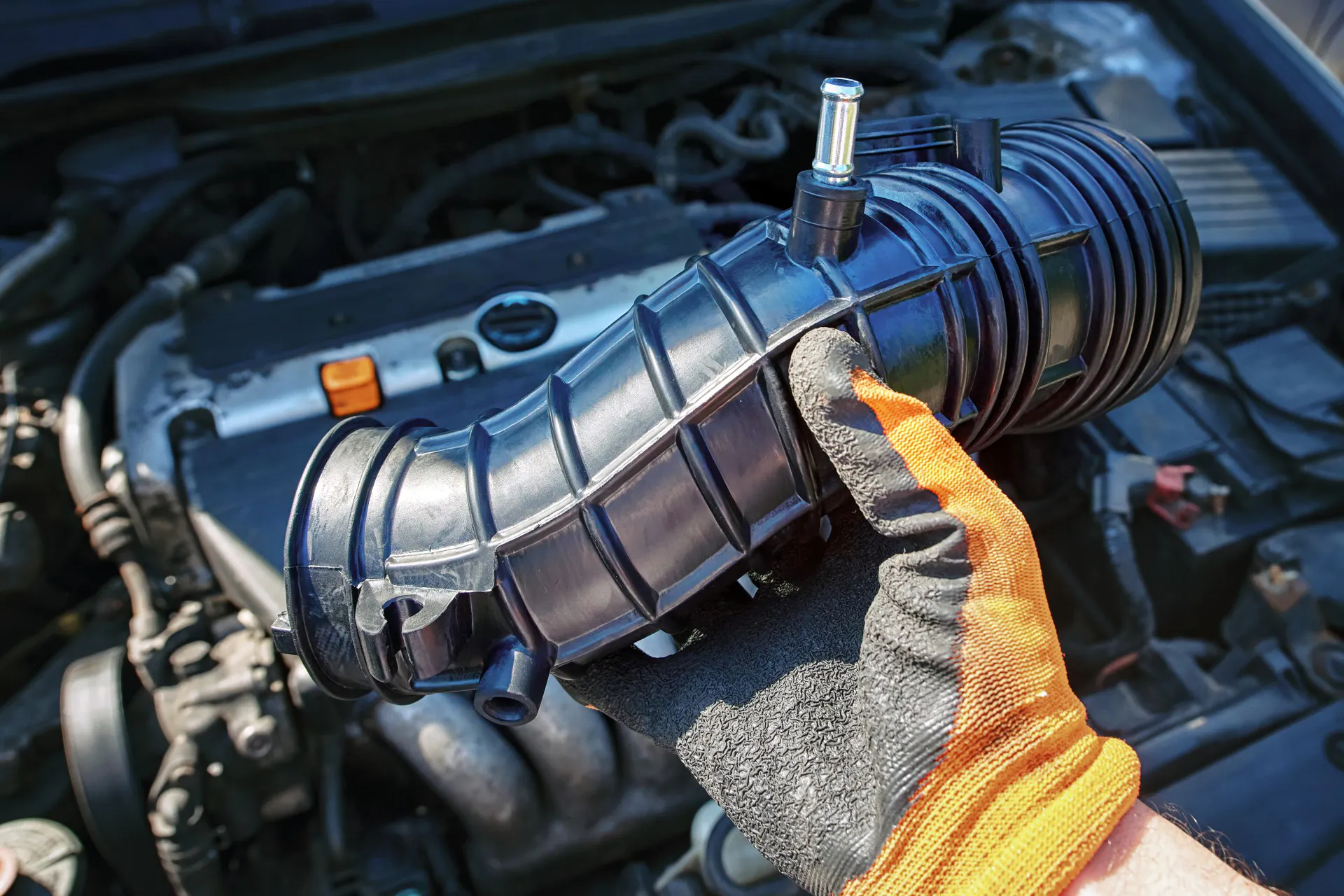
Code P0171 is a message from the engine control module (ECM) indicating that the air-fuel mixture in the first cylinder bank (Bank 1) is too lean. The engine receives more air than necessary or less fuel than required for the optimal 14.7:1 ratio. The ECM attempts to compensate by increasing fuel delivery through long-term fuel trim (LTFT) adjustments, but when these adjustments exceed a certain threshold (often around +25%), the system registers a fault and triggers the Check Engine light.
Most often, P0171 occurs due to unmetered air intake—air entering the intake manifold downstream of the mass airflow sensor (MAF), which the ECM cannot account for. According to Foxwell Diagnostic data (2024), unmetered air accounts for up to 80% of all P0171 cases. The second most common causes are issues with the MAF sensor and the fuel delivery system. The upstream oxygen sensor (O2 sensor) before the catalytic converter measures residual oxygen in the exhaust and signals the ECM about an imbalance, but the sensor itself is rarely the root cause.
Is it possible to drive with a P0171 code? Temporarily, yes, but it is not recommended. A lean mixture increases combustion temperature, risking valve overheating, detonation, and accelerated catalytic converter wear. If symptoms are minor (slight hesitation, minimal power loss), it is possible to drive to a repair shop. However, delaying repairs can lead to more costly consequences than early-stage fixes.
Diagnostics start with simple steps: visual inspection under the hood, checking vacuum hoses, reading scanner data (STFT/LTFT). Next, a smoke test to detect leaks, fuel pressure measurement, and sensor signal analysis follow. The “simple to complex” approach saves time and money.
Page contents
P0171 in 15 minutes: quick diagnostic algorithm
If the Check Engine light comes on and the scanner shows P0171, here is a step-by-step express diagnostic route:
- Read Freeze Frame and STFT/LTFT data—if LTFT > +15% at idle, the problem is confirmed.
- Perform a quick intake smoke test—spray carb cleaner around hoses and gaskets (an increase in RPM indicates a leak).
- Measure fuel pressure—connect a gauge to the fuel rail: normal is typically 43–58 psi (3.0–4.0 bar) at idle, 51–65 psi (3.5–4.5 bar) under load. Lower pressure indicates pump or filter issues.
- Check MAF sensor: grams per second at idle should be 3–5 g/s for 1.6–2.0 L engines. Low readings require cleaning or replacement.
- Inspect PCV/EVAP system—check the PCV valve and charcoal canister hoses for leaks.
- Check for exhaust leaks before the O2 sensor—soot traces or hissing at idle suggest manifold gasket issues.
- Reset adaptations and perform a test drive—after fixing the problem, allow the ECM to complete its learning cycle.
Error P0171 (DTC P0171): what does the “system too lean” code mean
P0171 is a diagnostic trouble code (DTC) indicating a lean mixture in the first cylinder bank (Bank 1). The ECM detects excess oxygen in the exhaust gases, signaling insufficient fuel or unmetered air. The upstream oxygen sensor (O2 sensor) before the catalytic converter measures residual O₂—if too much is present, the ECM increases the long-term fuel trim (LTFT).
According to the SAE J2012 standard (2023 update), P0171 is defined as “System Too Lean (Bank 1).” When LTFT exceeds the set limit (often around +25% for 1–2 minutes at 1500–4000 rpm), the system stores the P0171 code and activates the Check Engine light.
It is important to understand that P0171 is the ECM’s response to observed conditions. The code itself does not specify the exact location of the problem; it only confirms that the air-fuel ratio is out of range. Causes can vary—from a cracked vacuum hose to a weak fuel pump.
Ignoring P0171 is not advisable. A lean mixture raises combustion temperature, increasing the risk of detonation (uncontrolled combustion), valve and exhaust overheating, and accelerated catalytic converter damage. Early symptoms may be mild but worsen over time.
Freeze frame: reading in 60 seconds
Freeze Frame is a snapshot of engine parameters at the moment the DTC was recorded. It helps localize the conditions under which the problem occurred. Key parameters to check:
- ECT (engine coolant temperature) ≥176–194°F (80–90°C) confirms the engine is warmed up and the system is in closed-loop mode.
- RPM/load—idle (600–900 rpm) or cruising (1500–2500 rpm). This helps differentiate vacuum leaks (manifest at idle) from fuel issues (worsen under load).
- STFT/LTFT—if combined values exceed +20%, the mixture is lean. Positive values indicate the ECM is adding fuel.
- MAF (g/s) at idle should match engine displacement (3–5 g/s for 1.6–2.0 L).
- MAP/vacuum—check vacuum levels against model specifications.
Conclusions:
- Peaks at idle → check vacuum/PCV system.
- Increase under load → fuel system (pump/filter/injectors).
- Peaks under acceleration on gasoline → check LPG calibration.
What does “Bank 1” mean and when is it important
Bank 1 refers to the cylinder bank containing cylinder number one. In V-type engines (V6, V8), the engine is divided into two banks: Bank 1 and Bank 2. Bank 1 always includes cylinder #1; Bank 2 is the opposite bank. Inline four- and six-cylinder engines have only Bank 1—all cylinders belong to it.
This distinction is important for diagnostics. If code P0171 (Bank 1) appears without P0174 (Bank 2), the issue is localized to the first bank: a vacuum leak on the Bank 1 side, an injector issue, or an O2 sensor fault in that bank. If both codes appear simultaneously (P0171 + P0174), the cause is likely common: a faulty MAF sensor, low fuel pressure, or an air leak before the intake manifold split.
On V engines, each bank usually has its own upstream O2 sensor, allowing the ECM to control fuel trim separately for each bank. If P0171 is recorded only on one bank, this narrows the search area.
Note: Bank 1 and Bank 2 do not necessarily correspond to the left and right sides of the engine relative to the driver. Their positions depend on engine design and vary by manufacturer. Always verify cylinder #1 location in the service manual for the specific model.
Symptoms of P0171
Signs and symptoms accompanying P0171
A lean mixture affects engine operation differently depending on the degree of deviation and operating mode. The first and most obvious symptom is the Check Engine light on the dashboard. The ECM records P0171 when the long-term fuel trim (LTFT) exceeds the allowable threshold.
The engine runs unevenly. At idle, RPM fluctuates as the ECM tries to compensate for fuel shortage by adjusting throttle opening and air supply. This manifests as slight vibration or “hunting” RPM within 50–100 rpm.
During acceleration, hesitation and jerking occur. This is especially noticeable on a cold engine before the ECM enters closed-loop operation with the O2 sensor. A lean mixture causes ignition delay, felt as a “sluggish” gas pedal or brief power loss.
Engine power decreases. A lean mixture burns slower and produces less energy during the expansion stroke. This is critical at high RPM or overtaking, where the engine fails to deliver full power.
Fuel consumption may paradoxically increase. The ECM compensates for the lean mixture by increasing injector pulse width (positive LTFT), ultimately delivering more fuel than normal. If misfires occur, unburned fuel enters the exhaust, further increasing consumption.
Exhaust odor changes. A lean mixture produces a sharper, more acrid smell due to higher combustion temperature and increased nitrogen oxides (NOₓ).
Difficulty starting cold is a common symptom. The ECM enriches the mixture at startup, but if there is an air leak or low fuel pressure, multiple attempts may be needed to start. This is exacerbated in winter due to poorer fuel vaporization and slower sensor warm-up.
Idle vibrations may be accompanied by a slight ticking or “clicking” sound from the intake—indicative of air leaks through cracks in bellows or gaskets.
| Symptom | Likely cause | Quick test |
|---|---|---|
| Fluctuating idle RPM | Air leak, dirty MAF sensor | Spray carb cleaner around intake (RPM rise → leak) |
| Hesitation during acceleration | Low fuel pressure, clogged injectors | Fuel pressure measurement, STFT check under load |
| Power loss | Overall lean mixture (air leak + fuel) | Analyze LTFT/STFT on scanner (>+15% → lean) |
| Difficulty cold starting | Low fuel pressure, PCV air leak | Cold fuel pressure check, PCV valve inspection |
| Vibrations + ticking | Intake air leak | Smoke test, listen to intake with stethoscope |
| Increased fuel consumption | ECM compensating for lean mixture (LTFT +20–30%) | Read fuel trims on scanner |
Symptoms worsen under load (climbing, overtaking) and with a faulty MAF sensor, as the ECM receives distorted airflow data and cannot properly adjust fuel delivery.
Main causes of code P0171
Code P0171 appears when the air-fuel balance shifts toward excess air or insufficient fuel. The ECM compensates by increasing LTFT, but if the correction exceeds the limit (often around +25%), the system registers a fault.
Diagnostics follow the “common to rare” principle. The most frequent cause is unmetered air intake, accounting for up to 80% of P0171 cases. Air enters the intake manifold downstream of the MAF sensor, the ECM does not account for it, and fuel delivery is calculated based on underestimated airflow, resulting in a lean mixture.
The second most common cause is MAF sensor issues. A dirty or faulty MAF sensor underreports airflow—the ECM “thinks” there is less air and delivers insufficient fuel.
The third most frequent cause is fuel system faults: weak pump, clogged filter, low rail pressure, dirty injectors. If there is physically less fuel than the ECM expects, the mixture becomes lean.
The upstream oxygen sensor rarely causes P0171 directly. It detects excess oxygen and signals the ECM, but does not create a lean mixture itself. An exception is an exhaust leak before the sensor, where outside air is drawn into the exhaust and distorts readings.
The PCV valve (positive crankcase ventilation) and its hoses can cause air leaks if cracked or unsealed. This is especially noticeable at idle when intake vacuum is highest.
The EVAP system can also cause leaks if the purge valve is faulty.
Rare causes include ECM software mismatch (after tuning or a failed update), non-standard intake systems without calibration, and poor-quality fuel (severe dilution or low octane).
| Cause | Frequency (%) | Simple test | Tool | Difficulty/time |
|---|---|---|---|---|
| Air leak (hoses, gaskets) | ~80 | Spray carb cleaner, listen | Smoke machine, carb cleaner | Low / 30–60 min |
| Dirty/faulty MAF sensor | ~10 | Compare readings to reference RPM | OBD-II scanner, MAF cleaner | Medium / 20–40 min |
| Low fuel pressure | ~5 | Measure pressure at idle/load | Fuel pressure gauge | Medium / 30–60 min |
| Clogged injectors | ~3 | Injector balance test, bench test | Injector tester, scanner | High / 1–2 h |
| Exhaust leak before O2 sensor | ~1 | Inspect soot, listen for ticking | Exhaust smoke machine | Medium / 30 min |
| PCV/EVAP leaks | ~1 | Inspect PCV valve, vacuum test | Vacuum gauge, smoke machine | Low / 20–30 min |
Start with simple steps: visually inspect vacuum hoses, MAF-to-throttle pipes, intake manifold gaskets. Then connect a scanner and analyze fuel trims (STFT/LTFT).
Unmetered air intake in the intake system
Unmetered air intake occurs when air enters the intake manifold downstream of the MAF sensor. The ECM does not account for this air and calculates fuel delivery based on underestimated airflow, creating a lean mixture. According to Foxwell Diagnostic (2024), unmetered air causes up to 80% of P0171 cases.
Critical areas prone to leaks:
Vacuum hoses. Rubber hoses lose elasticity over time, crack due to temperature changes and oil exposure. Cracks may be microscopic and invisible but sufficient for leaks. Brake booster hoses, vacuum control hoses (if present), and PCV hoses are especially vulnerable.
Intake manifold gasket. Wear or improper bolt tightening causes gasket failure. Leaks often manifest at idle when intake vacuum is highest.
Throttle body gasket. A thin gasket between the throttle and intake manifold can dry out or deform over time.
Injector sealing rings. Rings between injectors and intake manifold wear out, especially after frequent removal. Air leaks through gaps around injectors.
Hose cracks. Corrugated hoses between the MAF and throttle, silicone or rubber tubes can crack. A 0.039–0.079 in. (1–2 mm) crack is enough to cause P0171.
EVAP system (charcoal canister). A stuck-open purge valve allows atmospheric air into the intake.
PCV valve. A stuck-open PCV valve or cracked PCV hose also causes leaks.
Diagnostics rely on two methods: smoke test and spraying flammable cleaner.
The smoke test is the gold standard. A smoke machine feeds smoke under slight pressure into the intake (via the MAF pipe or a vacuum hose). Engine off, throttle closed. Smoke escapes through leaks—visible as smoke streams from cracks, loose connections, or gaskets. This method is safe and accurate.
Spraying carb cleaner (or any flammable aerosol) is an alternative without a smoke machine. Engine runs at idle. Spray cleaner around suspect areas: hose joints, manifold gaskets, throttle body. If a leak exists, the cleaner is sucked in, causing a brief RPM increase (100–200 rpm) as the ECM compensates for extra “fuel.” Caution: work away from open flames and hot surfaces.
Listening with a stethoscope or hose segment. At idle, a characteristic whistle or hiss indicates a leak. Place one end of the hose to your ear, the other near suspect areas.
Leak repair:
- Replace cracked vacuum hoses (use heat-resistant hoses rated for at least 212°F (100°C)).
- Replace intake manifold and throttle body gaskets.
- Replace injector sealing rings.
- Repair or replace cracked hoses (bellows, silicone tubes).
- Check the EVAP system: replace the purge valve if stuck open.
After fixing leaks, reset ECM adaptations (long-term trims) and allow the system to complete learning cycles at idle and during driving.
Fuel delivery issues: from pump to injectors
Fuel shortage causes a lean mixture just like excess air. The ECM calculates fuel delivery based on MAF and oxygen sensor signals, but if there is physically less fuel than needed, the mixture becomes lean and P0171 is triggered.
Fuel pump. A worn pump fails to maintain adequate pressure in the fuel rail. Typical pressure for return-type systems is 43–58 psi (300–400 kPa) at idle and 51–65 psi (3.5–4.5 bar) under load. Returnless systems may have higher pressure: 58–73 psi (4–5 bar).
Check pressure with a gauge connected to the fuel rail. Start the engine. If pressure is below normal, the problem lies in the pump, regulator, or filter. To test pump flow, drain fuel from the rail into a measuring container for 30 seconds—normal flow is typically at least 1 L/min.
Fuel filter. A clogged filter restricts fuel flow. Pressure may be normal at idle but drop under load (acceleration). Filter replacement is standard maintenance every 18,600–37,300 miles (30,000–60,000 km) but is often neglected. If the filter hasn’t been changed for over 49,700 miles (80,000 km), start with it.
Fuel pressure regulator. A faulty regulator (if installed on the rail) may dump fuel into the return line prematurely, preventing proper pressure buildup. Test by briefly pinching the return line and monitoring pressure—if pressure spikes, the regulator is faulty.
Injectors. Dirty injectors spray fuel in large droplets instead of a fine mist, worsening mixture formation. Even if the injector delivers the correct volume, poor atomization causes local lean zones. Injector bench testing or ultrasonic cleaning restores spray pattern. Symptoms of dirty injectors include hesitation during acceleration, uneven cylinder operation, and black carbon deposits on spark plugs (paradoxically, injectors may leak unevenly).
Wiring and pump ground. Corroded contacts, weak ground, or a faulty relay reduce voltage to the pump, lowering performance. Check voltage at the pump with the engine running—it should be at least 12 V (preferably 13–14 V).
| Component | Symptom | Check | Normal value | Solution |
|---|---|---|---|---|
| Fuel pump | Pressure drop under load | Fuel rail gauge, flow test (30 sec) | 43–58 psi (3–4 bar) idle, 51–65 psi (3.5–4.5 bar) load; flow ≥1 L/min | Replace pump |
| Fuel filter | Low pressure, hesitation | Pressure comparison before/after filter | Pressure drop <4.4 psi (0.3 bar) | Replace filter |
| Pressure regulator | Low pressure, unstable | Pinch return line, vacuum line check | Pressure stable ±2.9 psi (0.2 bar) | Replace regulator |
| Injectors | Hesitation, uneven operation, black deposits | Injector balance test, spray pattern inspection | Variation <5%, conical spray | Clean/replace injectors |
| Pump wiring | Low voltage, pump noise | Multimeter at pump terminals | ≥12 V (preferably 13–14 V) | Clean contacts, replace relay |
Ultrasonic injector cleaning restores spray pattern in many cases. If the injector is mechanically worn (needle not sealing), cleaning won’t help—replacement is necessary.
After any fuel system work, reset ECM adaptations and allow the system to complete learning cycles.
Sensor malfunctions: oxygen sensor and MAF
Sensors are the ECM’s “eyes and ears.” Incorrect sensor data leads the ECM to make wrong decisions, causing a lean mixture even if the system is physically sound.
Oxygen sensor (O2 sensor). The upstream sensor before the catalytic converter measures residual oxygen in the exhaust and sends a signal to the ECM. A healthy sensor voltage oscillates rapidly between 0.1 and 0.9 V (zirconia-based sensors), responding to mixture changes. Oscillation frequency is typically 1–3 Hz on a warmed engine.
A “lazy” sensor responds slowly, with a smooth, delayed signal. The ECM cannot quickly adjust the mixture, causing lean conditions. If the sensor voltage is stuck low (<0.3 V), the ECM interprets this as a lean mixture and increases fuel delivery, but if the sensor is faulty, the correction is ineffective.
To check the oxygen sensor, connect a scanner or oscilloscope to its output. At idle, the signal should oscillate. Slow (<1 Hz) or absent oscillations indicate sensor wear. Also check the heater circuit: resistance should be 2–14 ohms (model-dependent), heater voltage at least 12 V.
An exhaust leak before the oxygen sensor distorts readings. Outside air drawn into the exhaust creates a false lean signal. Signs include hissing, ticking sounds from the exhaust manifold, soot around gaskets, or cracks.
MAF sensor (mass airflow sensor). The MAF measures the mass of air entering the engine and sends data to the ECM for fuel calculation. A dirty MAF underreports airflow—the ECM “thinks” there is less air and delivers insufficient fuel.
Contamination comes from oil mist (from crankcase ventilation), dust (especially with uncoated high-flow filters), and intake deposits. A thin film on the sensing element (platinum wire or film resistor) reduces measurement accuracy.
To check the MAF, measure readings at idle (warmed engine, ~800–900 rpm). Normal values for 1.6–2.0 L engines are 3–5 g/s; for 2.5–3.0 L, 5–7 g/s. Readings 20–30% below normal indicate contamination or failure.
An alternative test is to disconnect the MAF and start the engine. The ECM switches to a fixed fuel map mode, delivering fuel without MAF input. If the engine runs smoother (stable idle, no hesitation), the MAF is faulty.
Clean the MAF with a special MAF cleaner (not carb cleaner). Spray from 4–6 in. (10–15 cm) away and let dry for 10–15 minutes. Do not touch the element with hands or tools—it is fragile. Cleaning often restores accuracy if the element is undamaged.
ECM adaptation. After cleaning or replacing the MAF or oxygen sensor, reset long-term fuel trims (LTFT). The ECM “remembers” old values and continues compensating for a non-existent problem. Reset adaptations using a scanner (“Clear adaptations” function) or by disconnecting the battery for 10–15 minutes (less preferred because it resets all settings, including the radio and clock).
After reset, allow the ECM to complete a learning cycle: 5–10 minutes at idle, then smooth driving at various RPM without abrupt acceleration. The ECM recalibrates fuel maps based on sensor signals.
PCV/crankcase ventilation
The PCV (positive crankcase ventilation) system vents crankcase gases (oil and fuel vapors that pass the piston rings) back into the intake for combustion. The PCV valve regulates gas flow depending on intake vacuum.
PCV faults cause unmetered air leaks. A cracked PCV hose, a valve stuck open, or loose connections allow air into the intake downstream of the MAF sensor. At idle, when vacuum is highest, the leak is most noticeable: fluctuating RPM and high LTFT values.
Signs of PCV failure:
- Whistling or hissing under the hood at idle.
- High positive LTFT at idle that decreases under load.
- Oil deposits in the intake tract (if the valve is stuck closed and crankcase pressure forces oil through other passages).
PCV check:
- Visual inspection. Check hoses for cracks, kinks, or disconnected ends. PCV hoses are often rubber and wear faster than metal pipes.
- Vacuum test. At idle, pinch the PCV hose. If RPM drops by 50–100, the system is working (gas flow present). If RPM rises or stays the same, the valve may be stuck.
- Smoke test. Introduce smoke into the crankcase via the dipstick tube or oil filler neck (engine off). Smoke should exit through the PCV valve into the hose. If smoke escapes elsewhere (gaskets, seals), the PCV system is clogged or the valve is stuck.
Replacing the PCV valve and hoses is straightforward. Valves typically cost $10–30, hoses $5–15 per meter. After replacement, reset ECM adaptations.
Exhaust leaks before the oxygen sensor
An exhaust leak before the upstream oxygen sensor draws outside air into the exhaust tract. The oxygen sensor detects excess oxygen and signals the ECM of a lean mixture, although the actual mixture may be normal. The ECM increases fuel delivery, but this does not fix the problem because the leak persists.
Signs of exhaust leaks before the O2 sensor:
- Hissing or ticking sounds from the exhaust manifold, especially on a cold engine.
- Soot traces around the manifold gasket, cracks in welds.
- P0171 combined with codes P2195/P2197 (O2 sensor “stuck lean”).
Diagnostics:
- Visual inspection. Look for soot, black streaks around flanges, cracks in the manifold.
- Listening. At idle, listen to the exhaust tract. Leaks produce characteristic hissing or whistling.
- Exhaust smoke test. Introduce smoke into the exhaust with the tailpipe capped. Smoke will escape through leak points in the exhaust.
Repair:
- Replace the exhaust manifold gasket.
- Weld cracks (if the manifold is not cast iron—cast iron is difficult to weld and is usually better replaced).
- Tighten manifold bolts to the correct torque (often 15–22 lb-ft (20–30 Nm); check the service manual).
ECM software/non-standard intake/exhaust
ECM software mismatch with the engine’s physical configuration can cause P0171. This occurs when installing aftermarket components without calibration or after a failed software update.
Non-standard intake. Installing a cold air intake, high-flow filter, or removing resonators changes airflow. If the ECM is not recalibrated, it calculates fuel delivery based on old maps, potentially causing a lean mixture in some modes.
Removed catalytic converter. Installing a straight pipe or muffler instead of the catalytic converter without disabling downstream O2 sensor monitoring can trigger codes P0420/P0430 and indirectly affect fuel trims if the ECM misinterprets signals.
ECM software. Tuning software without accounting for physical changes (e.g., larger injectors, turbo) creates imbalance. Software update errors (incomplete write, incompatible version) are also possible.
Diagnostics:
- Check ECM software version with a scanner. Compare it with the latest version available for your model from the manufacturer.
- Revert to stock configuration for testing: install the original filter and resonators. If P0171 disappears, the problem is with aftermarket components.
- Update ECM software per an official service bulletin (TSB), if available.
Fuel quality
Poor fuel affects mixture formation but is rarely the sole cause of P0171. Severe fuel dilution (water, solvents), low octane, or contaminants can alter combustion speed and completeness.
Signs of bad fuel:
- P0171 appears immediately after refueling at a new gas station.
- Detonation (knocking under acceleration) is felt simultaneously.
- Fuel consumption sharply increases.
Test: fill the tank with quality fuel from a reputable station (preferably branded). Drive 31–62 miles (50–100 km). If symptoms disappear, the problem was fuel-related. If P0171 persists, look for other causes.
Step-by-step diagnostics and root cause search for P0171
Diagnostics for P0171 follow the “simple to complex” principle. Start with scanner data analysis, then proceed to physical checks.
- Read scanner data (STFT/LTFT).
Connect an OBD-II scanner. Check:- Freeze Frame Data—conditions when the ECM recorded P0171 (RPM, load, temperature).
- Short-Term Fuel Trim (STFT)—real-time fuel adjustment (several times per second).
- Long-Term Fuel Trim (LTFT)—averaged adjustment over a longer period.
Positive STFT/LTFT values (e.g., +15%, +25%) mean the ECM adds fuel to compensate for a lean mixture. Negative values (e.g., -10%) indicate a rich mixture, and the ECM reduces fuel.
Typical values for P0171:- LTFT at idle: +15…+30% (lean mixture).
- STFT fluctuates within ±10%, trying to adjust.
- Under load (2000–3000 rpm, load >20%), LTFT remains high or increases—sign of a systemic problem.
- Visual inspection under the hood.
Check:- Vacuum hoses for cracks, disconnected ends.
- Intake tract pipes (MAF to throttle).
- Intake manifold gaskets for signs of leaks (soot, oil).
- PCV valve and hoses.
- MAF sensor for contamination (oily film).
If obvious defects are found (cracked hose, disconnected pipe), fix them and clear the code. Perform a test drive. If P0171 does not return, the problem is resolved.
- Smoke test.
If visual inspection reveals no leaks, perform a smoke test. Introduce smoke at low pressure (0.5–1 psi) into the intake via the MAF pipe or vacuum hose. Look for smoke escaping from:- Gaskets (manifold, throttle).
- Cracks in hoses.
- Injector seals.
- PCV/EVAP hoses.
The smoke test is the most accurate method for detecting leaks, especially microcracks invisible to the eye.
- Fuel pressure check.
Connect a gauge to the fuel rail test port. Start the engine.- Normal pressure at idle: 43–58 psi (300–400 kPa) for return systems; 58–73 psi (4–5 bar) for returnless systems.
- Under load (acceleration, 3000 rpm), pressure should remain stable or slightly increase.
If pressure is below normal, check:
- Fuel pump (flow test: drain fuel from the rail into a measuring container for 30 seconds, normal at least 1 L/min).
- Fuel filter (replace if not changed for >37,000 miles (60,000 km)).
- Pressure regulator (pinch return line—if pressure spikes, the regulator dumps fuel too early).
- Sensor check (MAF, oxygen sensor).
MAF:- Read idle values (warmed engine). Normal for 1.6–2.0 L: 3–5 g/s. If 20–30% below normal, the MAF is dirty.
- Clean MAF with special cleaner. Let dry 10–15 minutes. Recheck.
Oxygen sensor:
- Connect an oscilloscope or scanner to the sensor output. At idle, the signal should oscillate between 0.1–0.9 V at 1–3 Hz.
- If the signal is smooth, slow, or stuck low (<0.3 V), the sensor is worn.
- PCV and EVAP system check.
- Inspect the PCV valve and hoses for cracks.
- Vacuum test: pinch the PCV hose at idle—RPM should drop 50–100.
- Check the EVAP purge valve: disconnect and see if P0171 disappears.
- Exhaust check before oxygen sensor.
- Inspect the exhaust manifold for cracks and the gasket for soot.
- Listen for hissing at idle.
- Exhaust smoke test: introduce smoke into the exhaust with the tailpipe capped.
- Reset adaptations and test drive.
After fixing defects:- Clear P0171 and ECM adaptations with a scanner (“Clear DTCs and adaptations”).
- Start the engine and let it idle for 5–10 minutes.
- Perform a test drive: smooth driving at various RPM (2000, 3000, 4000 rpm), no abrupt acceleration or braking, for 15–20 minutes.
- Read LTFT/STFT again. Normal values: ±5% at idle, ±10% under load.
If P0171 does not return after several trips, the issue is resolved.
Fuel trim guidelines (STFT/LTFT)
Fuel trims are key parameters for diagnosing P0171. The ECM continuously analyzes the oxygen sensor signal and adjusts fuel delivery to maintain a stoichiometric mixture (14.7:1).
STFT (short-term fuel trim) reacts instantly (several times per second) to mixture changes. Normal range is ±5–10%.
LTFT (long-term fuel trim) averages STFT over a longer period (tens of minutes to hours) and serves as a baseline correction. Normal range is ±10%.
Positive values (+) indicate fuel addition (lean mixture). Negative (-) indicate fuel reduction (rich mixture).
| Engine mode | Typical STFT/LTFT | Likely cause | Next test |
|---|---|---|---|
| Idle, warmed | LTFT +15…+25%, STFT ±5–10% | Air leak at idle (vacuum, PCV) | Smoke test, PCV check |
| Idle, warmed | LTFT +10…+15%, stable STFT | Dirty MAF (underreports) | Clean/check MAF |
| Under load (2000–3000 rpm) | LTFT rises to +20–30% | Low fuel pressure | Fuel pressure gauge, pump/filter check |
| Under load | STFT +15–20%, LTFT +10% | Clogged injectors | Injector balance test, cleaning |
| Idle and load | LTFT +25%, STFT “wavy” | Lazy oxygen sensor | O2 oscilloscope, sensor replacement |
| Idle, cold | LTFT +5%, warming → +20% | Exhaust leak before O2 (warmed) | Exhaust inspection, smoke test |
Rule of thumb:
- LTFT > +15% at idle → air leak or dirty MAF.
- LTFT increases with load → fuel system issue (pump, filter, injectors).
- STFT fluctuates > ±15% → slow oxygen sensor response.
Use a scanner with live data to monitor STFT/LTFT in real time across different modes.
Common code combinations and their meanings
P0171 rarely appears alone. Combinations with other codes help narrow the search area.
| Code combination | Likely common cause | Diagnostic priority |
|---|---|---|
| P0171 + P0174 | Common air leak before intake split, dirty MAF, low fuel pressure | Intake smoke test, MAF check, fuel pressure gauge |
| P0171 + P0101/P0102 | MAF sensor fault (P0101 – range/performance, P0102 – low signal) | Clean/replace MAF, wiring check |
| P0171 + P2195/P2197 | Oxygen sensor stuck lean (P2195 – Bank 1 Sensor 1 stuck lean) | O2 oscilloscope check, sensor replacement |
| P0171 + P0300 | Misfires (P0300 – random misfire) due to lean mixture or vacuum leak | Spark plugs, coils check, intake smoke test |
| P0171 + P0441/P0442 | EVAP system leak (P0441 – incorrect purge flow, P0442 – small leak) | Charcoal canister purge valve and EVAP hose check |
P0171 + P0174 is the most common combination. Both codes indicate lean mixtures in both cylinder banks. The cause is usually common: MAF sensor, fuel system, or air leak before the intake split.
P0171 + P0101 indicates incorrect MAF readings. Start with cleaning the sensor. If ineffective, replace it.
P0171 + P2195 means the oxygen sensor does not respond to mixture changes and is stuck at low voltage. Check the waveform and replace the sensor.
P0171 + P0300 indicates a lean mixture causing misfires. The air-fuel mixture does not ignite reliably due to excess air. Fixing P0171 often resolves the misfires.
Remedies: what to do for each cause
After diagnostics, proceed to repairs. The fix depends on the identified cause.
- Air leak:
- Replace cracked vacuum hoses (use heat-resistant hoses rated for at least 212°F (100°C)).
- Replace intake manifold and throttle body gaskets.
- Replace injector sealing rings.
- Repair cracked hoses (replace bellows, silicone tubes).
- Check the EVAP system: replace the purge valve if stuck open.
- Dirty/faulty MAF:
- Clean the sensor with special MAF cleaner. Let dry 15 minutes.
- If cleaning does not help (readings remain 20–30% low), replace it with an OE or quality OEM-equivalent part (Bosch, Denso).
- Low fuel pressure:
- Replace the fuel filter (if not changed for >37,000 miles (60,000 km)).
- Check/replace the fuel pump (flow test <1 L/min → replace).
- Replace the fuel pressure regulator if unstable.
- Clogged injectors:
- Perform ultrasonic injector cleaning on a test bench.
- If cleaning does not restore spray pattern or injector balance is not within 5%, replace the injectors.
- Faulty oxygen sensor:
- Check the sensor heater (resistance 2–14 ohms, voltage ≥12 V).
- If the signal is lazy or stuck lean, replace the upstream oxygen sensor.
- Exhaust leak before O2 sensor:
- Replace the exhaust manifold gasket.
- Weld cracks or replace the manifold (if cast iron and cracked).
- PCV fault:
- Replace the PCV valve ($10–30).
- Replace cracked PCV hoses.
- Non-standard configuration/software:
- Revert to the stock intake and filter for testing. If P0171 disappears, calibrate the ECM for the aftermarket parts or restore the factory setup.
- Update ECM software per an official service bulletin (TSB), if available.
Important: when working with the fuel system, follow safety precautions—relieve system pressure, work in a ventilated area, and wear protective eyewear.
After any repairs, reset ECM adaptations and complete the learning cycle.
Clearing the error and resetting ECM adaptations
After fixing the cause of P0171, clear the fault code and long-term fuel trims (LTFT). The ECM “remembers” old adaptations and continues compensating for a non-existent problem, distorting engine operation.
Clearing the fault code:
- Connect an OBD-II scanner.
- Select the “Clear DTCs” function.
- Confirm the action. The Check Engine light will turn off.
Resetting adaptations (LTFT):
Most scanners have a “Clear fuel trims” or “Reset adaptations” function. This resets long-term trims and returns the ECM to factory base maps.
If the scanner does not support adaptation reset, use the battery disconnect method:
- Turn off the ignition and remove the key.
- Disconnect the negative battery terminal.
- Wait 10–15 minutes (to discharge ECM capacitors).
- Reconnect the terminal.
Note: disconnecting the battery resets all settings (radio, clock, seat memory). Using a scanner is preferable.
ECM learning cycle:
After reset, recalibrate fuel maps:
- Start the engine and warm it to operating temperature (~194°F (90°C)).
- Run at idle for 5–10 minutes without load.
- Drive smoothly for 9–12 miles (15–20 km) at various RPM: 2000, 3000, 4000 rpm, avoiding abrupt acceleration and braking.
- The ECM collects sensor data and adjusts LTFT accordingly.
Post-learning check:
Connect the scanner and read LTFT/STFT. Normal values: ±5% at idle, ±10% under load. If within range, the repair is successful.
Will the code clear itself after repair?
Yes, after several cycles of “cold start → warm-up → driving” (usually 3–5 cycles), the ECM may automatically clear P0171 if conditions no longer trigger it. However, this takes time (several days). Clearing it with a scanner is faster and more accurate.
Features of P0171 on vehicles with LPG systems
Vehicles equipped with LPG (liquefied petroleum gas) systems have specific P0171 diagnostics. A lean mixture may be caused by LPG calibration, gas system component faults, or gasoline system issues.
Causes of P0171 on LPG:
- Incorrect LPG map calibration. If the reducer and gas injectors deliver less gas than required, the mixture becomes lean. The ECM raises LTFT, but if the problem is with LPG, fuel trims on gasoline will be normal while gas trims are high.
- Worn gas injectors. Over time, injectors lose performance and spray quality deteriorates. Symptoms mirror gasoline injectors: hesitation, power loss.
- Reducer malfunction. Low gas pressure at the reducer outlet (typically 13–17 psi (0.9–1.2 bar) for LPG) causes under-delivery. Check reducer temperature (should be warm to the touch when the engine runs, indicating proper coolant heating).
- Air leaks through LPG fittings. Additional pipes, tees, and hoses from the reducer to the mixer or injectors are potential leak points.
LPG P0171 diagnostics:
- Read fuel trims (LTFT/STFT) separately on gasoline and gas.
- If LTFT on gasoline is ±10%, but on gas is +20–30% → LPG under-delivery.
- If LTFT is high on both gasoline and gas → common problem (air leak, MAF).
- Check gas pressure at the reducer (gauge at outlet, typically 13–17 psi (0.9–1.2 bar) for LPG).
- Check gas injectors for balance and performance (similar to gasoline injectors).
- Perform an intake smoke test, including LPG pipes.
Remedies:
- Calibrate the LPG map according to actual corrections. First adapt the ECM on gasoline (reset LTFT + learning cycle), then adjust LPG based on the new baseline parameters.
- Replace worn gas injectors.
- Adjust the reducer (check heating temperature and outlet pressure).
- Fix leaks in LPG lines.
| Parameter | Gasoline | Gas | Interpretation | Action |
|---|---|---|---|---|
| LTFT | +5…+10% | +20…+30% | Gas under-delivery | LPG calibration, reducer/injector check |
| LTFT | +20…+30% | +20…+30% | Common air leak or low fuel pressure | Smoke test, pump check |
| LTFT | +5…+10% | +5…+10% | Normal (problem resolved) | Retest after 62 miles (100 km) |
| LTFT | +15% at idle, +5% on gas | – | Air leak on gasoline (vacuum at idle), gas compensates | Gasoline smoke test |
After LPG adjustment, reset adaptations and complete the learning cycle on gas (similar to gasoline).
Prevention: how to avoid P0171
Preventing the problem is easier than fixing consequences. Regular maintenance and monitoring key components reduce the risk of P0171.
Scheduled maintenance:
- Air filter: replace every 9,300–18,600 miles (15,000–30,000 km) or once a year (whichever comes first). A clogged filter reduces airflow, causing MAF malfunction.
- Fuel filter: replace every 18,600–37,300 miles (30,000–60,000 km). On some models, the filter is integrated into the pump (in the tank) and replaced less frequently (49,700–74,600 miles (80,000–120,000 km)).
Vacuum hose and pipe inspection:
- Inspect hoses every 12,400–18,600 miles (20,000–30,000 km) for cracks, wear, and disconnected ends.
- Pay special attention to PCV, brake booster, and EVAP system hoses.
- Replace hoses preventively if the rubber loses elasticity.
Quality filters and intake:
- Use filters from reputable brands (Bosch, Mann, Mahle).
- Avoid uncoated high-flow filters—they allow dust and oil mist to contaminate the MAF sensor.
- If a cold air intake is installed, ensure the system is calibrated for your ECM.
Throttle body and MAF cleaning:
- Clean the throttle body of carbon deposits every 24,900–37,300 miles (40,000–60,000 km).
- Clean the MAF sensor with special cleaner when symptoms appear (fluctuating idle, hesitation) or preventively every 37,300–49,700 miles (60,000–80,000 km).
Injector cleaning:
- Perform preventive injector cleaning every 37,300–62,100 miles (60,000–100,000 km) on a test bench or use quality fuel additives (e.g., Chevron Techron).
ECM software updates:
- Monitor service bulletins (TSB) for your model. Manufacturers sometimes release software updates that correct fuel map issues.
Use quality fuel:
- Refuel at reputable stations (branded networks).
- Avoid suspicious stations with unusually low prices.
LPG systems:
- Regularly service the LPG system: check reducer, injectors, and filters (every 6,200–9,300 miles (10,000–15,000 km)).
- Calibrate the LPG map after any changes to the gasoline system.
Note: this material is based on general diagnostic principles and international OBD-II standards. Specific procedures, normal values, and specifications may vary depending on the make, model, and year of the vehicle. Always refer to the service information for your model.
Frequently asked questions
Is it possible to drive with the P0171 code?
Temporarily — yes, but only to carefully reach diagnostics or a repair shop. It is not advisable to operate the vehicle with P0171 for a long time: a lean mixture increases combustion temperature, raises the risk of detonation, valve overheating, and accelerates catalytic converter wear. If you notice misfires, power loss, or unstable idle, do not delay repairs.
What most often causes the P0171 code?
The most common cause is unmetered air intake leaks: through vacuum hoses, intake manifold gaskets, the PCV valve, pipes, or the EVAP system. P0171 can also be caused by a dirty or faulty MAF sensor, low fuel pressure, clogged injectors, and exhaust leaks before the oxygen sensor. The oxygen sensor usually detects the problem rather than causing it.
How do you quickly identify the cause of P0171?
Start with a scanner and analyze Freeze Frame, STFT, and LTFT data. If positive fuel trims are especially high at idle, the problem is most often an air leak or PCV issue. If trims increase under load, check fuel pressure, pump, filter, and injectors. After that, proceed with an intake smoke test, MAF sensor check, and inspection of the exhaust before the oxygen sensor.
Can the P0171 code disappear on its own after repair?
Yes, after the cause is fixed, the code may clear itself after several complete driving cycles when the ECM confirms the problem no longer occurs. However, in practice, it is better to erase the code and reset adaptations with a scanner immediately. This way, the system will relearn faster, and you can immediately verify whether the fault is truly resolved.
Why does P0171 often appear on vehicles with LPG systems?
On vehicles with LPG, the code is often related not to the gasoline system but to incorrect gas map settings, insufficient gas pressure, worn gas injectors, or air leaks in LPG components. If fuel trims are close to normal on gasoline but significantly positive on gas, the problem is almost certainly in the gas equipment. In this case, first ensure proper operation on gasoline, then recalibrate the LPG system.