

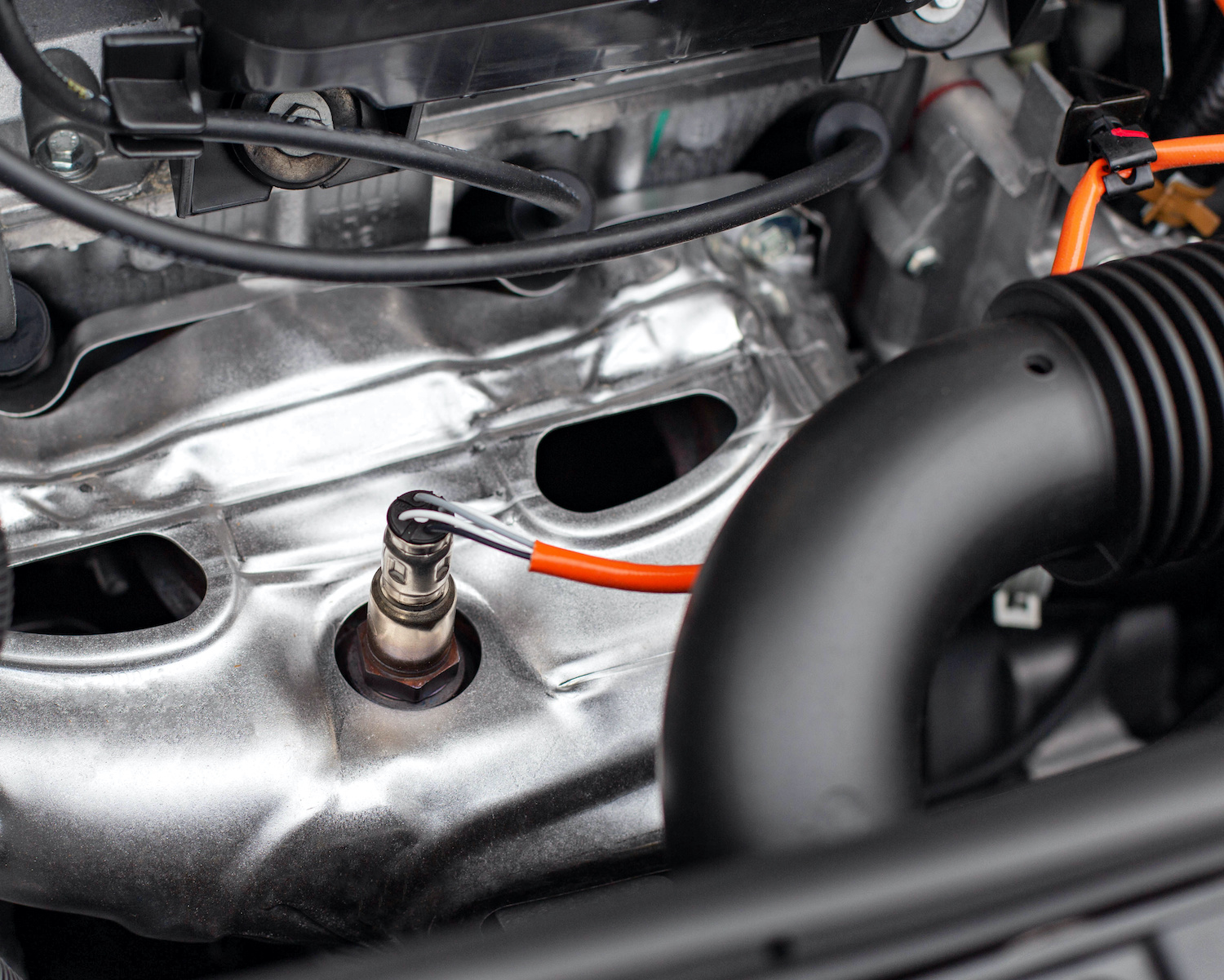
Code P0133 indicates a “slow response” from the oxygen sensor (Bank 1, Sensor 1). This impairs fuel mixture control, increases fuel consumption, and can accelerate catalytic converter wear. Below are quick actions, diagnostics, repairs, and parts selection.
The information is general and does not replace professional consultation.
“In most cases, the issue is not the sensor itself but the conditions that distort its signal. Exhaust leaks, oxidized connectors, or cracks in the manifold alter gas flow so that even a new oxygen sensor shows a delayed response. Therefore, diagnostics start not with sensor replacement but with checking for leaks and wiring.”
– Daniel Brooks, DecodeAuto
Page contents
What to do right now (brief plan)
Check for unusual noises or leaks in the exhaust before the sensor—hissing sounds, soot at joints, or black soot marks around flanges indicate air intrusion. Listen on a cold engine—leaks often produce a characteristic whistling sound. Read codes and freeze frame data via OBD-II, record fuel trim parameters (STFT/LTFT). Inspect the sensor connector and wiring for chafing, corrosion, or insulation damage.
If the exhaust is leaking, fix leaks first. For sensors with high mileage (over 62,000 miles (100,000 km)), prepare for replacement. Driving is possible with moderate symptoms, but avoid heavy loads until resolved—prolonged operation with incorrect mixture accelerates catalytic converter wear.
What does code P0133 (DTC P0133) mean: slow oxygen sensor response
P0133 is a diagnostic trouble code indicating that the powertrain control module (PCM) receives a “slow response” signal from the oxygen sensor (Bank 1, Sensor 1). The sensor located before the catalytic converter analyzes exhaust gases and the rate of switching between rich and lean mixtures. When signal transitions are delayed, the PCM loses correction accuracy and logs P0133 as a sensor or circuit response issue.
“Slow response” means the sensor voltage (0.1 to 0.9 V) does not switch quickly enough when the mixture changes. Normally, a healthy oxygen sensor on a warmed-up engine produces frequent oscillations—several times per second. If signal transitions become gradual or “stick” at one level, the PCM interprets this as a delay and stores P0133. The voltage graph of a healthy sensor looks like a fast, sharp sawtooth, while a slow sensor’s waves are gentle, sluggish, and rounded.
Where is the oxygen sensor (Bank 1, Sensor 1)?
Bank 1 refers to the cylinder bank containing cylinder number 1 (on inline engines, this is the only bank; on V engines, it is the side with cylinder #1). Sensor 1 is the upstream sensor, usually located on the exhaust manifold or at the beginning of the downpipe, before the exhaust enters the catalytic converter.
On inline engines (1ZZ-FE, 2ZR-FE, Gamma G4FC), Bank 1 Sensor 1 is at the front of the manifold. On V engines (e.g., Toyota V6), it is the sensor on the side with cylinder one, before the front catalytic converter. It is important not to confuse it with Sensor 2 (downstream sensor, after the catalytic converter)—P0133 specifically relates to the upstream sensor.
Types of oxygen sensors: narrowband vs wideband A/F
Before diagnostics, it is important to know which sensor type is installed, as testing methods differ.
Narrowband sensor (traditional O2):
- Typically 1–4 wires
- Signal oscillates between 0.1–0.9 V (classic “sawtooth”)
- Indicates only deviation from stoichiometry (14.7:1)
- Common in most vehicles before the 2010s
Wideband sensor (A/F, air-fuel ratio):
- Typically 5–6 wires
- Outputs linear voltage around 3.3 V at stoichiometric ratio
- Accurately measures rich and lean mixtures over a wide range
- Common in Toyota, Honda, some Ford/GM models since the 2000s
- Bosch LSU 4.9 is a popular wideband sensor
Key difference for P0133: narrowband sensors are tested by switching speed between 0.1–0.9 V, wideband sensors by the rate of change of reference voltage and pump current. Installing the wrong sensor type (for example, a narrowband sensor in place of a wideband sensor) can set this code.
| Parameter | Narrowband (O2) | Wideband (A/F) |
|---|---|---|
| Wires | 1–4 | 5–6 |
| Operating voltage | 0.1–0.9 V (oscillates) | ~3.3 V (stable at stoichiometry) |
| Operating principle | Switching rich/lean | Measuring precise A/F ratio |
| P0133 diagnostics | Switching speed | Delay in pump current change |
| Common beginner mistakes | Replacing with a universal sensor without calibration | Confusing 5–6 wire pinout |
Conditions for P0133 monitor activation
The PCM records P0133 not continuously but only under specific enabling criteria. Understanding these conditions helps reproduce the fault during diagnostics and ensures the monitor passes after repair.
Typical conditions for code setting:
- Engine warmed to operating temperature (usually above 176°F (80°C) coolant temperature)
- Engine control system in closed-loop mode (O2 feedback active)
- Stable RPM (idle or steady load)
- No other critical codes present (e.g., misfires)
- O2 sensor active (heated, heater working)
Why this matters: if you clear the code on a cold engine, the monitor will not run until the next full drive cycle. After repair, ensure the vehicle is driven long enough under conditions that activate the monitor (usually 15–30 minutes of combined driving with warm-up and steady load periods).
Main symptoms and consequences of P0133
If the check engine light is on and symptoms such as increased fuel consumption, unstable engine operation, and fluctuating idle occur, this may indicate P0133. Possible power loss, hesitation on acceleration, strong exhaust odor, and unburned fuel may be present. Prolonged driving with this fault affects catalytic converter and oxygen sensor life, increasing deposits and mixture imbalance.
Typical signs:
- Check engine light illuminated
- Increased fuel consumption (most noticeable effect)
- Unstable engine operation and fluctuating idle
- Power loss, hesitation during acceleration
- Smell of raw or unburned fuel from exhaust
- Sometimes hard starting, unstable LTFT/STFT corrections
When the oxygen sensor responds slowly, the PCM cannot promptly adjust fuel delivery. As a result, the mixture alternates between lean and rich with delay, causing uneven engine operation. In some cases, the catalytic converter can overheat from excess fuel or unburned hydrocarbons, shortening its life and potentially causing failure. Replacing a catalytic converter is costly.
7 main causes of P0133
P0133 is most often caused by factors that slow mixture switching, degrade electrical contact, or disrupt exhaust flow.
1. Oxygen sensor wear or contamination (lifespan, deposits, additives)
Over time, the sensor’s sensitive element accumulates soot, carbon deposits, or oil film. This physically slows its response to oxygen changes in the exhaust. Typical sensor life depends on model and operating conditions; poor fuel quality or oil leaks accelerate degradation.
2. Wiring damage, contact corrosion, poor ground
Corrosion on connector terminals or microcracks in wires increase circuit resistance. The sensor signal becomes distorted or delayed on its way to the PCM. Harness sections near the manifold are especially vulnerable—high temperatures degrade insulation. Poor sensor ground (often attached to the engine block and prone to oxidation) also causes signal delay.
3. Exhaust leaks and manifold cracks
Air intrusion through leaking gaskets, manifold joint cracks, or microcracks in cast manifolds (especially on high-mileage engines) artificially leans out the exhaust reaching the sensor. The PCM sees extra oxygen and misinterprets mixture composition—signal transitions slow down. This is a classic cause of a false slow-response code—the sensor is physically fine, but measurement conditions are compromised.
4. Intake and MAF sensor issues
Air leaks in the intake tract or a dirty/faulty MAF cause incorrect fuel calculations. The O2 sensor tracks these fluctuations, but due to fuel system inertia, signal transitions stretch out—the PCM records a delay.
5. Incorrect fuel pressure, leaking injectors
If fuel pressure is low or injectors leak, the mixture fluctuates. The sensor detects these changes, but fuel system inertia causes stretched signal transitions—the PCM logs a delay.
6. Incorrect PCM calibration or PCM malfunction
Rarely, suboptimal control software calibration or PCM memory errors cause the module to misinterpret response speed. Software updates covered by manufacturer TSBs may resolve the issue without hardware replacement.
7. Poor quality or incompatible sensor, incorrect heating
Installing a universal oxygen sensor without precise calibration for resistance or heater type can result in slow warm-up and response. Some aftermarket sensors may have different ceramic element characteristics. Some fuel additives (especially silicone-based) can poison the sensor’s sensitive element, permanently reducing its effectiveness.
| Cause | Likelihood | How to check | Typical solution |
|---|---|---|---|
| Sensor wear/contamination | High | Oscilloscope signal, visual inspection | Replace oxygen sensor |
| Wiring damage/corrosion | High | Multimeter (resistance, voltage), wiggle test | Clean/replace connector, repair harness |
| Exhaust leaks before sensor | Medium | Smoke machine, soapy water at joints | Replace gaskets, weld flanges |
| Manifold cracks, air intrusion | Medium | Visual inspection, listen for hissing | Weld or replace manifold |
| Intake/MAF issues | Medium | Inspect intake, check MAF readings | Fix leaks, clean/replace MAF |
| Incorrect fuel pressure/injectors | Low | Fuel pressure gauge, injector balance test | Replace regulator/injectors |
| PCM malfunction/software | Low | Check manufacturer TSBs, scanner diagnostics | Update PCM software |
| Incompatible/poor sensor | Low | Compare specs with OEM (resistance, type) | Replace with OEM or certified equivalent |
Step-by-step P0133 diagnostics
Start diagnostics via OBD-II: read codes with a scanner, record freeze frame data, and check STFT/LTFT and coolant temperature. Perform a visual inspection: sensor, wiring, connector, clamps, gaskets, exhaust manifold, and the joint before the catalytic converter.
Step 1. Read codes and freeze frame
Connect an OBD-II scanner, read code P0133 and related codes (P0130, P0131, P0171, P0172). Freeze frame shows conditions when the PCM logged the fault: RPM, load, engine temperature. If the code appears only on a cold engine, sensor heater issues may be suspected.
Step 2. Visual inspection of wiring and connector
Inspect the harness from the sensor to the PCM. Check the connector for corrosion, bent pins, and moisture. Perform a wiggle test—move the connector and wires with the engine running while monitoring scanner data. Voltage spikes indicate poor contact.
Step 3. Check oxygen sensor signal voltage
On a warmed-up engine (coolant temperature above 176°F (80°C)), connect a multimeter or oscilloscope to the sensor signal wire. A healthy narrowband sensor produces fast oscillations between 0.1–0.9 V, switching several times per second. Slow or stuck transitions confirm the problem.
Quick STFT/LTFT interpretation for P0133:
- STFT (short-term fuel trim) should fluctuate quickly within a narrow range (roughly a few percent around zero)
- LTFT (long-term fuel trim) should be near zero after warm-up
- If STFT/LTFT fluctuate slowly or show wide variation, this may support a slow sensor response diagnosis
- Consistently high positive LTFT (system compensating for a lean mixture) or negative LTFT (rich) can indicate root causes outside the sensor (leaks, MAF, injectors)
Step 4. Check exhaust system for leaks
Use a smoke machine or soapy water on manifold joints, gaskets, and flanges before Sensor 1. Bubbles or smoke indicate air leaks. Eliminate leaks before sensor testing to avoid a false diagnosis.
Step 4a. Check intake and MAF sensor
Inspect the intake tract for air leaks (smoke machine, listen for hissing). If the MAF is dirty, clean it with a dedicated MAF cleaner. Compare MAF readings at idle and 2,000 RPM with specifications for your model—deviations indicate MAF issues.
Signs of intake leaks: hissing on cold start, unstable idle, black oil/dirt marks around air duct joints.
Step 5. Check heater circuit and resistance
Disconnect the sensor connector and measure heater resistance (usually a few to a few dozen ohms; see the service manual for your specific model). Check for 12 V supply on the heater circuit with the ignition on. Missing voltage or an open heater circuit delays sensor warm-up and response.
Step 6. Compare upstream and downstream O2 sensor waveforms
If both sensors (Sensor 1 and Sensor 2) are available, compare their oscilloscope traces. The downstream sensor should show a more stable signal (the catalytic converter smooths fluctuations). If the upstream sensor is slower than expected, this can indicate degradation.
Methods to fix P0133
Apply repair steps in order: start by eliminating exhaust leaks (gaskets, welding manifold/joints), then repair wiring (clean contacts, restore ground, replace connector). If degradation is confirmed, replace the oxygen sensor with a suitable OEM or certified equivalent.
After repairs, clear the code and fuel trim adaptations if applicable, then perform a test drive and monitor fuel trims. In some cases, PCM software updates help. The sequence “leaks → wiring → intake/MAF → sensor → PCM” reduces repair costs and the risk of code recurrence.
Solution 1. Oxygen sensor replacement
Warm the threads (the sensor may seize), and use a special O2 sensor socket with a wire slot. Follow torque specifications from the service manual and apply anti-seize only if recommended. Avoid overtightening to prevent manifold thread damage.
Solution 2. Wiring and contact repair
Check heater power (12 V with ignition on), clean or replace connector terminals. Restore sensor ground—often attached to the engine block and prone to oxidation. Route the harness away from exhaust parts, and use heat-shrink tubing and heat-resistant wrap for protection.
Solution 3. Fix exhaust leaks
Replace flange gaskets and tighten or replace clamps. Manifold cracks require welding or part replacement. Align flange surfaces—misalignment creates small gaps that allow air intrusion.
Solution 4. PCM software update
Check manufacturer TSBs for calibration updates addressing P0133. Some automakers (Kia, Hyundai, Ford) released updates adjusting oxygen sensor response thresholds. Reflashing is done with dealer-level scan tools or specialized software.
Solution 5. Code reset and validation
After repair, clear the code with a scanner and warm the engine to operating temperature. Perform a readiness drive cycle—a combination of idle, acceleration, and deceleration per the vehicle manual. Recheck STFT/LTFT and sensor signal behavior. If the code does not return after driving under monitor activation conditions (usually 15–30 minutes of combined driving), the repair was successful.
The role of the exhaust manifold and gases in sensor operation
The exhaust manifold and gas flow are critical: a leak-free system prevents air intrusion that distorts mixture readings. The oxygen sensor measures residual oxygen for the PCM; cracks or gaps can cause incorrect data—signal transitions slow, and the PCM loses proper control.
When atmospheric air (21% O₂) enters the exhaust through a leak, the sensor sees a lean mixture even though the engine may be running normally. The PCM tries to enrich fuel but lags—creating a delayed correction cycle. Restoring manifold and joint integrity returns stable sensor response and correct mixture control.
P0133 specifics on popular vehicles
Ford (Focus, Fiesta, EcoBoost)
Exhaust flange leaks before the catalytic converter are common due to thermal deformation. Ford can be sensitive to PCM updates—check for TSBs covering O2 sensor slow response calibration. EcoBoost engines (1.0L, 1.6L) often have connector corrosion near the turbo.
Typical weak points: exhaust manifold flange gasket, sensor connector contacts near the turbo.
VAZ/Lada (Priora, Granta, Vesta)
Budget sensors (especially aftermarket) degrade faster with poor fuel. Proper grounding is critical—oxidized engine block ground can cause false codes. Check harness integrity near the manifold—high heat damages insulation.
Typical weak points: sensor ground on engine block, harness insulation near manifold.
Kia/Hyundai (Gamma, G4FC/G4FA)
PCM software updates often help (TSBs for Gamma engines may adjust response thresholds). Check exhaust flex pipes—they can start leaking quickly, causing air leaks before Sensor 1.
Typical weak points: exhaust flex pipes, PCM calibration.
Toyota (1ZZ/2ZR)
Original Denso sensors are highly durable, but minor air leaks are critical. Non-OEM sensors without proper calibration can cause slow response even with good wiring. Use only OEM or Denso/NTK sensors with exact part numbers.
Typical weak points: intake air leaks, non-OEM sensor mismatches.
Volkswagen/Audi/Skoda (VAG)
Exhaust flex pipe cracks before the catalytic converter are common above 93,000 miles (150,000 km). Check integration with the EGR system—a faulty EGR valve can indirectly affect sensor readings.
Typical weak points: exhaust flex pipe, EGR valve.
General Motors (Chevrolet, Opel)
Corrosion of ground contacts on the engine block is typical in humid climates. Check sensor ground connection reliability and connector contact quality.
Typical weak points: engine block ground, connector corrosion.
BMW
Heater circuit breaks in 4-wire sensors near the manifold occur at high mileage due to vibration and thermal cycling.
Typical weak points: sensor mounting location on manifold, heater wires.
Renault/Nissan
Wiring degradation near the exhaust manifold is common for K-series and HR16 engines. Check harness thermal protection condition.
Typical weak points: wiring near manifold, harness thermal protection.
| Make/Engine | Common causes | Notes | Recommended sensor (OEM ref.) |
|---|---|---|---|
| Ford Focus/EcoBoost | Flange leaks, connector corrosion | Check PCM update availability | Motorcraft DY-1184, Bosch 13477 |
| VAZ Priora/Vesta | Poor aftermarket sensors, bad ground | Inspect harness near manifold | Bosch 0258006537, NTK OZA659-EE11 |
| Kia Rio/Hyundai Solaris | Exhaust flex pipes, PCM calibration | Check TSBs for software updates | Hyundai 39210-2B130, Denso 234-9065 |
| Toyota 1ZZ/2ZR | Air leaks, non-OEM sensors | Use only Denso/NTK OEM | Denso 89465-02090, NTK 24437 |
| VW/Audi/Skoda | Flex pipe cracks, EGR | Inspect flex pipe and EGR valve | OEM by VIN |
| GM (Chevrolet, Opel) | Ground corrosion | Check ground connection reliability | OEM by VIN |
| BMW | Heater circuit break | Inspect wires near manifold | OEM by VIN |
| Renault/Nissan | Wiring degradation | Check harness thermal protection | OEM by VIN |
Oxygen sensor selection: OEM vs universal
Match thread size (M18×1.5 is standard for most vehicles), cable length, pin count (1, 2, 3, 4 for narrowband; 5–6 for wideband), heater type (built-in or external), and PCM compatibility. Universal sensors require soldering or crimping—higher risk of errors with incorrect pinout.
OEM sensors: exact PCM calibration match, ready connector, expected service life. Downsides—higher price, limited availability for rare models.
Universal sensors: often cheaper but require connector and wiring adaptation. Mismatched resistance or heater type can cause repeated P0133 codes even if the sensor element is good.
IMPORTANT: Wideband sensors (e.g., Bosch LSU 4.9) are not universal replacements for narrowband sensors. Compatibility is determined only by manufacturer catalog, VIN, and installed sensor type (narrowband/wideband). Wire count, connector pinout, and heater resistance must exactly match the original.
| OEM number | Manufacturer | Cable length | Pin count | Compatibility | Price (USD) |
|---|---|---|---|---|---|
| Denso 234-9065 | Denso | 23.6 in. (600 mm) | 4 | Kia Rio, Hyundai Solaris | 80–120 |
| Bosch 0258006537 | Bosch | 21.7 in. (550 mm) | 4 | VAZ Priora, Granta | 50–70 |
| Motorcraft DY-1184 | Motorcraft | 27.6 in. (700 mm) | 4 | Ford Focus 2.0L | 90–140 |
| NTK 24437 | NTK | 25.6 in. (650 mm) | 4 | Toyota 1ZZ/2ZR | 100–150 |
Repair costs and timeframes
Sensor: OEM is more expensive; aftermarket is often cheaper but carries a higher mismatch risk. Labor: sensor replacement takes 0.5–1.5 labor hours; diagnostics 0.5–1.0 labor hours. Additional costs such as flange gaskets and exhaust repairs (manifold welding) increase the estimate.
Costs vary by region, sensor accessibility, and additional work. Prices below are approximate guidelines and vary by market.
| Work/parts | Approximate range (USD) | Time (labor hours) |
|---|---|---|
| OBD-II diagnostics + inspection | 30–60 | 0.5–1.0 |
| Oxygen sensor replacement (labor) | 40–80 | 0.5–1.5 |
| O2 sensor (OEM) | 80–150 | – |
| O2 sensor (aftermarket) | 50–100 | – |
| Wiring repair | 20–50 | 0.3–0.8 |
| Gasket/flange replacement | 15–40 | 0.5–1.0 |
| Manifold welding | 60–150 | 1.0–2.0 |
Total cost to fix P0133: approximately $150–$350 (sensor + labor), up to about $600 with difficult access (V engine, turbo) or exhaust repairs.
Common mistakes in diagnostics and repair
- Replacing the sensor without checking for leaks and wiring. A new oxygen sensor will not fix the code if the cause is air intrusion through a manifold crack or an oxidized connector.
- Ignoring sensor heater and ground. Lack of 12 V on the heater or poor ground delays warm-up and response even for a good sensor.
- Installing a universal sensor without proper crimping/soldering. Incorrect pinout or poor soldering causes false codes or no signal.
- Clearing the code without fixing the root cause. Erasing P0133 with a scanner does not solve the problem—the code returns once monitor conditions are met.
- Ignoring intake and MAF issues. Air leaks or a dirty MAF can indirectly cause slow sensor response.
Prevention: how to avoid recurrence
Use quality fuel—additives in low-grade gasoline accelerate sensor contamination. Replace spark plugs and air filters on schedule—unburned fuel from misfires deposits on the oxygen sensor.
Maintain exhaust system tightness: check gaskets and clamps every 25,000–37,000 miles (40,000–60,000 km), especially after exhaust repairs. Avoid oil or coolant leaks into the combustion chamber—fluid contact drastically shortens sensor life.
Avoid short trips on a cold engine—the sensor does not reach operating temperature (572–752°F (300–400°C)), causing soot buildup. Occasionally drive at highway speed with a steady load—higher temperature helps burn off carbon deposits.
Related codes and when to visit a repair shop
Related codes:
- P0130 – O2 Sensor Bank 1 Sensor 1 circuit malfunction (general fault, may include slow response)
- P0131 – Low O2 Sensor Bank 1 Sensor 1 signal (often precedes P0133 with vacuum leaks)
- P0132 – High O2 Sensor Bank 1 Sensor 1 signal (opposite issue—stuck rich mixture)
- P0134 – No activity from O2 Sensor Bank 1 Sensor 1 (sensor does not switch at all)
- P0171/P0172 – System too lean/rich Bank 1 (occur with P0133 due to incorrect trims)
When to urgently visit a repair shop:
- Severe power loss, engine stalls
- Strong fuel smell inside the cabin, black smoke from the exhaust
- Exhaust noise (crackling, rumbling)—possible serious leak
- Catalytic converter overheating (glowing housing, smell of melted substrate)
Post-repair checklist
| Item | Checked | Comment |
|---|---|---|
| Exhaust leaks before Sensor 1 eliminated | ☐ | Smoke machine/soapy water confirmed tightness |
| Intake and MAF checked | ☐ | No leaks, MAF readings normal |
| Sensor signal: fast oscillations 0.1–0.9 V (narrowband) | ☐ | Verified with oscilloscope or live data scanner |
| STFT fluctuates in a narrow range, LTFT near zero | ☐ | Monitored at idle and 2,000 RPM |
| P0133 code does not return after readiness cycle | ☐ | Test drive performed under monitor activation conditions |
Frequently asked questions
Is it possible to drive with the P0133 code?
Temporarily, yes, but the consequences include increased fuel consumption and accelerated catalytic converter wear. Avoid heavy loads and long trips until the cause is fixed. Prolonged driving with an incorrect mixture can lead to misfires and possible engine damage.
Does cleaning the oxygen sensor help?
Rarely, and only temporarily. O2 sensor cleaners can remove surface deposits but do not restore a degraded ceramic element. If the signal is already slow, replacement is typically required.
How much does it cost to replace the oxygen sensor?
OEM parts usually cost about $80–$150, and labor is typically $40–$80. Aftermarket options are often cheaper but require compatibility checks. Exact cost depends on region and vehicle model.
How do you reset the code yourself?
After repair, connect an OBD-II scanner, clear the code (clear DTCs), then perform a readiness cycle—a combination of idle, acceleration, and deceleration according to the vehicle manual. If symptoms persist or the code returns, further diagnostics are required.