

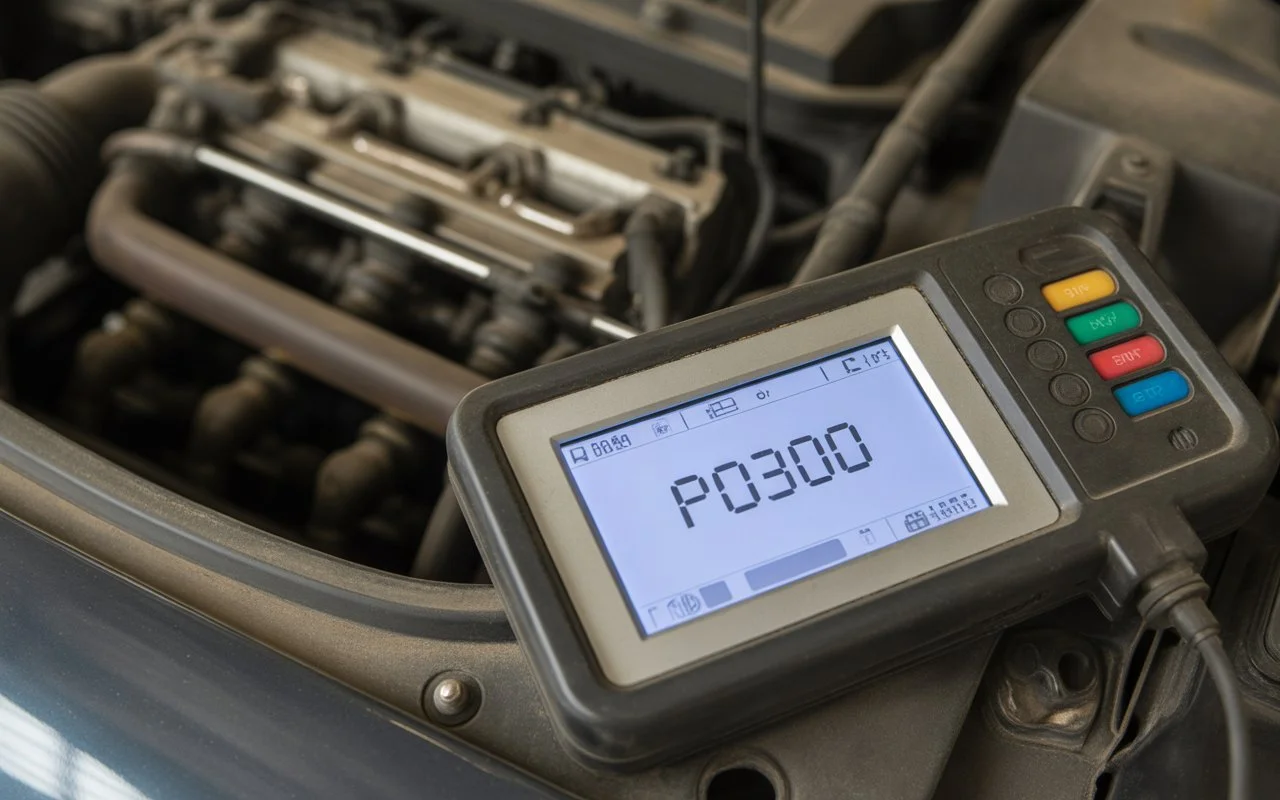
What to do right now: If the check engine light is flashing, immediately reduce engine speed and stop; flashing indicates active misfires and a risk of catalytic converter overheating. If the light is steady, a short drive to a repair shop is allowed without high revs. First steps: read codes with a scanner, check spark plugs for wear (gap >0.043 in. [1.1 mm] or black soot — replace as a set), inspect vacuum hoses for cracks. Basic sequence: spark plugs/coils → fuel pressure → air leaks → compression.
Page contents
What does error P0300 (DTC P0300) mean: decoding and general information
Code P0300 indicates random misfires occurring in multiple engine cylinders. Unlike codes P0301–P0308, which specify a particular cylinder, P0300 is stored when misfires happen irregularly and affect different cylinders. The PCM records this code according to SAE J2012 when it detects multiple incomplete combustion events of the air-fuel mixture.
What exactly happens inside the engine? Normally, each power stroke ends with ignition of the mixture and transmission of an impulse to the crankshaft. During a misfire, this impulse is absent or weakened, which is detected by the crankshaft position sensor. The PCM continuously monitors crankshaft acceleration after each power stroke: if the deviation exceeds a threshold (a calibration parameter depending on engine model and operating conditions), the system increments the misfire counter for the corresponding cylinder.
When misfires are detected in multiple cylinders without a stable pattern, the PCM sets P0300. This means the issue is systemic—affecting the overall ignition, fuel supply, air intake, or engine management system rather than being localized to a single cylinder.
The technical detection mechanism is based on adaptive learning by the PCM. During engine braking (when injectors are off and the engine rotates by inertia), the PCM creates a baseline pattern of crankshaft sensor pulse intervals—known as Crank Relearn in GM/Ford or Adaptive Numerator in Chrysler. This reference is stored in memory and used as a benchmark. During engine operation, the PCM compares current intervals with the baseline pattern. If the difference reaches the sensitivity threshold (a calibration parameter unique to each model and operating conditions—load, rpm, temperature), the system registers misfires and sets P0300.
It is important to understand: code P0300 is not a diagnosis of a specific part but a signal of combustion process disruption. Causes may include weak spark, fuel shortage, excess air, or mechanical issues preventing the cylinder from generating normal power.
OBD-II standards regulate misfire detection through Mode 06 (test data on misfires, where the FAIL flag indicates a problem after two drive cycles) and Mode 07 (continuous monitoring with real-time misfire counting per cylinder). – SAE J1979 (Tomorrow’s Technician, 2024).
Additionally, SAE J1979-2 requires the system to save a freeze frame for the highest priority misfire event when memory overflows. This means conditions under which the PCM recorded P0300 (rpm, load, temperature, throttle position) will be available via scanner and help narrow down the cause.
Is it safe to continue driving with P0300 and how serious is it?
This information is general and does not replace professional consultation.
No, if the check engine light is flashing. Yes, if it is steady and symptoms are mild—but only until reaching a repair shop, avoiding high revs and sudden acceleration.
A flashing check engine light is a critical warning. It means the PCM detects active misfires in real time, and unburned fuel enters the exhaust system. There it combusts in the catalytic converter, instantly raising the ceramic block temperature to extreme levels. Modern catalytic converters are designed for normal operating temperatures; raw fuel can exceed safe limits, causing melting and destruction of catalyst cells within minutes under heavy load.
Unburned fuel from misfires overheats the catalytic converter, causing internal damage; replacement costs range from $1,000 to $2,500. Continuing to drive also washes oil from cylinder walls, accelerating engine wear (A-Premium, 2023).
Besides the catalytic converter, misfires damage the engine itself. Incomplete combustion causes some fuel to wash down cylinder walls, removing the oil film. This leads to dry friction between pistons, rings, and cylinder walls, accelerating piston group wear. Ignoring P0300 and continuing to drive with misfires may require not only catalytic converter replacement but also major engine overhaul.
When the light is steady, not flashing, it means misfires were recorded historically but are not currently critical. In this case, a short drive to a mechanic is permissible—preferably without hard acceleration, high rpm, or full load. However, diagnostics should not be delayed: even rare misfires increase emissions, reduce catalytic converter lifespan, and impair vehicle performance.
Do not do this: Do not disconnect coils/plugs/injectors on a running engine “for testing” — this can damage PCM drivers and quickly overheat the catalytic converter with raw fuel. Do not run the engine on a single cylinder. Do not spray flammable liquids near a hot exhaust manifold. Diagnose using misfire counters (Mode $06/$07), cylinder part swaps, and baseline measurements.
Key rule: flashing check engine light—immediately reduce rpm and stop. Steady light—go straight to diagnostics, but avoid extremes.
Main symptoms of error P0300
When the PCM detects multiple misfires, the driver experiences several characteristic signs. Let’s analyze each symptom in detail.
Unstable idle operation (engine roughness)
The engine shakes or vibrates when stopped at a traffic light or in traffic. This happens because one or more cylinders fail to deliver normal power to the crankshaft. Instead of smooth rotation, the crankshaft receives uneven impulses, which are transmitted to the vehicle body. Roughness may be constant or intermittent, depending on the stability of conditions causing misfires.
Loss of power and poor throttle response
When pressing the accelerator, the vehicle accelerates with noticeable effort, jerks, or hesitation. Instead of smooth acceleration, the engine exhibits hesitation—moments when power seems to drop briefly. This results from cylinders not firing synchronously. When misfires occur under load, the PCM adjusts fuel delivery and ignition timing to compensate for power loss but cannot completely eliminate hesitation.
Increased fuel consumption
Unburned mixture exits through the exhaust instead of producing useful work. The PCM detects insufficient torque and increases fuel delivery. The result is higher fuel consumption with worsened performance.
Flashing or steady check engine light
Flashing indicates active misfires at the moment. Steady illumination means the code is stored but current conditions are not critical. P0300 often appears under load (acceleration, climbing) and then switches to a steady light.
Unusual sounds (popping) in the exhaust system
Unburned fuel combusts in the exhaust, causing popping or sputtering sounds. This signals that misfires are severe enough for fuel to pass through cylinders without ignition.
Difficulty starting the engine
Especially when hot. If P0300 is caused by weak spark or low fuel pressure, the engine may crank longer than usual before starting.
These symptoms rarely occur in isolation—usually a combination is present. It is important to note under which conditions they worsen: cold start, under load, low or high rpm. This information aids diagnostics.
All possible causes of error P0300: from spark plugs to PCM
Multiple misfires can be caused by problems in five key engine systems. Let’s review each group from most likely to rare.
Ignition system issues
The ignition system is the first to check for P0300. Worn or fouled spark plugs fail to produce a strong spark or lose spark under load. Electrode gap increases over time due to erosion, requiring higher voltage for ignition. If plugs have not been replaced per schedule (commonly every 37,000–62,000 miles [60,000–100,000 km] for standard plugs and 62,000–93,000 miles [100,000–150,000 km] for iridium), misfires are likely.
Ignition coils may lose output due to internal breaks or insulation failures. This is especially common in systems with individual coils per cylinder: one or two faulty coils can contribute to random misfires. High-voltage wires (if present) may crack, oxidize at terminals, or lose insulation resistance, causing spark to short to ground without reaching the plug.
Fuel system faults
A weak fuel pump or clogged fuel filter reduces rail pressure. The PCM calculates injection based on nominal pressure (calibration parameter; check the service manual), but if pressure falls below minimum, the mixture becomes lean and misfires occur.
Clogged or faulty injectors spray fuel unevenly. If one or two injectors deliver too little or too much fuel, mixture composition in their cylinders changes, causing misfires. Poor-quality fuel with deposits accelerates injector clogging and may itself cause misfires due to low octane rating.
Air intake system issues
Air leaks into the intake manifold (through cracked hoses, gaskets, throttle body) cause more air to enter cylinders than the PCM accounts for. The mass airflow sensor (MAF) registers one value, but actual air is higher—resulting in a lean mixture and misfires.
The MAF sensor itself may give incorrect readings due to contamination or wear. If the sensor gives inaccurate readings, the PCM supplies incorrect fuel amounts, pushing the mixture out of optimal range. An EGR valve stuck open continuously recirculates exhaust gases into the intake, reducing oxygen and disrupting combustion. The impact of a dirty air filter depends on intake system type; in modern MAF systems, the sensor compensates for reduced airflow, so the effect on mixture is minimal but overall power drops.
Specifics for GDI engines (direct injection): additionally check the high-pressure fuel pump (HPFP) and high-pressure rail. Low pressure in the high-pressure circuit (even if the low-pressure side is normal) causes poor fuel atomization and misfires. A PCV valve stuck open can cause significant air leaks. Another common GDI issue is exhaust leaks before the oxygen sensor, distorting sensor readings.
Mazda-specific example: MAF is often critical; check LTFT > +10% at idle and under load. PCV valve or intake hose leaks are frequent causes of random misfires. Smoke testing is recommended before disassembling the fuel system.
Air leak detection is performed using a smoke machine or by spraying a flammable liquid (for example, starting fluid) around hoses and gaskets on a running engine. If rpm changes sharply during spraying, the leak is found.
Engine mechanical faults
Low or uneven cylinder compression results from worn piston rings, burnt valves, or a blown head gasket. If compression in one cylinder is significantly lower than others (variation over 10%), the mixture does not compress to the required pressure and temperature, causing unstable ignition.
Incorrect timing marks (if the chain or belt has slipped a tooth) shift valve timing. Intake, compression, power, and exhaust strokes occur at suboptimal moments, reducing power and causing misfires. Low oil level or fuel dilution also indirectly affect engine operation but rarely cause P0300 directly.
Sensor and PCM malfunctions
The crankshaft position sensor (CKP) sends the PCM information about crankshaft speed and position. If the signal is interrupted, distorted, or lost, the PCM cannot accurately synchronize injection and ignition, resulting in misfires logged as P0300.
The camshaft position sensor (CMP) determines engine phase (which cylinder is on the compression stroke). CMP failure disrupts injection and ignition sequence. The oxygen sensor affects fuel mixture adjustment: if faulty, the PCM receives false data and misadjusts fuel delivery.
Common factors: power and ground issues at the PCM, alternator problems, oxidation of engine ground connections—all sources of interference and signal loss. Injector driver failures can also cause misfires. Sometimes PCM software issues (outdated firmware, corrupted calibration data) can contribute to false misfire detection.
| Cause | Symptoms | Quick check | Likelihood |
|---|---|---|---|
| Spark plug wear | Idle shaking, jerks on acceleration, increased fuel consumption | Visual inspection of gap and deposits; replace as a set | High |
| Faulty ignition coils | Power loss, jerks, check engine flashing | Resistance test per service manual; cylinder-by-cylinder swap | High |
| Low fuel pressure / clogged injectors | Hard start, fuel smell, hesitation under load | Fuel rail pressure gauge; injector balance test | Medium |
| Air leaks | Unstable rpm, lean mixture shown by long-term fuel trim | Smoke machine or starting fluid spray | Medium |
| Blown head gasket / low compression | Overheating, white exhaust smoke, power loss | Compression test, leak-down test | Low |
Understanding all possible causes helps avoid unnecessary part replacements and allows systematic checking from simple to complex systems.
P0300 diagnostics: how to find the cause of misfires
This information is general and does not replace professional consultation.
Proper P0300 diagnostics follow the principle “from simple to complex” and “from cheap to expensive.” The goal is to localize the fault as precisely as possible before replacing parts.
Step 1: Basic OBD-II scanner diagnostics
Connect an OBD-II scanner and read trouble codes. Besides P0300, pay attention to related codes: P0301–P0308 (misfires in specific cylinders), P0171/P0174 (lean mixture), P0420 (catalyst), and codes from the MAF, CKP, and oxygen sensors.
Review freeze frame data—a snapshot of conditions when the PCM recorded the fault: engine rpm, load, coolant temperature, throttle position, short-term and long-term fuel trims. If misfires occurred during cold start and low rpm, the problem may be plugs or low compression. If under high load, check fuel pressure and air leaks.
Example freeze frame Mode $06/$07 analysis: Mode $06, Test ID $53 (Misfire): Cylinder 1 Count=0/Limit=200; Cylinder All=57/Limit=200 – P0300 active at 52% load (freeze frame: 2650 rpm; ECT 190°F [88°C]). A value approaching or exceeding the Limit for “All Cylinders” together with active misfires can correspond to P0300.
Enable misfire monitor mode (usually available in live data or Mode 06/07). Run the engine at idle and observe misfire counters per cylinder. If one or two cylinders increment faster, the problem is localized and no longer pure P0300 but the beginning of a P030X. If counters increase randomly across all cylinders, look for a common cause (fuel, air, management).
Where to find Mode $06/$07 in popular scanners:
- Launch/Autel: Live Data menu → Misfire Counters or Mode $06 → Test ID $53 (Misfire Monitor).
- ELM327/Torque: add PID for Misfire Counters from the extended parameters list.
- OBDeleven/VCDS (VAG): Measuring blocks → “Misfire” group or Advanced Measuring Values.
Step 2: Visual inspection under the hood
Inspect all accessible connectors, wires, and hoses. Look for cracks in high-voltage wires, coil damage (white deposits, melting), and oxidized contacts. Check intake tract sealing: feel all hoses from the air filter to the intake manifold, inspect the throttle body gasket and EGR valve. Any crack or loose connection is a potential air leak source.
Step 3: Spark plug inspection
Remove plugs and assess condition. A normal electrode has light brown or gray deposits, with the gap within manufacturer specification (commonly 0.035–0.043 in. [0.9–1.1 mm] for standard plugs; check the service manual). Black soot, oil on the threads, or severe electrode erosion indicate problems.
If unsure about a plug, swap it with a neighboring cylinder and retest with a scanner. If the misfire “moves” with the plug, the plug is faulty. If it stays, check the coil, wire, or cylinder.
Step 4: Ignition coil and high-voltage wire check
Measure primary and secondary coil resistance with a multimeter (values in the manufacturer service manual). Readings outside spec or an open circuit indicate coil replacement.
Similarly, swap coils to see if the misfire moves—this helps identify a faulty coil. Check high-voltage wires for insulation breakdown: in the dark with the engine running, sparks may be visible. Replace damaged wires as a set.
Step 5: Fuel pressure check
Connect a pressure gauge to the fuel rail (if a test port is available). Start the engine and measure pressure at idle and under load (quick throttle input). Compare with manufacturer specifications (calibration parameter; check the service manual).
If pressure is low, check the fuel pump, pressure regulator, and filter. If pressure fluctuates or drops under load, the pump may be worn or the filter clogged.
Step 6: Injector balance test
Many scanners support active injector tests: the PCM commands each injector to open, and the system evaluates rpm change. If one injector shows less response, it may be clogged or faulty. Professional injector cleaning often resolves issues without replacement.
Step 7: Air leak detection
Use a smoke machine: connect it to the intake tract and introduce smoke under low pressure. Leaks are visible by escaping smoke. If no smoke machine is available, spray starting fluid around hoses, gaskets, and the throttle body on a running engine. A sharp rpm increase indicates a leak.
Step 8: MAF, CKP, CMP sensor check
Compare MAF readings via scanner with reference values for your engine model (depends on displacement; roughly 1–2 g/s per liter at idle; check the service manual).
Check CKP and CMP waveforms (if an oscilloscope is available). Signals should be clean without dropouts or interference. Oxidized connectors or damaged wiring can cause false misfires.
Step 9: Cylinder compression measurement
If previous checks reveal no issues, measure compression. Specs are listed in the service manual (engine-dependent), with less than 10% variation between cylinders. Low compression in multiple cylinders indicates ring or valve wear. Uneven compression suggests localized faults (burnt valve, stuck rings).
Leak-down testing can be performed by introducing compressed air into the cylinder through the spark plug hole and listening for escaping air (intake, exhaust, crankcase, radiator). This identifies specific faults.
Step 10: PCM and wiring diagnostics
Check all engine and PCM ground connections. Oxidation or poor ground contact is a common cause of strange problems. Inspect wiring harness integrity, especially at rub points and bends.
If all systems are checked and no cause is found, update PCM firmware if applicable. Manufacturers sometimes release updates improving misfire detection algorithms and eliminating false triggers.
Decision tree: “What to check in order”
| Condition | What to check |
|---|---|
| LTFT > +10% at idle and increasing with rpm | Air leak (PCV/intake hoses) or MAF sensor |
| LTFT normalizes above 2000 rpm | Local leak near throttle body |
| Fuel pressure below spec at idle and under load | Fuel pump or filter |
| Misfire counters increase in 1–2 cylinders | Spark plug/coil of specific cylinder |
| Misfire counters increase randomly in all cylinders | Common cause (fuel/air/management) |
| Compression below spec in multiple cylinders | Ring/valve wear or timing system |
| Component/system | Test method and tool | Reference value or expected result |
|---|---|---|
| Spark plugs | Visual inspection of gap and deposits; swap test | Gap per manual (commonly 0.035–0.043 in. [0.9–1.1 mm]), light brown deposits |
| Ignition coils | Resistance test per service manual; swap test | Resistance per manufacturer specification |
| High-voltage wires | Visual inspection for breakdown; resistance test | No sparks on insulation; check manual |
| Fuel pressure | Pressure gauge on fuel rail at idle and load | Per model specification (check manual) |
| Injectors | Scanner balance test; professional cleaning | Even response from all injectors |
| Air leaks | Smoke machine or starting fluid spray | No leaks detected |
| MAF sensor | Live data scanner; oscilloscope | Approx. 1–2 g/s per liter at idle (check manual) |
| CKP / CMP sensors | Oscilloscope; connector and wiring check | Stable signal without dropouts |
| Cylinder compression | Compression gauge; leak-down test | Per manual; variation <10% |
Note: Numeric thresholds (plug gaps, fuel pressure, MAF flow, compression) are calibration parameters. Always refer to the service manual/specifications for your model.
This sequence allows systematic elimination of possible causes and precise fault localization, minimizing unnecessary replacements.
Methods to fix error P0300
After diagnostics and cause localization, proceed to repair. Typical repair scenarios by system are considered.
Ignition system
If diagnostics reveal worn plugs, replace the entire set, even if only one looks damaged. Plugs from the same batch wear similarly, and replacing one will not solve the problem long-term.
For faulty coils, replace the defective coil (or the ignition module if individual replacement is not possible). Replace high-voltage wires as a set. Be sure to clean and apply dielectric grease to all contacts and terminals—oxidation often causes recurring problems after repair.
Fuel system
If pressure is low due to a clogged filter, replace the fuel filter. If the pump is weak, replace the fuel pump (usually located in the tank). The pressure regulator, if faulty, can be replaced separately or with the pump depending on design.
Clogged injectors may respond well to professional cleaning, which is cheaper than replacement and often effective. If cleaning fails or an injector leaks, replace it. Use quality fuel and avoid questionable gas stations—this is the best prevention against clogging.
Air intake and exhaust system
Eliminate all detected leaks: replace damaged hoses and intake manifold and throttle body gaskets. Clean the throttle body to improve idle stability.
If the EGR valve sticks open, clean or replace it. Replace dirty air filters per schedule. A clogged catalytic converter is an expensive problem; if damaged, replacement is required (cost from $900 to $1,500+ for popular models).
Engine mechanical faults
Low compression may require major overhaul: piston ring replacement, valve reconditioning, or valve replacement. A blown head gasket requires gasket replacement and checking cylinder head flatness.
Incorrect timing marks require correction. If the chain or belt is stretched, replace the timing kit.
Electronics and sensors
Update PCM firmware if updates are available from the manufacturer. Replace faulty sensors (CKP, CMP, MAF, oxygen sensors). Repair wiring: clean oxidized contacts, replace damaged harness sections, and ensure reliable ground connections.
Common mistakes in DIY diagnostics
Inexperienced DIYers often make typical errors leading to wasted money and prolonged repairs.
Replacing all coils without checking specific cylinders. Instead of reading misfire counters or swapping coils, they buy a full set and replace everything at once. Often the problem lies in plugs or air leaks, not coils.
Ignoring freeze frame and fuel trims. Long-term fuel trim shows how the PCM adjusts mixture over time. Normal fuel trims: STFT and LTFT within ±10% are generally normal; ±15–20% is borderline, so investigate the cause; over ±20% is critical. If LTFT is strongly positive (for example, >+15%), the mixture is too lean—look for air leaks or MAF issues. If negative (< −15%), the mixture is rich—injectors may leak or the pressure regulator may be faulty.
Skipping air leak detection with a smoke machine. Cracks in hoses or gaskets are often invisible visually. Without smoke testing, leaks are easily missed, and air leaks are a common cause of P0300.
Not measuring compression with fluctuating symptoms. If misfires appear and disappear without pattern and plug, coil, and fuel checks show nothing, measure compression. Low compression in multiple cylinders can cause such symptoms.
Misinterpreting MAF readings. The sensor may show normal values at idle but distorted readings under load. Compare readings with reference values for your engine or a known-good sensor.
Prevention: how to avoid recurrence of error P0300
The best way to avoid misfires is regular maintenance and attention to quality consumables.
Regular spark plug replacement per schedule. Do not wait for plugs to fail completely. Replace according to manufacturer recommendations (commonly every 37,000–62,000 miles [60,000–100,000 km] for standard plugs, 62,000–93,000 miles [100,000–150,000 km] for iridium or platinum). Use manufacturer-recommended plugs—experiments with aftermarket substitutes often cause problems.
Replace air and fuel filters per schedule. A dirty air filter restricts airflow; a dirty fuel filter reduces pressure and clogs injectors. Air filter replacement interval is commonly 9,000–19,000 miles (15,000–30,000 km), fuel filter 25,000–37,000 miles (40,000–60,000 km), depending on the model.
Monitor intake system sealing. Periodically inspect hoses, gaskets, and the throttle body. Clean the throttle body every 19,000–25,000 miles (30,000–40,000 km) and check the EGR valve for deposits.
Use quality fuel. Refuel at reputable stations. Poor fuel accelerates injector clogging and deposit formation on plugs and valves. Periodic professional injector cleaning every 37,000–50,000 miles (60,000–80,000 km) can be a useful preventive measure.
Annual check of fuel trims and catalytic converter condition. Connect a scanner yearly and monitor long-term fuel trim. If values exceed ±10%, investigate the cause before codes appear. A clogged catalytic converter from prolonged misfires is expensive to replace—better to prevent it.
- Plugs per manual (37,000–93,000 miles [60,000–150,000 km])
- Air filter 9,000–19,000 miles (15,000–30,000 km)
- Fuel filter 25,000–37,000 miles (40,000–60,000 km)
- Throttle body cleaning 19,000–25,000 miles (30,000–40,000 km)
- Injector cleaning 37,000–50,000 miles (60,000–80,000 km)
- Fuel trim check annually
This information is for educational purposes only and does not replace professional inspection and diagnostics at a certified repair facility.
Frequently asked questions
Is it possible to continue driving with the P0300 error?
If the Check Engine light is flashing, you must not continue driving — immediately reduce engine speed and stop, because active misfires quickly overheat the catalytic converter. If the light is steady and symptoms are mild, it is acceptable to carefully drive to a repair shop without hard acceleration or high rpm.
What most often causes the P0300 error?
Most often, P0300 is related to ignition system problems: worn spark plugs, faulty coils, or damaged high-voltage wires. It can also be caused by low fuel pressure, clogged injectors, air leaks in the intake, a faulty MAF sensor, mechanical engine issues, or sensor and PCM malfunctions.
What should be checked first when P0300 occurs?
Start with basic scan tool diagnostics: read codes, check freeze frame data, and review misfire counters. Then inspect spark plugs and coils, examine vacuum hoses and the intake for air leaks, and measure fuel pressure. If simple checks show nothing, proceed to compression testing and sensor inspection.
Is the P0300 error dangerous for the engine and catalytic converter?
Yes, especially if misfires are active. Unburned fuel enters the exhaust system, burns in the catalytic converter, and can quickly overheat or damage it. Additionally, fuel washes away the oil film on cylinder walls, accelerating piston group wear and increasing the risk of serious engine repairs.
Will the P0300 error disappear by itself after the cause is fixed?
After repair, the code may clear itself after several drive cycles if misfires no longer occur. However, it is usually better to erase the code with a scanner and verify that misfire counters no longer increase. This helps confirm that the problem is truly resolved.