

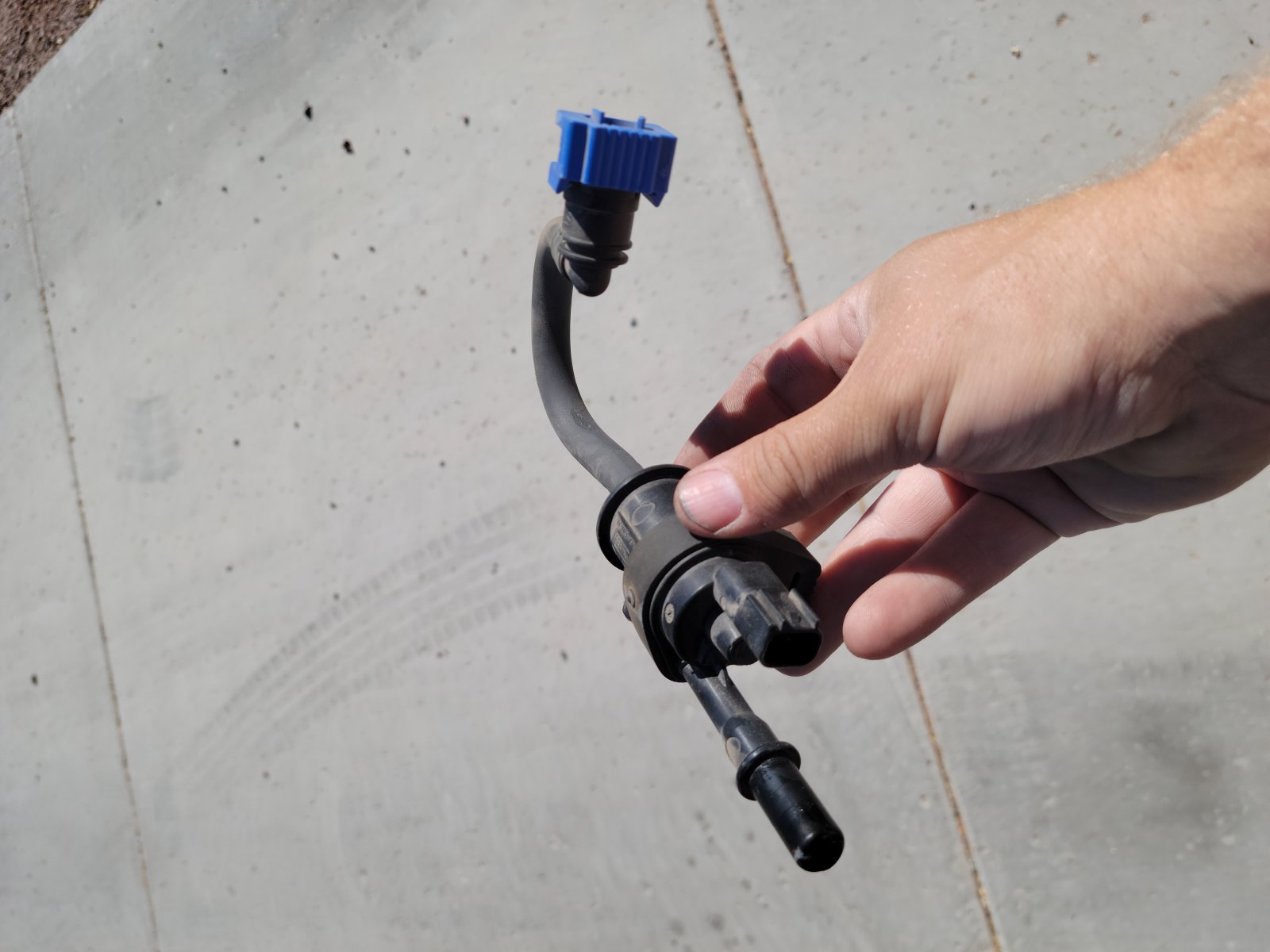
Briefly: P1450 is a diagnostic trouble code (DTC) indicating a problem bleeding vacuum from the fuel tank (EVAP system). It often appears as a check engine light and refueling difficulties (fuel nozzle clicking off). Below is a quick overview of meanings, symptoms, causes, step-by-step diagnostics, and repair options for Ford, Mazda, and other brands.
“P1450 is not a final diagnosis, but information. The PCM indicates that the EVAP system cannot normalize fuel tank pressure. In many cases on Ford and Mazda vehicles, this is caused by a purge valve stuck open, creating constant vacuum. But before replacing parts, you need to understand why the PCM set the code—what signals it saw and under what conditions the code was stored.” – Daniel Brooks, DecodeAuto
Page contents
What does the P1450 code mean and why does the check engine light come on?
P1450 is a diagnostic trouble code (DTC) that stands for “Unable to Bleed Up Fuel Tank Vacuum.” The PCM records this code when the fuel tank pressure sensor (FTP) detects excessive vacuum while the engine is running, and the EVAP system cannot normalize the pressure.
Simply put: the PCM sees that there is too much vacuum in the tank and cannot relieve it. This occurs during EVAP monitoring when the PCM checks the system’s integrity and its ability to release or build vacuum.
Common causes include a stuck-open purge valve, a faulty vent valve, clogged or kinked EVAP hoses, a defective FTP sensor, or a damaged charcoal canister. The first step is to check the fuel cap and visually inspect the hoses, then proceed to diagnose EVAP components.
Main symptoms of a P1450 malfunction
Symptoms relate to EVAP system malfunction and pressure imbalance in the fuel tank. Most often, this includes the check engine light and refueling difficulties. Sometimes hissing is heard when opening the fuel cap; less commonly, rough idle and a slight fuel vapor smell occur.
Typical signs:
- Check engine light on—this is the only symptom always present when the code is stored.
- Fuel nozzle clicks off at the gas station—refueling is interrupted because the vent valve does not release pressure, preventing fuel vapors from escaping the tank.
- Hissing when unscrewing the fuel cap—a sign of excessive vacuum or pressure in the tank.
- Fuel vapor smell near the vehicle—rare, possible with EVAP system leaks.
- Rough idle—very rare, if the purge valve sticks open and causes unmetered air to enter the intake manifold.
Important note: P1450 usually does not affect vehicle drivability. The vehicle typically drives normally, but the problem appears during refueling or emissions testing.
7 main causes of the P1450 code
We will review causes from most common to rare, explaining the failure mechanism:
1. EVAP purge valve
This is a solenoid valve controlled by the PCM that routes fuel vapors from the canister to the intake manifold. If the valve sticks open, vacuum from the intake constantly pulls from the fuel tank, creating excessive vacuum. The PCM detects this via the FTP sensor and stores P1450.
In practice, on Ford vehicles, a faulty purge valve is the most frequent cause of P1450. Start diagnostics here.
2. EVAP vent solenoid
This valve opens to release pressure and ventilate the EVAP system. If it sticks closed, the tank cannot vent properly—vacuum is not released, and the PCM sets the code. This often causes refueling difficulties.
3. Clogged, kinked, or cracked EVAP hoses
Charcoal dust from a deteriorated canister can clog lines between the tank and canister. Hoses may also be pinched due to improper installation or cracked from aging. The result is disrupted airflow and inability to relieve vacuum.
4. Fuel tank pressure sensor (FTP sensor)
The sensor measures pressure or vacuum in the tank and sends a signal to the PCM. If faulty or with damaged wiring, it may send incorrect data. The PCM sees a false vacuum reading and stores the code.
5. Charcoal canister
The charcoal media deteriorates over time, especially if the tank is overfilled and liquid fuel enters the canister. Charcoal dust clogs valves and hoses, blocking the system.
6. Fuel cap
If the cap is not sealed tightly or the gasket is damaged, pressure balance in the tank is disrupted. Although this usually triggers P0455/P0456 codes (leaks), it can sometimes affect system operation during EVAP tests.
7. Wiring, connectors, and rare PCM faults
Corroded connectors, broken wires, or short circuits in valve or sensor control circuits. Rarely, PCM software issues, especially after repairs or flooding.
Brand tip: For Ford and Mazda, first check the purge and vent valves. If there is a fuel smell and refueling difficulty, inspect the vent valve and canister for blockages.
How the EVAP system works and the role of vacuum
The evaporative emission control system (EVAP) prevents gasoline vapors from escaping into the atmosphere. Here is how it works:
Fuel vapors from the tank travel through a hose to the charcoal canister, where activated charcoal adsorbs and holds them. When the engine runs, the PCM opens the purge valve, and vacuum from the intake manifold draws accumulated vapors from the canister into the combustion chamber, where they burn with the air-fuel mixture.
To check system integrity and proper operation, the PCM runs an EVAP test. During the test:
- The vent solenoid closes, sealing the system.
- The purge valve opens, and vacuum from the intake creates negative pressure in the tank and canister.
- The FTP sensor measures pressure changes in the tank.
If vacuum cannot be properly built or released after the test, the PCM stores P1450—“Unable to Bleed Up Fuel Tank Vacuum.” Simply put, the PCM cannot restore normal pressure in the tank, signaling a fault.
EVAP monitor enabling conditions and FTP norms
The PCM initiates EVAP monitoring only under certain enabling conditions:
- Fuel level: typically 15–85% of tank capacity (excluding empty or full tanks where testing is impossible)
- Engine coolant temperature (ECT): within a specified range (for example, 158–203°F (70–95°C) for a warmed-up engine)
- Intake air temperature (IAT): usually above a threshold to avoid condensation or freezing
- No other active DTCs: critical engine codes block EVAP testing
- Speed and load: specific RPM or speed ranges for stable vacuum
Typical FTP signal values for Ford/Mazda:
| Condition | Normal FTP value | Deviation (problem) |
|---|---|---|
| Engine off, tank sealed | ~0 kPa (atmospheric pressure) | Constant vacuum (-2 to -5 kPa) = purge valve stuck open |
| EVAP test, purge 40% open | -1 to -3 kPa (light vacuum) | No change = clog/fault |
| Vent open for pressure release | Returns to ~0 kPa within 10–15 seconds | Vacuum holds = vent stuck closed |
How P1450 differs from related codes:
| Code | Issue | Key difference |
|---|---|---|
| P1450 | Unable to release vacuum | Vacuum holds after test |
| P0442 | Small EVAP leak | System loses vacuum gradually |
| P0455 | Large EVAP leak | System does not hold vacuum at all |
| P0446 | Vent valve malfunction | Ventilation issue, not vacuum |
| P0451 | FTP sensor range/performance | Sensor gives incorrect readings |
Note: Check EVAP operation specifics by VIN and the factory service information for your model—calibrations and test algorithms may vary between vehicle generations. The general logic above is based on OBD-II standards (SAE J1979-2, 2021) and manufacturer practice.
Vehicles where P1450 is most commonly recorded
P1450 is frequently reported on Ford (Focus, Fusion/Mondeo, Escape/Kuga, F-150, Explorer) and Mazda (3, 6, CX-5) vehicles by owners and technicians. Less commonly on Nissan, Toyota, Lincoln, Mercury, and Volvo. Model years roughly cover 2007 to 2019 but depend on platforms and PCM calibrations.
Always check service information and technical service bulletins (TSBs) by VIN—specific models and years may have known issues and manufacturer recommendations.
| Brand | Models | Approximate years | Typical EVAP weak points |
|---|---|---|---|
| Ford | Focus, Fusion, Escape, F-150, Explorer | 2010–2019 | Purge valve, FTP sensor, canister clogging |
| Mazda | 3, 6, CX-5 | 2007–2018 | Purge valve, vent valve, EVAP hoses |
| Lincoln | Navigator | 2006–2014 | Pinched EVAP hoses, canister clogging, vent valve |
| Nissan | Altima, Sentra | 2008–2016 | Vent valve, FTP sensor |
| Toyota | Camry, Corolla | 2009–2015 | Fuel cap, purge valve (less common) |
Check TSBs by VIN: Your specific model may have technical bulletins covering known factory issues. Where to look:
- Ford: official site owner.ford.com (Service Schedules & Recalls section) or database motorcraftservice.com
- Mazda: service portal mazdausa.com/owners or dealer inquiry
- General TSB databases: paid services alldatadiy.com, mitchell1.com or free owner forum sections
Step-by-step P1450 diagnostics for DIY
This information is general and does not replace professional consultation. Fuel system work requires safety precautions.
Diagnostics proceed from simple to complex. Here is an algorithm to help localize the problem:
Step 1. Read codes with an OBD-II scanner and review freeze-frame data
Connect the scanner, read code P1450 and freeze-frame data (conditions when the code was stored).
Freeze-frame cheat sheet—what to check:
- ECT (engine coolant temperature): EVAP test runs on a warmed-up engine (usually >158°F (>70°C))
- Fuel level: should be 15–85% for a valid test
- Vehicle speed / engine load: monitor conditions—often mid-range RPM or load
- FTP (fuel tank pressure): sign and value—negative means vacuum; if constant, indicates a problem
- Purge duty cycle: purge valve opening percentage when the code was stored
- Vent valve status: vent valve open/closed state
- Duration of purge activation before the code: shows how quickly the problem appeared
- Presence of other EVAP DTCs: P0442/P0455/P0446/P0451 indicate related issues
Logic: the code is set when vacuum does not release after the test—look for the cause of vacuum retention (purge open, vent closed, clog).
If the scanner supports actuator control, run EVAP monitors—this shows whether the system passes the test.
Step 2. Check the fuel cap
Ensure the cap is tightened until it clicks. Inspect the seal for cracks or wear. If in doubt, replace it with an OEM or quality aftermarket cap.
Step 3. Visual inspection of the EVAP system
Inspect hoses and tubes for cracks, pinching, fuel traces, or charcoal dust. Check valve and sensor connectors for corrosion and secure connections.
Step 4. Check the purge valve
Use the scanner to activate the purge valve (usually 30–40% open). A click should be heard. When removed, the valve should not allow airflow when closed (unpowered). When powered with 12 V, it should open and allow airflow.
On Ford, test by disconnecting the valve connector at idle. If vacuum in the tank disappears (according to FTP on the scanner), the valve was stuck open and needs replacement.
Step 5. Check the vent solenoid
The valve should open to release pressure. Activate it with the scanner and check airflow by blowing air through it. If it does not open or is clogged, replace it.
Step 6. Check the FTP sensor
Measure reference 5 V, ground, and signal with a multimeter. Signal voltage should change with tank pressure (a hand vacuum pump can be used).
Step 7. Use a smoke machine to find leaks and blockages
If the problem is not found, introduce smoke into the EVAP system through the service port. Smoke will reveal leaks in hoses or blockages not visible to the eye.
Step 8. Clear codes and perform a test drive
After fixing the fault, clear the code with a scanner, complete an EVAP test cycle (usually drive 9–19 miles (15–30 km) in various conditions), and confirm the monitors pass.
Important: Perform work outdoors or in a well-ventilated area. Fuel vapors are explosive—avoid sparks, do not smoke, and keep away from open flames.
Diagnostic tree (brief):
- P1450 + refueling difficulty? Yes → Check vent valve/vent filter/canister for clogging. No → 2.
- At idle, disconnect purge connector: FTP/symptom vacuum gone? Yes → Replace purge valve. No → 3.
- Activate vent with scanner: click/airflow present? No → Replace vent. Yes → 4.
- Apply manual vacuum to FTP: signal changes? No → Diagnose/replace FTP/wiring. Yes → 5.
- Smoke test: leaks/blockages in hoses? Yes → Fix. No → 6.
- Check connectors/grounds/valve/FTP circuits for opens/shorts → fix, then run EVAP monitor cycle.
| Symptom | Likely components | Quick check method |
|---|---|---|
| Fuel nozzle clicks off | Vent valve, canister, hose clog | Activate vent; check airflow; inspect vent filter; look for charcoal dust |
| Hissing when opening cap | Purge stuck open, vent closed | Disconnect purge at idle and monitor FTP/behavior; command vent |
| Only check engine light | Purge/vent/FTP/wiring | Activate purge/vent; read FTP; check circuits |
| Fuel smell | EVAP leaks, damaged canister | Smoke test; inspect lines/canister |
| Rough idle (rare) | Purge open (vacuum leak) | Purge should not pass air unpowered; opens at 12 V |
How to fix the P1450 code: repair methods
This information is general and does not replace professional advice. EVAP component repair and fuel vapor handling require safety precautions.
Repair methods depend on the identified cause. Here are ready solutions for each component:
Replace/check fuel cap
Inspect the cap seal for wear. Replace if cracked or hardened. Tighten until it clicks (usually 3–4 clicks). Clear codes with a scanner and verify the EVAP monitors pass.
Fix leaks and blockages in EVAP hoses
Replace cracked or pinched hoses. Clean lines of charcoal dust (use low-pressure compressed air—no more than 7 psi (0.5 bar)—to avoid pushing dust deeper). Ensure hoses are properly routed and not pinched by suspension or body parts.
Important: When blowing air, follow flow direction—from tank to canister, from canister to intake. Do not use high-pressure air to avoid damaging charcoal media or creating more blockages.
Replace purge valve
Check power and PCM control. If stuck, replace it with an OEM-equivalent part. After installation, check connection tightness and activate the valve with a scanner to verify operation.
Example for Ford Focus: disconnect connector, remove vacuum hose (use pliers for clamp), remove two 8 mm bolts, remove old valve. Install new valve with a new seal, reassemble in reverse order, and clear codes.
Check/replace vent solenoid
If stuck closed, the tank cannot vent and P1450 appears. Replace the valve and check the vent filter if present.
Diagnose/replace FTP sensor
Check wiring with a multimeter. Test sensor response to vacuum with a hand pump. Replace if the signal is incorrect or absent.
Clean/replace canister
If charcoal media is damaged, replace the entire unit. Clean lines of charcoal dust to prevent clogging new parts.
Clear the code and verify
Delete the DTC with a scanner. Perform an EVAP test cycle: warm up the engine, drive 9–19 miles (15–30 km) in mixed conditions (city + highway), and ensure monitors complete and the code does not return.
Post-repair verification cycle (general)
- Cold start → warm up to operating temperature (ECT >158°F (>70°C)).
- 10–15 minutes city driving (stop-and-go, varying RPM).
- 10–15 minutes steady driving at 37–56 mph (60–90 km/h) (to stabilize vacuum).
- Park and let engine cool.
- Repeat 10–15 minutes of mixed driving.
- Check EVAP monitor status with OBD-II scanner: should be “Complete.”
What NOT to do (dangerous mistakes)
- Do not continue fueling after the first click of the nozzle—overfilling can cause liquid fuel to enter and damage the canister.
- Do not apply 12 V to valves for more than 2–3 seconds continuously—the solenoid coil may overheat.
- Do not blow out the canister with high-pressure air—it will damage the charcoal media and cause more blockages.
- Avoid working near open flames or sparks—fuel vapors are explosive.
- Do not block the EVAP system with plugs—this will disrupt system operation and cause new codes.
Parts recommendation: Use OEM parts or trusted brands (Motorcraft for Ford, Denso for Mazda). Verify part numbers by VIN to avoid incompatibility.
Is it safe to drive with P1450 and associated risks
Driving with P1450 is usually possible—the vehicle remains drivable and does not lose power. However, it is not recommended.
Reasons:
Refueling difficulties. If the vent valve sticks, you may not be able to refuel properly—the nozzle may click off every few seconds.
Increased emissions. Uncontrolled fuel vapor release raises hydrocarbon (HC) emissions, which can cause an emissions test failure.
EVAP monitor failure. During inspections (if OBD checks are performed in your area) or emissions tests in the US, the vehicle may fail if the EVAP monitor is incomplete or a code is present.
Potential damage to components. Prolonged operation with a faulty purge valve may harm the canister (liquid fuel ingress during overfilling). However, the extent of any related damage depends on the vehicle and operating conditions.
“P1450 rarely affects drivability but often interferes with refueling. It’s best to fix the issue promptly.” – Daniel Brooks, DecodeAuto
Summary: short-term driving is possible, but it is advisable to repair the fault as soon as possible.
Tools and parts for diagnostics and repair
For diagnosing and repairing P1450, you will need:
Tools:
- OBD-II scanner with actuator control (to activate valves and EVAP monitors)
- Hand vacuum pump (for testing FTP sensor and valves)
- Smoke machine for EVAP (or access to a repair shop that has one)
- Multimeter (for wiring, voltage, resistance checks)
- Connector kit and contact cleaner
Parts (as needed):
- EVAP purge valve
- Vent solenoid valve
- Fuel tank pressure sensor (FTP sensor)
- EVAP hoses (rubber or reinforced)
- Fuel cap (with seal)
- Charcoal canister (EVAP canister)
Prevention: how to avoid P1450 recurrence
To help prevent P1450 from returning, follow these recommendations:
- Inspect EVAP hoses, connectors, and mounts every 6–12 months. Check for cracks, kinks, fuel traces, or charcoal dust.
- Use the original fuel cap and tighten it until it clicks (3–4 clicks) to help ensure system sealing.
- Avoid overfilling after the first click at the pump. Overfilling can cause liquid fuel to enter and damage the canister.
- Replace clogged EVAP vent filters if specified by the manufacturer.
- Use quality fuel—impurities can accelerate charcoal media degradation.
Disclaimer: The information in this article is for educational purposes only and does not replace professional inspection by a certified technician. EVAP system diagnostics and repairs require safety precautions and specialized equipment. DecodeAuto is not responsible for results of self-repair.
Frequently asked questions
Is it possible to continue driving with P1450?
Yes, temporarily. The vehicle remains drivable. However, it is not advisable to delay repairs—issues with refueling, passing inspection, and increased emissions may occur.
How to clear the code after repair?
Use an OBD-II scanner to delete the code from PCM memory. Then perform a drive cycle (9–19 miles (15–30 km) in various modes) until the EVAP monitor completes. If the cause is fixed, the code will not return.
Will disconnecting the battery terminal help?
It will temporarily erase the code from memory, but without fixing the cause, the code will return after the EVAP test runs. The correct method is diagnosis and repair.
Is it always the gas cap?
No. The gas cap is one possible cause, but it is not the most common. In many cases on Ford and Mazda vehicles, EVAP valves, blockages, or the FTP sensor are responsible. Start with diagnostics using the above algorithm.
Where is the purge valve located on my vehicle?
Usually, the valve is located near the engine on the line from the charcoal canister to the intake manifold. On Ford and Mazda, it is often near the intake manifold or mounted on an engine bracket. Check your model’s service information for the exact location.
How does P1450 differ from P0455/P0456?
P1450 indicates vacuum cannot be released; P0455/P0456 indicate leaks (large/small) in the EVAP system. With P1450, vacuum holds; with P0455/P0456, vacuum is lost.
How to tell if purge or vent is at fault?
If the purge valve is stuck open, vacuum may remain even when it should be released; disconnecting the purge connector may change FTP readings. If the vent valve is stuck closed, refueling is difficult and the system cannot vent properly.
Is a smoke machine always needed?
No. With P1450, vacuum-retention issues (valves/blockages) are often the main focus, but smoke helps rule out leaks or hidden restrictions.
The code returned after valve replacement. Why?
Check wiring/connectors, charcoal canister contamination, correct hose routing, and completion of the EVAP monitor (9–19 miles (15–30 km) in various modes).