

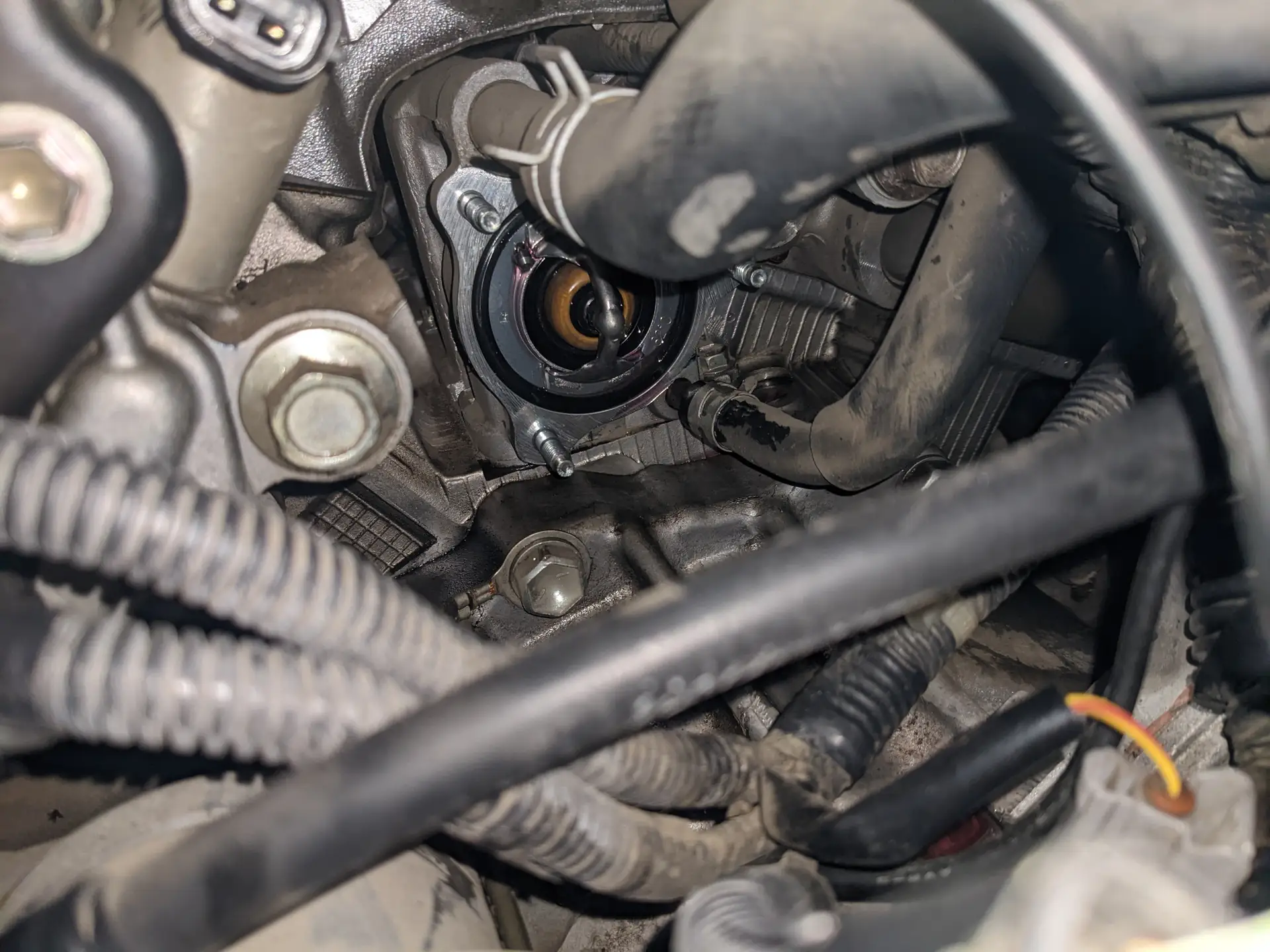
“Over years of experience, I have seen hundreds of P0128 cases, and in most instances, the cause is the thermostat stuck in the open position. However, it is crucial to understand not just what failed, but why the PCM recorded this specific fault. Let’s analyze how the control module makes this decision and what to do about it.”
– Daniel Brooks, DecodeAuto
Page contents
Quick answer: what to do if P0128 appears
If the P0128 code appears on the dashboard, follow this procedure:
- Check the coolant level in the expansion tank with a cold engine. Top up with manufacturer-recommended coolant if necessary.
- Warm up the vehicle and carefully feel the upper and lower radiator hoses. If both quickly become warm, the thermostat is likely stuck open.
- Connect an OBD-II scanner and read data: engine coolant temperature (ECT), intake air temperature (IAT), vehicle speed, engine run time, and Freeze Frame (the moment the fault was recorded).
- Replace the thermostat if diagnostics indicate it. If ECT readings are abnormal, check the temperature sensor and its wiring.
- Clear the code with the scanner and perform a test drive until the engine reaches operating temperature.
Important safety information: Always wait for the engine to cool down before working on the cooling system. Hot coolant is pressurized and can cause severe burns. Do not open the radiator cap or expansion tank cap on a warm engine. Antifreeze is toxic—avoid skin and mucous membrane contact and wear gloves. Dispose of used coolant according to local regulations—do not pour it into drains or onto the ground.
Note: The P0128 code indicates the engine is not reaching the target temperature within the specified time. It is an informational alert about a temperature regulation issue, not a direct indication of a faulty part. The diagnostic task is to identify the cause of the condition.
What is the P0128 code and how is this DTC interpreted?
The P0128 code stands for “Coolant Thermostat (Coolant Temperature Below Thermostat Regulating Temperature)”—meaning the coolant temperature is below the thermostat’s regulating temperature. Simply put, the PCM has detected that the engine is warming up too slowly and does not reach the expected operating temperature within the set time.
How does the PCM generate this code?
The powertrain control module continuously monitors coolant temperature via the ECT (Engine Coolant Temperature) sensor. It takes into account several parameters:
- IAT (Intake Air Temperature) at startup;
- Engine run time since cold start;
- Vehicle speed and engine load;
- A reference warm-up curve programmed into the PCM for the specific engine.
If the ECT sensor shows a temperature below the thermostat opening threshold (usually around 190–203°F (88–95°C), depending on engine calibration) after a certain time post-start under normal driving conditions, the PCM compares the actual temperature rise with the reference. If there is a deviation, the code is set—typically after two consecutive warm-up cycles with repeated conditions.
Important clarification: distinguish between the thermostat opening temperature (usually 180–190°F (82–88°C)) and the regulated target engine temperature (around 194–203°F (90–95°C)). The first is when the thermostat valve begins to allow coolant flow to the radiator. The second is the operating temperature the PCM expects within a given time. Thresholds depend on manufacturer calibrations. Check exact values in the OEM manual for your engine model.
Technical note: according to the SAE J1979 standard, the PCM analyzes PIDs (Parameter IDs) for ECT and IAT, as well as system readiness time. If the temperature does not reach the calibrated threshold within the specified time, DTC P0128 is generated.
Key point: P0128 is not a verdict on a specific component. It is information about a temperature regulation issue. The PCM is indicating that coolant temperature is not rising as expected. The diagnostic goal is to find the cause of this condition.
Summary: P0128 is set when the PCM detects the engine warms up slower than the reference curve programmed in the calibrations. In most cases, the cause is a thermostat stuck open.
Relation to electronically controlled thermostats
Some modern vehicles (BMW, VAG, and others) are equipped with electronically controlled or heated thermostats (MAP-controlled). These systems allow the PCM to actively regulate the valve opening timing depending on conditions. Faults in the heater circuit or control signal can trigger related codes such as P0597 (low thermostat control voltage), P0598 (high voltage), or P0599 (control circuit open).
How to diagnose: check power supply to the thermostat heater with a multimeter (usually 12 V with ignition on), verify the presence of a control signal from the PCM (typically PWM or constant voltage during cold start). Consult TSBs for your vehicle—for example, VAG often issues bulletins on thermostat calibrations.
Main symptoms and signs of P0128 fault code
P0128 rarely goes unnoticed—it manifests through characteristic symptoms that drivers observe during everyday use:
- Check Engine light illuminates steadily or intermittently. It may appear during cold start and turn off after warming up or stay on continuously.
- Temperature gauge needle rises slowly or remains below the midpoint even after 10–15 minutes of driving. The engine warms up slowly.
- Cabin heater provides weak or delayed heat. Warm air appears later than usual, especially noticeable during short winter trips.
- Increased fuel consumption—the PCM maintains a richer mixture longer until it confirms the engine is warmed up.
- Cooling fan sometimes runs continuously or activates more frequently due to incorrect temperature sensor data.
- Slight power loss and sluggish throttle response with a cold engine—especially noticeable before reaching the normal 194–203°F (90–95°C).
- OBD monitors remain “Not Ready”—some self-diagnostic systems do not complete test cycles due to improper warm-up. This can prevent passing emissions inspections, as diagnostic equipment requires all monitors to be ready for emissions evaluation.
Important note on the fan: if the radiator fan runs when the air conditioning is on, this is normal. Many control systems automatically activate the fan with A/C to cool the condenser. Do not consider this a fault. Only continuous fan operation at low engine temperature without A/C is suspicious.
Tip: if you notice the engine warms up slowly and the heater blows cool air, connect a scanner and check for fault codes. P0128 often “hides” behind these everyday symptoms.
Summary: Key symptoms—Check Engine light, slow warm-up, weak cabin heating, and temperature gauge below normal. During short winter trips, the engine may not reach operating temperature, affecting comfort and efficiency.
How serious is the P0128 fault and can you continue driving?
The severity of P0128 is moderate. Driving with this code is possible, but ignoring it is risky.
Short-term risks
In the first days or weeks after the code appears, significant engine damage usually does not occur. The vehicle starts, runs, and drives. However:
- Increased fuel consumption will become constant—the PCM enriches the mixture to compensate for the “cold” mode.
- Uncomfortable operation in winter—the heater does not warm properly, windows fog up, and the cabin remains cool.
Long-term risks
Prolonged engine operation at low temperatures (below 176–194°F (80–90°C)) leads to serious consequences:
- Accelerated wear of components. Engine oil thickens at low temperature, loses flowability, and lubricates less effectively. This increases wear on piston rings, bearings, and camshafts.
- Deposits and carbon buildup. Fuel burns inefficiently, forming resinous deposits on valves, pistons, and spark plugs.
- Risk of overheating in the future. If P0128 is caused by low coolant level or air pockets, over time this may lead to localized overheating and head gasket damage.
When is urgent repair needed?
Immediately visit a repair shop if:
- Coolant level drops rapidly—there is a leak.
- Temperature fluctuates sharply between low and high—risk of overheating.
- Related codes P0115–P0119 (ECT sensor fault) or P0125 (temperature below closed loop threshold) appear.
Conclusion: driving is possible but not for long. Address the cause promptly to avoid serious consequences.
Summary: Short-term—discomfort and increased fuel consumption; long-term—engine wear, deposits, and overheating risk. Do not delay repairs.
Main causes of P0128 code
Let’s review the primary causes that trigger P0128. Each has its own diagnostic profile and testing method.
Faulty thermostat (stuck open)
This is the most common cause. The thermostat is a valve regulating coolant flow between the short and long circulation loops. When closed (cold engine), coolant circulates only inside the engine block, accelerating warm-up. When temperature reaches 180–190°F (82–88°C), the thermostat opens and allows coolant through the radiator.
If the thermostat is stuck open, coolant constantly flows through the long loop including the radiator. The engine warms up slowly, especially at idle and highway driving. The PCM sees the temperature rising too slowly and sets P0128.
How to check the thermostat without removal:
- Start a cold engine.
- Feel the upper radiator hose (from thermostat to radiator) and the lower hose (return from radiator).
- Normally, the upper hose remains cold for the first 5–7 minutes while the thermostat is closed. The lower hose is also cold.
- If the upper hose heats up quickly along with the lower hose, the thermostat is open from the start and faulty.
Faulty intake air temperature sensor (IAT)
The IAT sensor measures intake air temperature. The PCM uses this data to calculate the expected engine warm-up curve. If the IAT shows lower values (e.g., during cold start the sensor “sees” 5°F instead of actual 41°F (-15°C instead of +5°C)), the PCM may assume the engine should warm up slower than it actually does. Conversely, elevated IAT readings cause the PCM to expect faster warm-up than occurs, triggering P0128.
How to check:
- Connect an OBD scanner and compare IAT readings with actual outside temperature during a cold start (engine off for at least 2 hours).
- A discrepancy greater than ±18°F (10°C) indicates a sensor or wiring issue.
- Inspect the IAT sensor connector for corrosion, moisture, or wire damage.
- Measure sensor resistance with a multimeter at different temperatures and compare with reference values from the manual. Typically, at room temperature (68°F (20°C)), IAT resistance is about 2–3 kΩ (similar to ECT).
Note: IAT faults rarely cause P0128 alone. They usually exacerbate existing thermostat or ECT issues. If codes related to IAT (e.g., P0110–P0113) appear simultaneously, diagnose them first.
Low coolant level or poor coolant quality
Low coolant level disrupts heat exchange and creates air pockets in the cooling system. If air reaches the ECT sensor, it shows lower temperatures—the PCM interprets the engine as colder than it really is.
Causes of low level:
- Leaks through hoses, clamps, radiator, water pump, or head gasket.
- Evaporation due to past overheating.
- Natural evaporation with a faulty expansion tank cap.
Old or inappropriate coolant (e.g., mixing different types G11/G12/G13 or dilution with water) can reduce heat transfer efficiency. The fluid absorbs heat from the engine less effectively, slowing warm-up.
How to check:
- Inspect coolant level in the expansion tank with a cold engine. Level should be between MIN and MAX marks.
- Check coolant color and condition. Cloudy, rusty, or uneven fluid indicates contamination.
- Inspect hoses, clamps, and radiator for leaks or dried coolant traces.
Faulty coolant temperature sensor (ECT)
The temperature sensor is a variable resistor (thermistor) whose resistance changes with temperature. The PCM supplies a 5 V reference voltage and calculates temperature from the returned signal.
ECT sensor faults:
- Thermistor degradation—resistance does not match actual temperature.
- Corroded sensor connector contacts—signal distortion.
- Broken or shorted wiring between sensor and PCM.
If the sensor gives a falsely low reading, the PCM sets P0128 even if the engine warms normally.
How to check the ECT sensor:
- Locate the sensor (usually on or near the thermostat housing).
- Disconnect the sensor connector.
- Measure resistance between sensor terminals at different temperatures:
- At room temperature (~68°F (20°C)): typically 2000–3000 Ω.
- At operating temperature (~194°F (90°C)): typically 200–300 Ω (check after warming up).
- Compare readings with reference values from your vehicle’s repair manual. Note: exact resistance depends on sensor type and manufacturer. Use only OEM manual data for your model.
Attention: if codes P0115, P0116, P0117, P0118, or P0119 appear alongside P0128, diagnose those first. They indicate electrical faults in the ECT sensor circuit.
Cooling fan issues (continuous operation)
The radiator fan is designed to provide forced cooling at high temperatures (usually activates at 203–212°F (95–100°C)). If the fan runs continuously or turns on too early, it overcools the radiator and prevents the engine from reaching operating temperature.
Causes of continuous fan operation:
- Stuck fan relay.
- Short circuit in the fan control circuit.
- Faulty fan control module (if electronic).
How to check:
- Start a cold engine.
- Listen—fan should not run below 194°F (90°C).
- If the fan runs immediately, check the fan relay and wiring.
Important note: the fan may run when the air conditioning is on even with a cold engine—this is normal system operation to cool the A/C condenser. Do not mistake this for a fault.
Summary table: P0128 causes and quick fixes
| Component | Main symptom | Testing method | Fix method |
|---|---|---|---|
| Thermostat | Both radiator hoses heat up quickly | Feel hoses during warm-up | Replace thermostat |
| IAT sensor | IAT differs from outside temperature by >18°F (10°C) | Compare scanner readings with actual temperature | Check connector/wiring, replace sensor |
| Coolant | Low level, leaks, cloudy color | Inspect tank and system for leaks | Top up or replace coolant, fix leaks |
| ECT sensor | Incorrect temperature readings, codes P0115–P0119 | Measure resistance with multimeter (see OEM manual) | Replace sensor, repair wiring |
| Fan | Runs continuously at low temperature without A/C | Check operation on cold start | Replace relay, repair control circuit |
Summary: Thermostat stuck open is the cause in most cases. Low coolant level, faulty ECT sensor, or continuously running fan are less common but important factors.
Step-by-step diagnosis to pinpoint the cause of P0128
Diagnosing P0128 involves sequential checks of the cooling system and PCM data. Follow all steps in order to accurately identify the fault.
Step 1: Visual inspection of the cooling system
Start with a basic check:
- Coolant level—open the hood with a cold engine and check the expansion tank level. It should be between MIN and MAX marks.
- Signs of leaks—inspect hoses, clamps, radiator, water pump, and thermostat housing. Look for drips and white residue (dried coolant).
- Condition of hoses—feel for cracks, bulges, or soft spots.
- Radiator/expansion tank cap—ensure it is tightly closed and the valve functions (should hold pressure).
If leaks or low level are found, fix these issues before further diagnostics.
Step 2: Reading data with an OBD-II scanner
Connect a diagnostic scanner (ELM327 or similar) and perform the following:
- Read the P0128 code and check for other codes (especially P0115–P0119, P0125, P0126).
- Freeze Frame—review data at the moment the fault was recorded:
- ECT temperature.
- IAT temperature.
- Vehicle speed.
- Engine run time.
- Real-time parameter monitoring—start the engine and observe:
- ECT—temperature should rise smoothly from 68–86°F (20–30°C) to 194–203°F (90–95°C) (exact thresholds depend on your engine calibration; see OEM manual).
- IAT—intake air temperature (for comparison).
- Warm-up speed—compare with your vehicle’s normal pattern.
If ECT rises too slowly or stalls around 158–176°F (70–80°C), the problem lies with the thermostat or coolant circulation.
Step 3: Thermostat check by touch
Warm up the engine and check hoses:
- Start a cold engine.
- Place your hand on the upper radiator hose (from thermostat to radiator). Normally, it stays cold for the first 5–7 minutes.
- When ECT reaches the thermostat opening threshold (usually 180–190°F (82–88°C)), the upper hose should suddenly warm up—this indicates thermostat opening.
- If the upper hose heats immediately along with the lower hose, the thermostat is stuck open.
Alternative method: use a non-contact IR thermometer for precise hose temperature measurement.
Step 4: Check ECT sensor and wiring
If the thermostat is fine, check the sensor:
- Disconnect the ECT sensor connector (engine off).
- Measure resistance between sensor terminals at room temperature. Note: values depend on model. Typically, at ~68°F (20°C) resistance is 2000–3000 Ω; verify with your OEM manual.
- Check PCM reference voltage at the sensor connector (should be about 5 V with ignition on).
- Inspect wiring—check continuity from sensor to PCM, connector condition, and absence of corrosion.
- Check sensor ground—resistance between ground terminal and battery negative should be under 5 Ω.
If sensor resistance is out of range or wiring has opens/shorts, replace the sensor or repair the circuit.
Step 5: Additional checks
If previous steps did not reveal the problem:
- Check the fan—start a cold engine and ensure the fan does not run before 194–203°F (90–95°C) (with A/C off). If it does, check the relay and control circuit.
- Bleed air pockets—bleed the cooling system via the air release valve (if present) or the highest point in the system.
- Check the water pump—ensure coolant circulates properly. A faulty pump disrupts circulation and causes uneven warm-up.
Summary: Diagnosis includes coolant level inspection, Freeze Frame reading, hose check, ECT sensor and wiring test. The key point is to rule out the thermostat as the primary cause.
How to fix P0128: repairs and component replacement
After diagnosis, proceed to repairs. Let’s review typical procedures for each cause.
Thermostat replacement
Thermostat replacement is the most common operation for P0128. Procedure for a 4-cylinder engine (typical):
Tools and materials:
- New thermostat with manufacturer-recommended opening temperature (usually 180–190°F (82–88°C)).
- New thermostat housing gasket (or sealant per manufacturer specs).
- Coolant (for topping up after replacement).
- Wrenches (sizes depend on vehicle model).
- Container for draining coolant.
Steps:
- Drain coolant below thermostat level. Open radiator drain plug or disconnect lower hose.
- Remove thermostat housing—unscrew mounting bolts (usually 2–3). Note: torque specs depend on engine model. Refer to OEM manual. Do not use generic values—they may not suit your vehicle.
- Remove old thermostat and clean gasket surface.
- Install new thermostat—ensure correct orientation (usually marked with flow direction arrow).
- Install new gasket and tighten housing bolts in a crisscross pattern per OEM manual.
- Refill coolant and bleed air pockets (see below).
- Warm up engine to operating temperature, check for leaks and proper hose heating.
Important: use only thermostats with opening temperatures recommended by the manufacturer. Installing a thermostat with a different temperature may cause recurring faults or overheating.
Coolant: topping up, replacement, and air bleeding
Topping up coolant:
- Open expansion tank cap with a cold engine.
- Top up with manufacturer-recommended coolant to the MAX mark.
- Close cap and start engine.
Coolant replacement:
- Drain old coolant via radiator drain plug.
- Flush system with distilled water (run engine for 5–10 minutes, then drain).
- Fill with new coolant per OEM specification (G11, G12+, G13, etc.).
Air bleeding:
- Locate air release valve (usually on thermostat housing or upper hose).
- Open valve and start engine. Top up coolant in the tank until fluid flows from valve without bubbles.
- Close valve, warm engine to 194°F (90°C), and check level stabilization.
Note: vacuum coolant filling systems (e.g., Mityvac MV8500) speed up bleeding and reduce air entrapment risk. Gravity filling requires careful attention—monitor even heating of all hoses and radiator.
Replacing the temperature sensor (ECT)
If diagnostics indicate sensor failure:
- Disconnect battery negative terminal (to avoid short circuits).
- Drain coolant below sensor level.
- Disconnect sensor connector and unscrew sensor (usually 19 mm wrench).
- Clean threads and apply a thin layer of heat-resistant sealant if recommended.
- Install new sensor and tighten per OEM specs (usually 11–18 lb-ft (15–25 Nm); verify in the manual).
- Reconnect connector, refill coolant, and start engine.
- Check real-time ECT readings with scanner—they should match actual temperature.
Repairing ECT/fan wiring and connectors
If opens, shorts, or corrosion are found:
- Inspect wiring harness from sensor to PCM. Locate the damaged section.
- Clean connector contacts of corrosion (use contact cleaner).
- Replace the damaged wiring section—solder and insulate with heat-shrink tubing.
- Check fan relay—replace if stuck.
Summary: Thermostat replacement is the main procedure; always bleed air after coolant refill. ECT and wiring checks require a multimeter and comparison with OEM reference values.
How to clear P0128 code after repair
After fixing the cause, clear the code from the PCM memory.
Method 1: OBD-II scanner (recommended)
- Connect the scanner to the diagnostic port.
- Select “Clear DTC” function.
- Confirm code clearing.
Method 2: Disconnect battery terminal
- Disconnect battery negative terminal for 5–10 minutes.
- Reconnect terminal.
Warning: this method resets all PCM adaptive memory values (throttle position, fuel trims, etc.) and also resets clock and radio settings.
Test drive after clearing:
- Start engine and warm it to 194–203°F (90–95°C).
- Drive for 15–20 minutes, including highway driving.
- Check with scanner if P0128 returns.
If the code does not reappear after 2–3 drives, the repair was successful.
Mini-guide on drive cycles and readiness monitors:
After clearing, the PCM must complete drive cycles for OBD readiness monitors. Check monitor status with a scanner. Full completion usually requires:
- Cold start (engine temperature close to ambient).
- Warm-up to operating temperature while driving.
- Steady-speed highway segment (37–50 mph (60–80 km/h)) for 5–10 minutes.
- Stops at traffic lights and idling.
If the thermostat monitor remains “Not Ready” after 2–3 cycles, the problem may not be fully resolved.
Summary: Clear the code with a scanner; manual battery reset clears all adaptive memory values. After repair, perform a test drive and verify OBD monitor readiness.
Common mistakes in diagnosing and repairing P0128
Avoid these typical errors to save time and money:
- Replacing the ECT sensor “blindly” without checking the thermostat first. Always check the thermostat first—it is the cause in most cases.
- Ignoring low coolant level. Check coolant level before replacing parts. Low level causes air pockets at the ECT sensor, leading to false readings.
- Installing a thermostat with incorrect opening temperature. Using a thermostat that does not match OEM specs can cause recurring faults or overheating. Verify opening temperature in the manufacturer’s manual.
- Neglecting air bleeding after topping up or replacing coolant. Air in the system disrupts heat transfer and causes incorrect temperature readings.
- Failing to warm up and monitor ECT parameters after repairs. Always warm the engine and verify temperature rise with a scanner after part replacement.
Summary: Do not replace the ECT sensor without checking the thermostat; check coolant level before repairs. Always bleed the system after coolant refill and monitor temperature with a scanner.
Cooling system maintenance and service schedule
To prevent P0128 recurrence, follow the maintenance schedule:
- Coolant replacement: intervals depend on model. Example for Hyundai Tucson: first change at 130,000 miles (210,000 km) or 120 months, subsequent changes every 18,600 miles (30,000 km) or 24 months. For most vehicles, every 3–5 years or 37,000–62,000 miles (60–100k km). Check exact intervals in the OEM manual or maintenance schedule. No universal numbers.
- Radiator/expansion tank cap inspection: check valve and seal condition every 18,600 miles (30,000 km). A faulty cap fails to hold pressure, accelerating coolant evaporation.
- Hose and clamp inspection: check for cracks, bulges, and leaks every 9,000–12,000 miles (15–20,000 km).
- Heater operation check: if cabin heating worsens, check coolant level and air pockets.
- Use correct coolant: only manufacturer-approved types (G11, G12+, G13, etc.). Mixing types is not recommended unless the manufacturer specifically approves it.
- Radiator cleaning: clean radiator fins from dirt, insects, and dust every 12,000–18,600 miles (20–30,000 km) to maintain heat dissipation.
| Component | Service interval | Operation |
|---|---|---|
| Coolant | 37,000–62,000 miles (60–100k km) / 3–5 years (model-dependent; check OEM manual) | Replacement |
| Radiator cap | 18,600 miles (30k km) | Valve inspection |
| Hoses and clamps | 9,000–12,000 miles (15–20k km) | Visual inspection |
| Thermostat | As needed (upon symptoms) | Replace if stuck |
| Radiator | 12,000–18,600 miles (20–30k km) | Clean fins |
Summary: Replace coolant per OEM schedule (usually 3–5 years or 37,000–62,000 miles (60–100k km)). Check coolant level, expansion tank cap, and hoses every 9,000–18,600 miles (15–30k km).
Seasonal and operational features (winter/summer, climate)
P0128 appears more often under certain climate conditions:
Winter (cold)
- Engine warms up longer due to low ambient temperature.
- “Borderline” thermostats (worn but not fully stuck) more often show defects in freezing weather.
- Use of radiator shutters or insulation is allowed only per manufacturer recommendation.
- Note: during short winter trips (less than 10–15 minutes), the engine may not reach full operating temperature even with a good thermostat. This is normal. But if the PCM sets P0128, the temperature is below the calibrated threshold even for cold conditions.
Summer (heat)
- Faulty fan or low coolant level cause unstable temperature more quickly.
- Overheating risk is higher in hot weather, especially if the system is already compromised by leaks or air pockets.
Important: low ambient temperature alone does not cause P0128. The code appears due to thermostat or sensor faults, or low coolant level. Cold weather only intensifies symptoms.
Interpretation for short winter trips:
During short cold trips (e.g., 3–6 miles (5–10 km) between home and work), the engine may not warm fully. This does not automatically trigger P0128—the PCM accounts for drive cycles and conditions. But if the thermostat is faulty, the code will set even under these conditions because the temperature deviation from the calibration curve is too large.
Summary: Symptoms are more pronounced in winter; the code sets if the thermostat is faulty or temperature is below the cold-condition threshold. In summer, overheating risk is higher with a faulty cooling system.
When to visit a repair shop: red flags
Stop self-diagnosis and consult professionals if:
- Rapid coolant loss—visible leaks under the vehicle, white smoke from the exhaust (sign of coolant entering the combustion chamber).
- Sharp temperature gauge fluctuations—temperature jumps between low and high. Risk of overheating and head gasket damage.
- Repeated P0128 immediately after reset and repair—the code returns after 1–2 drives. Possible more serious faults (clogged radiator, faulty water pump, PCM issues).
- Related fault codes: P0115–P0119 (ECT circuit fault), P0125 (temperature below closed loop threshold), P0126 (insufficient coolant temperature for stable operation).
Important: when P0125 and P0115–P0118 appear simultaneously, diagnose electrical faults in the ECT sensor circuit first (open/short circuit), as they can mimic P0128 symptoms.
Summary: Rapid coolant leaks, temperature spikes, code recurrence after repair, or related codes P0115–P0119/P0125 are reasons for immediate service. Simultaneous codes require priority diagnosis of ECT electrical issues.
Technical details for advanced users: how the PCM generates P0128
For those who want a deeper understanding of the PCM algorithm.
Calculation algorithm
The PCM uses a mathematical model to calculate expected coolant temperature:
- Initial parameters: at engine start, the PCM records IAT (e.g., 50°F (10°C)) and ECT (e.g., 54°F (12°C)—engine cooled to ambient temperature).
- Warm-up modeling: based on run time, vehicle speed, and air flow (MAF), the PCM calculates how fast ECT should rise.
- Thermostat threshold: for most engines, thermostat opening temperature is 180–190°F (82–88°C). The PCM expects that at speeds of 31–50 mph (50–80 km/h) and air flow ≥11 g/s, the engine will reach this threshold within a certain time (usually 10–20 minutes, depending on calibration).
- Error setting: if after the specified time ECT remains below the threshold (e.g., 167°F instead of expected 190°F (75°C instead of expected 88°C)), the PCM notes the deviation. If conditions repeat on the next trip, P0128 is stored and Check Engine is activated.
Data for analysis
During diagnostics, pay attention to:
- Freeze Frame—the moment the code was set. Check ECT, IAT, speed, and run time.
- PID ECT (Parameter ID 05)—current coolant temperature.
- PID IAT (Parameter ID 0F)—intake air temperature.
- Vehicle Speed (PID 0D)—vehicle speed at fault occurrence.
Example: if at IAT 41°F (5°C) and 37 mph (60 km/h), ECT after 20 minutes is 162°F instead of expected 190°F (72°C instead of expected 88°C), the PCM will set P0128.
Sources: SAE J1979 (OBD-II standard).
Summary: The PCM calculates expected temperature based on IAT, run time, and vehicle speed. If ECT is below threshold after calibrated time, P0128 is set.
Related materials
For deeper understanding, see other DecodeAuto materials:
- Related codes:
- P0125—Coolant temperature below closed loop threshold
- P0126—Insufficient coolant temperature for stable operation
- P0115–P0119—ECT sensor circuit faults
Disclaimer: Information is general and does not replace professional consultation. Repairs and diagnostics should be performed according to OEM manuals and local safety regulations.
Frequently asked questions
Can the P0128 code appear in winter due to severe frost?
No, frost itself does not cause P0128. The code occurs due to a stuck thermostat, a faulty ECT sensor, or low coolant level. However, in cold weather, symptoms become more noticeable: the heater works poorly, and the engine warms up slowly. If the thermostat is already worn, freezing weather can make the problem more noticeable.
Which thermostat and coolant should I choose?
Thermostat: use only a thermostat with the opening temperature recommended by the manufacturer (usually 180–190°F (82–88°C)). This information is indicated in the owner's manual or on the old thermostat. Coolant: use a fluid that meets the OEM specification (G11, G12, G12+, G12++, G13, etc.). Do not mix different types unless the manufacturer specifically approves it. Check the owner's manual or maintenance schedule.
Will the Check Engine light turn off by itself after repair?
Yes, if the cause is eliminated and the engine warms up normally. The Check Engine light will usually turn off automatically after 2–3 consecutive trips reaching an operating temperature of 194–203°F (90–95°C). However, it is recommended to reset the code manually with a scanner to ensure the code does not return.
How long is it safe to drive with P0128?
Short-term driving (a few days) will not cause critical damage, but prolonged operation (weeks or months) is risky. The engine runs in cold mode, which accelerates wear, worsens lubrication, and increases the risk of carbon buildup. Address the cause as soon as possible.
Why does the code appear more often in winter?
In winter, the engine warms up longer, and borderline faults (for example, a slightly worn thermostat) become more pronounced. If the thermostat opens slightly earlier than normal, in cold weather this leads to insufficient warm-up. In summer, such a defect may go unnoticed.
Will a radiator shutter help?
A shutter (or radiator insulation) can temporarily help in winter if the thermostat is functioning normally but the engine warms up slowly due to severe cold. However, this does not solve the problem of a stuck thermostat or a faulty sensor. Important: install the shutter only according to the manufacturer's recommendation to avoid the risk of overheating in summer or during prolonged engine operation.