

“P0455 is not a death sentence for parts but a signal of a loss of system integrity. Most often, the issue is resolved by checking the fuel cap and visually inspecting the hoses. The ECM does not guess the leak—it detects the inability to create a vacuum in the EVAP system. Understanding the test conditions helps distinguish a real fault from a false trigger.” – Daniel Brooks, DecodeAuto
Page contents
Short answer: what to do right now
This information is general and does not replace professional consultation.
Tighten the fuel cap until it clicks—this resolves many P0455 cases. Clear the OBD-II code with a scanner and drive 1–3 trips with the fuel level between 30–80%. If the Check Engine light returns, inspect the EVAP hoses and purge and vent valve connectors for cracks and disconnections. For precise leak detection, schedule a smoke test.
You can drive without risk to handling, but fuel consumption may slightly increase, a gasoline odor may appear, and you may fail an emissions inspection. Prolonged operation with a leak accelerates corrosion of EVAP components and can mask other codes.
What does code P0455 (DTC P0455) mean?
Code P0455 indicates that the ECM has detected a large leak in the evaporative emission control system (EVAP). The technical definition according to SAE J2012 (2016 edition) is “Evaporative Emission Control System Leak Detected (Gross Leak).” A large leak is generally considered equivalent to an opening larger than 0.040 in. (1 mm), where the control module cannot create or maintain a vacuum in the system.
How the EVAP system works and why P0455 occurs
The EVAP system captures gasoline vapors from the fuel tank and stores them in a charcoal canister. When the engine operates under certain conditions, the purge valve opens and directs vapors into the intake manifold for combustion. This prevents hydrocarbon (HC) emissions into the atmosphere and complies with EPA (40 CFR Part 86) standards.
The ECM performs a system leak test by closing the vent valve to seal the system, controlling the purge valve to create a vacuum, and measuring the pressure decay rate via the fuel tank pressure sensor (FTP sensor). If the pressure drops faster than the set threshold, the system records a large leak and stores P0455.
With a large leak, the system cannot maintain the required vacuum, so the ECM stores P0455 and turns on the Check Engine light.
SAE J2012 (2016 edition) defines the format and set of diagnostic trouble codes (DTCs) for OBD-II systems, including EVAP codes, and is equivalent to ISO 15031-6. SAE J1979-2 (2021) describes diagnostic services based on the UDS protocol (ISO 14229-1), using codes from J2012.
Main symptoms of code P0455
The Check Engine light is on—this is a constant and definitive symptom of P0455. Sometimes a gasoline smell is noticeable inside the cabin or near the vehicle, especially after parking in the sun when vapor pressure rises. In some cases, drivers notice a slight change in fuel consumption due to vapor leakage, and rarely, a rough idle. Vehicle handling usually remains unaffected—P0455 does not impact engine starting, power, or driving safety.
Typical symptoms include:
- Check Engine light on continuously (primary sign)
- Gasoline odor near the vehicle or inside the cabin (especially after parking)
- Minor fuel consumption changes in rare cases
- Refueling difficulties—fuel nozzle clicks off early due to excess pressure
- Rarely: rough idle or slight throttle response delay
Main causes of code P0455
Faulty or loose fuel cap
The fuel cap is the most common cause of P0455. Wear of the rubber seal, cracks in the cap body, or stripped threads compromise EVAP system integrity. Even if the cap is tightened, a hardened seal due to age and temperature can prevent vacuum retention.
Ensure the cap is tightened until it clicks (usually 2–3 clicks). During visual inspection, look for seal cracks, thread corrosion, or damage to the built-in pressure relief valve. Replace the cap at the first sign of defects—this is the simplest and most cost-effective solution.
Important: the cap must match your vehicle model in attachment type (internal/external thread or bayonet), diameter, insertion depth, and pressure valve design. Modern caps include inlet and outlet valves to regulate fuel vapor pressure. Using an incompatible cap can cause leaks, fuel tank damage, or EVAP system faults. It is best to use an original cap or a certified equivalent selected by OEM number or vehicle VIN.
Damage to EVAP hoses and pipes
EVAP hoses and pipes are prone to cracking from temperature fluctuations, vibration, and material aging. Tears, cracks, or loose clamp connections cause leaks detected by the ECM as P0455. Areas near the canister and vent valve are especially vulnerable due to heat exposure from the road and engine.
Any air leak in the line between the tank and canister breaks system integrity. A loose clamp is easily diagnosed manually—pressing the hose causes it to shift or rotate on the fitting.
Faulty purge valve
The purge valve is controlled by the ECM and opens to release fuel vapors from the canister into the intake manifold. If the valve sticks open, the system cannot create a vacuum during the leak test—the ECM stores a large leak code. Causes of sticking include contamination, mechanical wear, or solenoid failure.
The valve may also leak when closed due to seal ring damage or seat corrosion. In this case, fuel vapors continuously enter the intake, disrupting the air-fuel mixture and causing a rough idle.
To check the purge valve: measure solenoid resistance with a multimeter (typical values vary by model—refer to service information). Blow through the valve with a vacuum pump—it should not pass air when closed. Apply voltage to the terminals—you should hear a click and see the valve state change.
Faulty vent valve
The vent valve is a normally open solenoid that allows air into the canister during purge and closes to seal the system during EVAP testing. If the valve sticks open due to dirt or debris, the system cannot seal—the ECM cannot create a vacuum and stores P0455.
Common vent valve faults include sticking from dirt, an open circuit, or connector corrosion.
To check the valve: apply 12V to the terminals—you should hear a click and valve closure. Blow air through both directions with power off (valve open) and with power on (valve closed). Create a vacuum with a hand pump—the valve must hold vacuum when 12V is applied.
Charcoal canister damage
The charcoal canister can be damaged by mechanical impacts, corrosion, and liquid fuel intrusion. Cracks in the canister body or damaged pipes cause large leaks. Fuel entering the canister (for example, from overfilling the tank) damages the charcoal and breaks system integrity.
The canister is located under the vehicle, often near the rear wheel area or fuel tank, and is vulnerable to stone and curb impacts. Visual inspection may reveal dents, cracks, or corrosion on the body. Canister replacement is relatively costly.
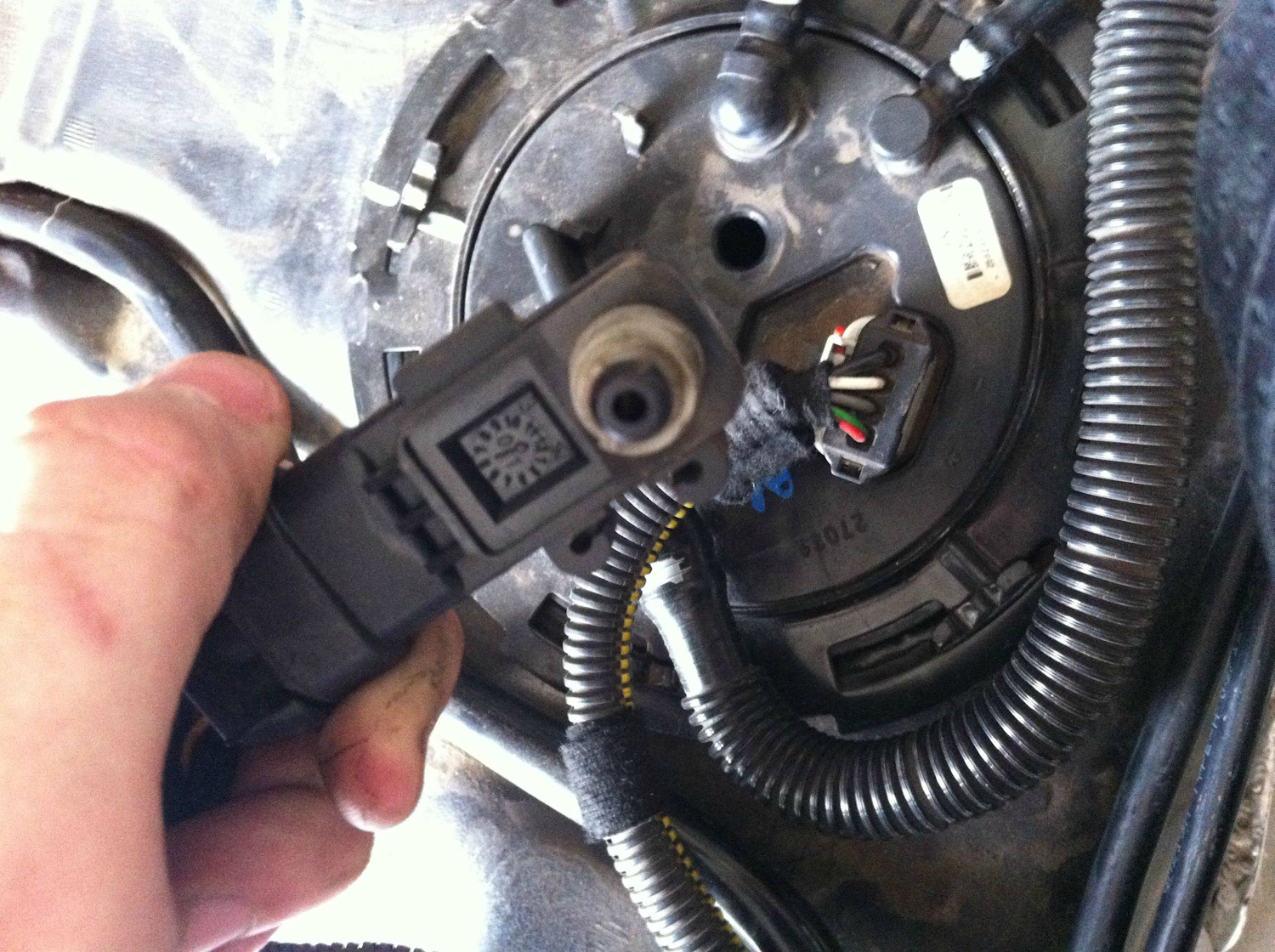
Fuel tank pressure sensor failure
The fuel tank pressure sensor (FTP sensor) measures pressure and vacuum in the EVAP system. If the sensor provides incorrect readings due to internal failure or contact oxidation, the ECM detects a pressure drop that does not exist. In this case, there is no real leak, but the ECM stores P0455 based on false data.
The sensor is located on the fuel tank or near the canister. Checking the FTP sensor includes multimeter testing and monitoring PID parameters via an OBD-II scanner. If sensor readings fluctuate or remain constant despite changing conditions, replace the sensor.
Step-by-step diagnosis of code P0455: how to find the leak
This information is general and does not replace professional consultation.
Step 1: Check the fuel cap
Inspect the cap for cracks, seal wear, and thread damage. Tighten the cap until it clicks (usually 2–3 clicks). If the seal is hardened or visible defects are present, replace the cap.
Step 2: Visual inspection of EVAP hoses and pipes
Inspect all visible EVAP hoses for cracks, tears, dry rot, and disconnections. Check clamps—tighten or replace if loose. Pay attention to areas near the canister, vent valve, and fuel tank. Look for fuel leaks or vapor stains.
Step 3: Read codes with an OBD-II scanner and check Freeze Frame data
Connect an OBD-II scanner, read codes, and check Freeze Frame data. Freeze Frame shows engine conditions at the time the code was recorded: RPM, load, coolant temperature, fuel level. This helps determine under what conditions the leak occurred.
Check EVAP readiness monitors. Clear the code and drive 1–3 full drive cycles with fuel level between 30–80% (required for EVAP test initiation). If the code returns, proceed to the next step.
Step 4: Check purge and vent valves
Check solenoid power and resistance with a multimeter (refer to your model’s service information). Blow through the valve by mouth or with a vacuum pump—it should not pass air when closed. Apply voltage to the terminals—you should hear a click and see the valve state change. Create a vacuum with a pump and check retention when 12V is applied to the vent valve.
Step 5: Smoke test (professional method)
If no leak is found visually, use an EVAP smoke machine. Connect the adapter to the EVAP service port (usually on the canister or vent tube). Introduce smoke at safe pressure (refer to the smoke machine manufacturer’s recommended pressure). Look for smoke escaping from hoses, connections, canister body, or fuel filler neck.
Step 6: System leak test
Evaluate the system’s ability to hold vacuum or pressure via FTP sensor readings through an OBD-II scanner. Close the vent valve and create vacuum—the system should hold it for at least 30–60 seconds. A pressure drop indicates a leak.
Step 7: After repair—clear codes and recheck
Replace faulty components, clear codes with a scanner, and drive several cycles to complete EVAP monitors. Ensure the code does not return.
How to fix code P0455 and reset the Check Engine light
Fixing P0455 depends on diagnostic results. If the cause is a faulty fuel cap, replace it with an original or certified equivalent matching your VIN and system pressure. Incorrect pressure valves or seals can cause the code to return.
If EVAP hoses are damaged, repair the section or replace the hose entirely. Use hoses designed for fuel vapors (marked EVAP or Fuel Vapor) with appropriate diameter and heat resistance. Tighten clamps or replace them with new ones.
Faulty purge and vent valves usually require replacement. Cleaning valves may provide temporary relief, but mechanical wear or seat corrosion requires replacement. When replacing, check connector cleanliness and wiring condition—contact oxidation can cause false codes.
If the canister is cracked, replace the unit. Repairing the canister body is not recommended, as fuel vapors can penetrate any seams. If liquid fuel has entered the canister, replacement is also necessary—the charcoal is damaged and no longer functions properly.
After repair, clear codes with an OBD-II scanner and drive 1–3 cycles to complete EVAP monitors. Keep fuel level between 30–80%—this is typically required for EVAP test initiation. If the code returns, repeat diagnostics—hidden leaks or sensor faults may be present.
| Cause | Action | Difficulty | Time |
|---|---|---|---|
| Fuel cap | Seal inspection, replacement | Low | 5–10 min |
| EVAP hoses/pipes | Repair/replacement, clamp tightening | Medium | 0.5–2 hr |
| Purge valve | Multimeter diagnosis, replacement | Medium | 0.5–1.5 hr |
| Vent valve | Vacuum test, replacement | Medium | 0.7–1.5 hr |
| Charcoal canister | Canister replacement | Medium–high | 1–3 hr |
| Pressure sensor (FTP) | Signal check, replacement | Medium | 0.5–1.5 hr |
| Fuel tank (crack) | Repair/replacement | High | 3–6 hr |
Is it safe to drive with code P0455?
This information is general and does not replace professional consultation.
Yes, short-term driving with P0455 is possible—the code rarely affects vehicle handling or driving safety. P0455 does not typically cause immediate problems with engine starting, power, or braking.
However, prolonged operation with an active leak carries risks. Gasoline odor inside the cabin or near the vehicle causes discomfort and may indicate a serious leak. Fuel consumption may slightly change due to vapor loss. Hydrocarbon (HC) emissions increase due to vapor leaks, polluting the environment and likely causing an emissions test failure in jurisdictions with emissions testing.
Long-term driving with a leak accelerates corrosion and contamination of EVAP components. Fuel vapors can settle on connectors and valves, causing contact oxidation. The leak may mask other fault codes, complicating diagnostics. It is recommended to fix P0455 within 1–2 weeks after detection.
Differences between P0455, P0456, and P0442
Codes P0455, P0456, and P0442 differ by the size of the detected EVAP system leak. P0455 indicates a large leak—generally equivalent to an opening larger than 0.040 in. (1 mm). P0456 means a very small leak—about 0.020 in. (0.5 mm). P0442 indicates a small to medium leak—equivalent to 0.028–0.040 in. (0.7–1 mm).
Practical diagnostic implication: P0455 is often detected by visual inspection or fuel cap check. P0456 and P0442 almost always require a smoke test, as microcracks and microleaks are not visible to the naked eye.
| Code | Leak size | Typical causes | Diagnostic approach |
|---|---|---|---|
| P0455 | Large leak (>1 mm) | Fuel cap, hose rupture, valve stuck open | Visual inspection, cap check |
| P0442 | Small/medium leak (0.7–1 mm) | Microcrack in cap/hose, purge valve | Visual inspection + smoke test |
| P0456 | Very small leak (0.5 mm) | Purge valve, microcracks, FTP sensor | Smoke test, vacuum test |
Common mistakes in diagnosing and repairing P0455
Replacing parts blindly without accurate diagnosis is the most frequent mistake. Vehicle owners replace the purge valve or canister based on assumptions without checking the fuel cap and hoses. This leads to unnecessary expense and code recurrence.
Ignoring the fuel cap as the root cause is the second most common mistake.
Skipping the smoke test after a clean visual inspection is the third mistake. Microcracks and hidden leaks are not visible to the eye. Without a smoke test, leak detection becomes guesswork.
Failing to check connectors and power supply to the valves and FTP sensor is another mistake. Contact oxidation can cause false codes, but owners rarely check connector cleanliness before replacing parts.
Premature conclusions with incomplete EVAP readiness monitors after code reset. Many clear the code and immediately go for inspection without waiting for readiness monitors to complete. The EVAP system is not ready—inspection fails even if the repair was done correctly.
Prevention: how to avoid repeated P0455
Do not overfill the fuel tank—stop at the first automatic nozzle shutoff. Overfilling increases vapor pressure and may cause liquid fuel to enter the canister, damaging the charcoal and causing leaks.
Monitor the condition of the fuel cap and seal. Inspect the seal every 6–12 months for cracks and hardening. Replace the cap if defects are visible—this prevents most P0455 cases.
Inspect visible EVAP hoses, connections, and clamps every 6–12 months. Look for cracks, dry rot, and fuel leaks. Clean valve and pressure sensor connectors to remove oxidation—this helps prevent false codes.
After off-road driving, curb impacts, or deep water crossings, check the canister and EVAP lines. The canister is located under the vehicle and is vulnerable to mechanical damage.
At the first sign of gasoline odor inside the cabin or near the vehicle, perform a visual inspection of the EVAP system. Early diagnosis prevents major leaks and costly repairs.
Tools and parts for EVAP diagnosis/repair
| Tool/part | Purpose | Safety note |
|---|---|---|
| OBD-II scanner with active tests | Read codes, Freeze Frame, valve control | Do not disconnect the battery while the scanner is operating |
| EVAP smoke machine | Leak detection under pressure | Use safe pressure according to manufacturer instructions |
| Vacuum/hand pump | Check purge/vent valve sealing | Follow manufacturer vacuum recommendations |
| Multimeter | Check solenoid resistance and FTP signal | Disconnect power before testing |
| Original fuel cap | Replacement for worn seal | Select by VIN or OEM number |
| EVAP hoses, clamps | Replace damaged sections | Use hoses marked Fuel Vapor |
| Purge/vent valve | Replacement if faulty | Select by VIN |
| Charcoal canister | Replacement for cracks or fuel intrusion | Do not repair—replace only |
| Fuel tank pressure sensor (FTP) | Replacement for false readings | Check signal before replacement |
“In EVAP diagnostic work, beginners often skip the simple fuel cap check and immediately go for valves. This leads to unnecessary expense and code recurrence. My advice is to always start with the cap and hoses, then move to valves and canister.” – Daniel Brooks, DecodeAuto
This content is for educational purposes only, does not replace a professional inspection, and is not a repair manual.
Frequently asked questions
How to reset the P0455 code after repair?
Connect an OBD-II scanner, select the "Clear Codes" or "Erase DTCs" function, and confirm the clearing. Then drive 1–3 complete drive cycles (cold start, city, highway) with a fuel level of 30–80% to complete the EVAP readiness monitors. Check the monitor status with the scanner—EVAP should be "Ready" before inspection. Disconnecting the battery terminal for 10–15 minutes can also clear codes but erases all ECM adaptations (idle speed, fuel trim, readiness monitors). This method is not recommended unless absolutely necessary, as it requires relearning systems and completing all monitor cycles.
What is the difference between codes P0455, P0456, and P0442?
The difference lies in the size of the detected leak. P0455 indicates a large leak (>1 mm), P0442 a small/medium leak (0.7–1 mm), and P0456 a very small leak (0.5 mm). Diagnostic approaches differ: P0455 is often identified by visual inspection and checking the gas cap; P0456 and P0442 almost always require a smoke test to locate microleaks.
Will any gas cap fit?
No, the gas cap must match your vehicle model in mounting type (internal/external thread or bayonet), diameter, insertion depth into the filler neck, and excess pressure valve design. An incorrect cap compromises sealing and causes repeated P0455 codes. Modern caps contain intake and exhaust valves to regulate fuel vapor pressure. Using an incompatible cap can lead to leaks, fuel tank damage, or EVAP system faults. It is better to use an original cap or a certified equivalent selected by OEM number or vehicle VIN.
Can the P0455 code appear due to poor-quality fuel?
Indirectly—yes. Overfilling the tank "to the brim" or foamy gasoline can cause liquid fuel to enter the charcoal canister, damaging the charcoal and compromising the seal. Fuel quality itself (octane rating, impurities) is rarely the primary cause of P0455 but can worsen the problem if a leak exists. Filling only to the first automatic shutoff is an important preventive measure. Adding fuel after shutoff increases the risk of fuel entering the canister and can cause premature canister failure.
Why did the P0455 code return after replacing the gas cap?
If the code returned after replacing the cap, possible reasons include: the cap does not match your vehicle model in valve design; a leak in another component (hoses, purge/vent valves, canister); or a faulty fuel tank pressure (FTP) sensor giving false readings. Perform step-by-step diagnostics: inspect hoses, test valves with a multimeter and vacuum pump, and use a smoke machine to find hidden leaks.
How can you tell if the FTP sensor is giving false readings?
Connect an OBD-II scanner with PID monitoring and observe the fuel tank pressure sensor readings in real time. If readings fluctuate without an obvious reason, remain constant despite changing conditions (for example, opening/closing the gas cap or activating the purge valve), or go beyond the typical range, the sensor may be faulty. Also check the sensor connector for corrosion and contact oxidation.