

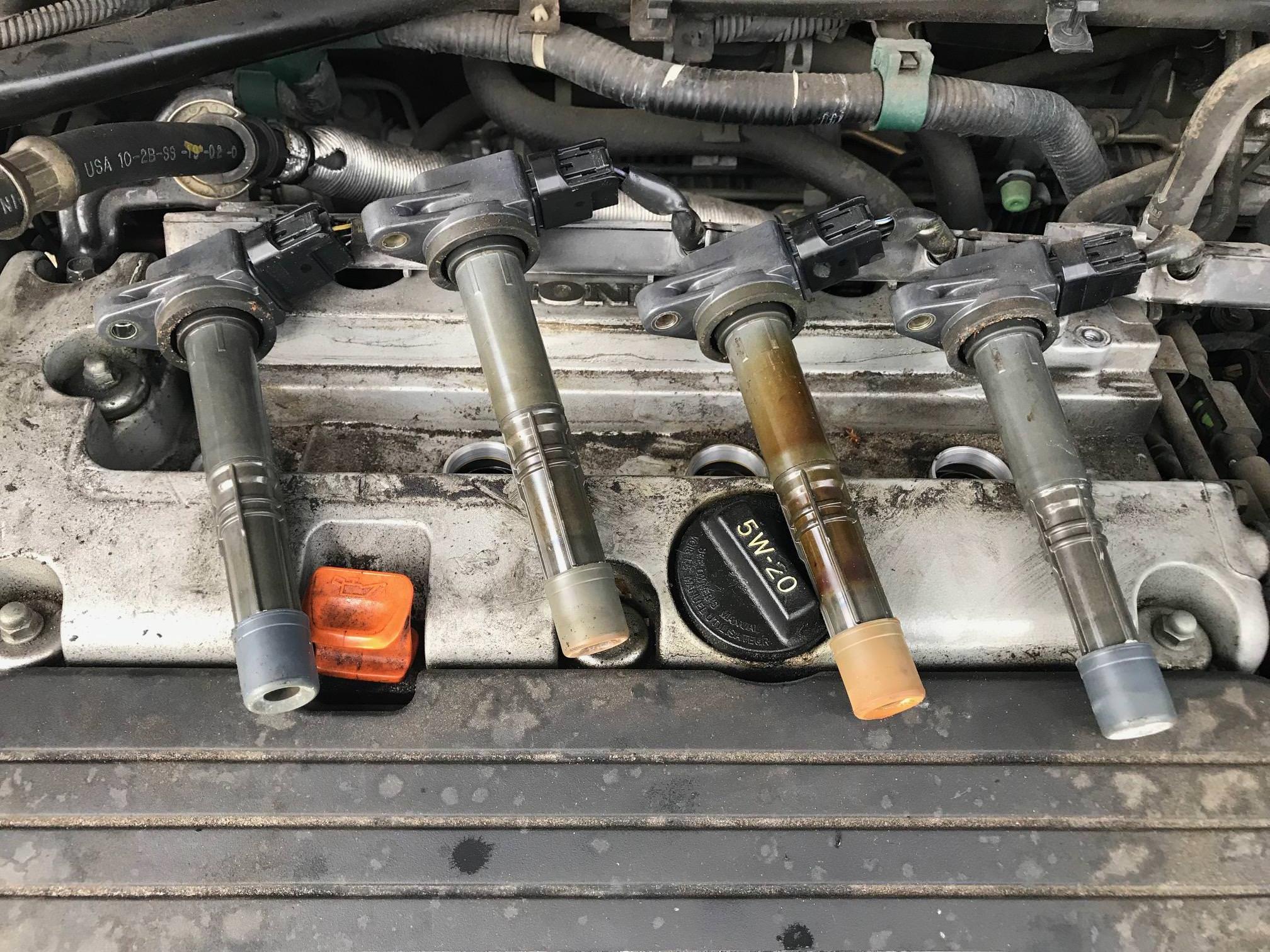
Code P0304 indicates that the ECM has detected misfires in the fourth cylinder — the air-fuel mixture ignited improperly or did not ignite at all. If the Check Engine light is flashing, immediately reduce speed and stop to avoid damaging the catalytic converter in a single trip. If the light is steady, get to a repair shop without heavy loads. The main culprits are: spark plug/coil, injector/fuel, mechanical issues (compression/valves), and air leaks. Diagnosis: swap the coil from cylinder 4 to another cylinder — if the code moves, the coil is faulty. Compression and leak-down tests reveal mechanical problems. Do not clear the code before recording the Freeze Frame data, or you will lose the conditions under which the code occurred. Costs: spark plug $5–20, coil $50–150, injector $150–400, cylinder head overhaul $800–2000. Ignoring the issue can damage the catalytic converter ($500–1500) and the engine.
Error P0304 is a diagnostic trouble code (DTC) indicating that the engine control module (ECM) has detected misfires in the fourth cylinder. Simply put, the ECM has detected that the mixture in this cylinder ignited improperly or not at all and stored this information. As a result, the Check Engine light turns on — sometimes steady, sometimes flashing if misfires are currently active.
“P0304 is not a verdict but information. The ECM is indicating: ‘I see a problem in cylinder 4, address it.’ The key is to understand what exactly went wrong before replacing parts blindly.” – Daniel Brooks, DecodeAuto
The P0304 code belongs to the P030X group (P0300–P0306). P0300 indicates random or multiple misfires without cylinder specificity, while codes P0301–P0306 point to misfires in cylinders 1 through 6 respectively. If the scanner shows P0304, the ECM has determined the issue is localized in the engine’s fourth cylinder.
It is important to understand that a misfire is an event where the crankshaft does not receive the expected acceleration from that cylinder. The ECM monitors crankshaft speed variation (via the crankshaft position sensor, CKP) and compares cycles. When the acceleration from cylinder 4 deviates from normal, the ECM logs a misfire. If enough such events accumulate, the code is stored and the Check Engine light illuminates.
“The misfire detection mechanism is based on monitoring crankshaft rotational irregularities. When a cylinder misses a combustion stroke, the crankshaft loses acceleration impulse, which the ECM registers as deviation from the reference sequence.” – According to SAE J1979 (On-Board Diagnostics) standard
Page contents
Quick response: what to do right now
If you see P0304 on the scanner or the Check Engine light comes on, act according to the symptoms:
- Flashing Check Engine — immediately reduce speed, avoid sudden acceleration and heavy loads, and stop in a safe place. A flashing light means active misfires right now: unburned fuel enters the exhaust system, ignites, and overheats the catalytic converter to critical temperatures. This leads to costly catalytic converter repairs ($500–1500) and possible engine damage.
“A flashing Check Engine with P0304 warns that unburned fuel is entering the catalytic converter. Continuing to drive under heavy load often destroys the converter in one trip: ceramic honeycombs sinter and the converter fails internally.”
- Steady Check Engine but relatively stable engine operation — you can drive to a repair shop at low load and moderate speed. However, the longer you ignore the code, the higher the risk of secondary damage: oil dilution by fuel, increased cylinder wear, catalytic converter overheating.
- Engine misfires, strong vibration, gasoline smell from the exhaust — do not continue driving under load. Better call a tow truck or drive at low RPM to the nearest repair shop.
Basic inspection without tools (5 minutes):
- Open the hood, locate the ignition coil and spark plug well of the fourth cylinder (see below on how to find cylinder 4).
- Check if the coil connector is loose, and inspect for visible cracks, oil, or water in the spark plug well.
- Inspect vacuum hoses and intake pipes near the fourth cylinder — a disconnected or cracked hose can cause air leaks and misfires.
- If you have a scanner, read the codes and record the Freeze Frame data (conditions when the code appeared: RPM, temperature, load).
- Decide: if the Check Engine light is flashing and symptoms are critical — call a tow truck; if steady and symptoms are mild — drive slowly to a repair shop or perform basic diagnostics yourself (see “Diagnosis” section).
Safety disclaimer:
This information is general and does not replace consultation with a qualified specialist. Working on the engine requires safety precautions: turn off ignition before removing coils/plugs, avoid contact with hot parts, wear safety glasses when working with the fuel system.
How to find the fourth cylinder on the engine?
On inline engines (I4), cylinders are numbered sequentially from the timing drive (usually at the front of the engine where the belt or chain is). The order is 1-2-3-4 from front to back. The fourth cylinder is the last one, closer to the transmission.
On V-type engines (V6, V8), numbering depends on the manufacturer:
- GM/Chrysler (traditional RWD scheme): Odd cylinders (1-3-5-7) on the right bank (passenger side on most longitudinal rear-wheel-drive applications), even cylinders (2-4-6-8) on the left bank. Numbering in each bank is front to back. The fourth cylinder is on the left bank, second in order.
- Ford/Audi (sequential numbering by bank): Right bank (passenger side) cylinders 1-2-3-4, left bank 5-6-7-8. The fourth cylinder is the last on the right bank.
Tip: Check the diagram under the hood (sometimes there is a sticker with numbering) or the service manual for your vehicle’s VIN. If unsure, use the coil swap method: swap the coil from the suspect cylinder to another; if the code “moves” with the coil, the coil is faulty.
What does error P0304 mean: misfire in cylinder 4
Error P0304 stands for “Cylinder 4 Misfire Detected.” It means the engine control module (ECM) has detected misfires in the fourth cylinder according to engine numbering. The code breakdown:
- P – powertrain (engine/transmission);
- 0 – generic (universal OBD-II code);
- 3 – ignition/misfire system;
- 04 – cylinder number (4th).
When the ECM logs P0304, it means the mixture in cylinder 4 did not ignite properly over several combustion cycles. The ECM compares the crankshaft’s angular acceleration from each cylinder: during normal combustion, the crankshaft receives a sharp acceleration from expanding gases. If acceleration from cylinder 4 is missing or significantly weaker, the ECM registers a misfire.
The OBD-II standard defines the conditions for setting code P0304. The ECM accumulates misfire counters for each cylinder separately (Mode 6 misfire counters). If the number of misfires over a certain period exceeds a threshold, the code is stored and the Check Engine light turns on. When misfires are active (engine currently misfiring), the light flashes, warning of catalytic converter damage risk.
Important: P0304 does not indicate why the misfire occurred. The ECM sees the symptom — lack of normal crankshaft acceleration from cylinder 4 — but not the direct cause. It could be a weak spark, fuel shortage, low compression, air leak, or wiring issue. Diagnosis is needed to determine the exact cause.
How serious is error P0304 and can you keep driving?
Severity depends on how the error manifests: steady or flashing Check Engine light.
Flashing Check Engine — critical. It means misfires are happening right now while driving. Unburned fuel from cylinder 4 enters the exhaust system and ignites in the catalytic converter. The converter is not designed for such temperatures: its ceramic honeycombs overheat, sinter, and break down.
“Unburned fuel from misfires burns in the catalytic converter, heating it to critical temperatures. Ceramic honeycombs lose their ability to oxidize CO and hydrocarbons, causing irreversible degradation.”
Replacing the catalytic converter on most cars costs hundreds of dollars, sometimes exceeding $1500. Additionally, unburned fuel contaminates the oil (through cylinder walls), diluting it and accelerating wear of piston rings, bearings, and other engine parts.
Steady Check Engine — less critical but should not be ignored. It means the ECM recorded misfires in the past, but they may be rare or absent now. However, even rare misfires can cause damage: fuel burns incompletely, fuel consumption rises, power drops, and the catalytic converter gradually clogs. The longer you ignore the code, the higher the chance that the primary issue (e.g., weak coil) will lead to secondary problems (cylinder scoring, valve damage, catalytic converter failure).
Can you drive with P0304?
- If the Check Engine light is flashing — do not continue driving under load. Call a tow truck or drive at minimal RPM to the nearest repair shop.
- If the Check Engine light is steady and symptoms are mild (slight misfire, minor power loss) — you can drive to a repair shop but avoid sudden acceleration, high RPM, and long trips. The sooner you fix the cause, the lower the risk of secondary damage.
- If the engine misfires heavily, vibrates, smells of gasoline from the exhaust, or you hear backfires — better call a tow truck. These are signs of active misfires that can cause critical damage.
Prolonged driving with misfires risks costly cylinder head and catalytic converter repairs. In some cases, unburned fuel can cause scoring on cylinder walls or piston damage. Therefore, the earlier you start diagnostics, the better.
Symptoms of error P0304: how the fault manifests
Symptoms and signs of P0304 depend on the cause but usually include:
- Check Engine light on or flashing — the primary and most obvious symptom. Flashing means active misfires now; steady means misfires were recorded earlier.
- Engine misfires — uneven running with missed combustion strokes. Cylinder 4 does not provide normal crankshaft acceleration, causing vibration and rough operation.
- Rough idle — fluctuating RPM, engine shaking, possible stalling at traffic lights or during braking.
- Power loss, sluggish acceleration — engine runs on three cylinders (or cylinder 4 performs poorly), reducing power especially during acceleration and uphill.
- Increased fuel consumption — unburned fuel exits the exhaust, and the ECM compensates by adding fuel to other cylinders.
- Gasoline smell from the exhaust — unburned fuel smells like raw gasoline. If you carefully sniff the exhaust, the smell is sharp and fuel-like.
- Jerks during driving — engine stumbles when accelerating or maintaining speed.
- Vibration in the steering wheel and body — uneven cylinder operation causes stronger engine vibration transmitted to the steering and chassis, especially at idle.
- Possible backfires in the exhaust — unburned fuel ignites in the exhaust system, causing pops or loud bangs from the muffler.
- Fluctuating RPM — idle speed may fluctuate as the engine tries to stabilize but cylinder 4 prevents it.
Important: if symptoms appear only when cold (right after start) or only when hot (after warming up), this guides diagnostics. Cold symptoms often indicate condensation, air leaks, or a faulty spark plug; hot symptoms suggest coil overheating, sticking injector, or compression loss (see FAQ section).
Main causes of code P0304
Causes of P0304 can be divided into four main groups: ignition system, fuel system, mechanical engine faults, and electronics/sensors. According to practical data (AutoZone, 2023), ignition system accounts for about 70–80% of cases, fuel system 15–20%, mechanical and electronics 5–10%.
Ignition system
The most common culprits are the ignition coil and spark plug of the fourth cylinder. This is the leading cause of P0304, especially on cars with over 62,000 miles (100,000 km).
The ignition coil generates the high-voltage pulse that ignites the mixture in the cylinder. If the coil weakens or fails, the spark becomes weak or disappears entirely. This is especially noticeable under load: during acceleration or climbing, the coil fails to keep up, and the ECM logs misfires.
Signs of a faulty coil:
- Misfires worsen under load (acceleration, passing).
- Visually, the coil may have cracks or burn marks (white or black streaks on the casing).
- If the engine misfires constantly, the coil is likely completely failed.
The spark plug is a consumable part. Over time, electrodes wear, the gap increases, and deposits form. Incorrect gap (too large or small) worsens spark quality. A fouled or oil-soaked plug may not spark at all.
Signs of a faulty spark plug:
- Black soot (rich mixture, oil in combustion chamber).
- White or light gray deposits (lean mixture, overheating).
- Oil-soaked plug (oil enters chamber through rings or valve seals).
- Worn electrode, increased gap.
High-voltage wires (if present) may short to ground or have internal breaks. Worn or cracked insulation causes current loss, preventing spark delivery.
Oil or water in the spark plug well is a common issue on some engines (e.g., Hyundai/Kia with G4KD/G4FC engines). Oil leaks through a worn valve cover gasket, wetting the plug and coil, causing misfires.
Swap method for quick diagnosis:
If you suspect the coil or plug, the fastest check is swapping. Swap the coil from cylinder 4 with that of cylinder 1 (or another “healthy” cylinder). Clear codes with a scanner, drive a few miles (a few kilometers), and read codes again. If the code changes to P0301 (cylinder 1), the coil is faulty — the problem “moved” with the coil. If the code remains P0304, the coil is fine; look elsewhere.
You can similarly check the spark plug: swap the plug from cylinder 4 with that of cylinder 2 or 3. If the code migrates to P0302 or P0303, the plug is faulty.
“The swap method is a simple and reliable way to localize coil or plug faults without expensive equipment. If the code follows the part, it’s the culprit.” – Confirmed by practice (PartsGeek, 2024; YouTube ‘Causes and Fixes P0304’, 2023; Hot Shot’s Secret, 2024)
Fuel system
The fuel injector of the fourth cylinder may be clogged or sticking. The injector delivers fuel under pressure at a precise moment. If clogged, it sprays fuel poorly, resulting in a lean or uneven mixture. If stuck open, the mixture is rich, flooding the plug.
Signs of a faulty injector:
- Gasoline smell from the exhaust (rich mixture).
- Black soot on the fourth cylinder’s spark plug (injector leaking).
- Misfires under load when more fuel is needed (clogged injector can’t keep up).
How to check the injector:
- Cylinder balance test — some scanners can perform injector balance tests by sequentially disabling injectors and observing RPM changes. If disabling the fourth cylinder injector barely changes RPM, it is not working or contributing.
- Pulse check — use an oscilloscope or noid light to verify if the injector receives control signals. If signals are present but the injector doesn’t work, it is faulty.
- Acoustic “click test” — with ignition on (engine off), you can hear injector clicks when powered directly. No click indicates sticking or coil break.
- Ultrasonic cleaning — clogged injectors can be cleaned on a special ultrasonic bench. This is cheaper than replacement and often restores normal function.
Fuel pressure — low pressure in the fuel rail can cause misfires on all cylinders but sometimes manifests more in one (e.g., if cylinder 4 injector is slightly clogged and pressure is low, that cylinder’s mixture becomes lean first).
Check:
- Fuel pump — weak pump fails to maintain pressure, especially under load.
- Fuel filter — clogged filter reduces pressure.
- Fuel pressure regulator — faulty regulator may hold pressure too low or too high.
Fuel trims (Live Data) — modern scanners show Short Term Fuel Trim (STFT) and Long Term Fuel Trim (LTFT). If STFT/LTFT are strongly positive (e.g., above +10%), the ECM tries to compensate for a lean mixture by adding fuel. If negative, the mixture is rich, and the ECM reduces fuel. Analyzing trims helps determine if cylinder 4’s mixture is lean or rich and guides diagnostics.
| Symptom | Likely cause | Quick check |
|---|---|---|
| Misfires under load, lean mixture (STFT above +10%) | Clogged injector in cylinder 4 or low fuel pressure | Measure fuel rail pressure with gauge; perform injector balance test with scanner |
| Gasoline smell, black plug, rich mixture (STFT below -10%) | Injector leaking (stuck open) | Check injector resistance with multimeter; perform acoustic click test |
| Misfires at idle and under load, fuel pressure below spec | Weak fuel pump or clogged filter | Replace fuel filter; check pump performance |
Mechanical engine faults
Low compression in cylinder 4 is one of the most serious causes of P0304. Compression is the pressure created in the cylinder during the compression stroke. If compression is low, the mixture compresses poorly, and temperature and pressure are insufficient for proper ignition.
Causes of low compression:
- Worn piston rings — rings fail to seal the cylinder, gases leak into the crankcase.
- Burned valve — intake or exhaust valve does not close fully, compression escapes through the gap.
- Damaged cylinder head gasket — gasket between head and block is blown, compression leaks into adjacent cylinder or cooling system.
- Scoring on cylinder walls — mechanical damage (from overheating, debris, wear) reduces compression.
How to check compression:
- Compression gauge — a device screwed in place of the spark plug that shows cylinder pressure during starter cranking. Measure compression in all cylinders. If cylinder 4 is significantly lower (for example, 116 psi (8 bar) versus normal for that engine), there is a problem.
- Leak-down test — a more precise test. Compressed air is fed into the cylinder through the spark plug hole (piston at top dead center of compression stroke), and the percentage of air leakage is measured. Leakage above 10–15% may indicate poor compression. The location of hissing air helps identify the cause: hissing from exhaust — valve; from oil filler neck — rings; from adjacent cylinder — head gasket.
Timing system issues:
- Timing mark shift — if the timing chain or belt jumps one or two teeth, valve opening phases shift. This changes cylinder filling and combustion conditions. The ECM may log misfires even if all parts are physically intact.
- Camshaft or lifter wear — worn cam lobes cause valves to open partially or late, disrupting cylinder filling.
Tip: if misfires are constant across all engine modes (idle, load, cold, hot) and coil/plug swaps didn’t help, first check compression. Low compression indicates mechanical failure that coil replacement won’t fix.
Electronics and sensors
ECM problems are rare but possible. Sometimes the coil driver inside the ECM fails, and the coil does not receive a proper signal. This can be checked by connecting an oscilloscope to the coil control wire and inspecting the signal waveform.
Wiring and connectors — corroded, broken, or damaged wires between the ECM and coil/injector can cause misfires. Check the coil connector of cylinder 4 for corrosion or loose contacts. Perform a “wiggle test” — move the connector and wiring harness while the engine runs. If misfires appear or disappear, the problem is in the wiring.
The crankshaft position sensor (CKP) indirectly affects misfire detection. If the CKP signal is unstable, the ECM may misinterpret crankshaft acceleration and log false misfires (or miss real ones). However, a faulty CKP usually triggers codes P0335/P0336 (CKP signal missing or incorrect), not an isolated P0304.
Air leaks via EGR and PCV — the exhaust gas recirculation (EGR) system or positive crankcase ventilation (PCV) valve stuck partially open can lean out the mixture in a specific cylinder (near the EGR channel) or cause oil/air leaks. This is a rare but real cause of localized misfires.
Live Data and Mode 6 misfire counters — advanced scanners show misfire counters per cylinder in Mode 6 (SAE J1979 standard). These are data the ECM collects before triggering the DTC. You can see how many misfires were recorded in cylinder 4 over the last 1,000 revolutions or current trip. A high counter (e.g., 50 misfires per 1,000 revs with a threshold of 30) confirms P0304 and helps assess misfire frequency.
“Mode 6 in OBD-II provides non-continuous monitor data, including misfire counters per cylinder before exceeding the threshold that triggers the MIL (Check Engine). Cylinder 4 uses Component ID $04, showing misfires per 1000 revolutions.” – SAE J1979 standard (Denlors Tools blog, 2009; MOTOR Magazine, 2002)
ECM firmware updates — some manufacturers release technical service bulletins (TSB) with software updates to fix occasional false misfire codes. If all physical checks are clear but the code appears rarely without symptoms, check ECM firmware currency.
Diagnosing error P0304: how to find the cause yourself
Step-by-step diagnostic algorithm for P0304:
Step 1: Connect an OBD-II scanner and read codes
Connect the diagnostic scanner to the OBD-II port (usually under the steering column). Read all active and stored fault codes. If only P0304 appears, the problem is localized in cylinder 4. If additional codes appear (e.g., P0171 – lean mixture, P0420 – catalytic converter, P035X – coil circuits), record them as they may guide diagnostics.
Be sure to record Freeze Frame data — conditions when the ECM logged the code: engine RPM, coolant temperature, vehicle speed, engine load. Freeze Frame shows when misfires occurred: idle, acceleration, cold or hot engine. This is an important clue.
Step 2: Visual inspection of the ignition system
Open the hood, locate cylinder 4 (see “How to find cylinder 4” section). Inspect:
- Ignition coil — check for cracks, burn marks (white or black streaks), oil or water on the casing.
- Spark plug well — check for oil, water, or dirt. A “wet” well may indicate oil ingress through the valve cover gasket.
- Coil connector — ensure it fits tightly, no corrosion or oxidation on contacts.
- High-voltage wires (if present) — check for cracks, melting, or burn marks.
Step 3: Check the spark plug
Remove the spark plug from cylinder 4. Inspect it:
- Normal plug — light brown or gray deposits on the electrode, gap within specification (usually 0.031–0.043 in. (0.8–1.1 mm), check your engine’s specs).
- Black, oil-soaked plug — sign of rich mixture or oil in combustion chamber (worn rings, valve seals).
- White deposits — sign of lean mixture or overheating.
- Worn electrode, increased gap — plug has reached end of service life, replace it.
If the plug looks bad, replace it with a new one set to the correct gap. If the plug was the cause, misfires should stop.
Step 4: Coil swap test
If the plug is fine, next check the coil. Swap the coil from cylinder 4 with that of cylinder 1 (or another healthy cylinder). Procedure:
- Turn off ignition.
- Disconnect connectors from both coils.
- Remove mounting bolts (usually one bolt per coil).
- Swap coils: put the fourth cylinder coil on cylinder 1, and vice versa.
- Reconnect connectors, start the engine.
- Clear codes with scanner (important!), drive 6–9 miles (10–15 km).
- Read codes again.
Results:
- If the code changes to P0301 (cylinder 1), the coil is faulty — the problem “moved” with the coil. Replace the coil.
- If the code remains P0304, the coil is fine. The problem lies elsewhere (injector, compression, wiring).
You can similarly check the spark plug: swap the plug from cylinder 4 with that of cylinder 2 or 3, clear codes, drive, and read again. If the code migrates, the plug is faulty.
Step 5: Injector check
If coil and plug are fine, the next suspect is the injector.
Acoustic check: Disconnect the injector connector of cylinder 4, start the engine. If the engine runs as poorly or better (if the injector was flooding fuel), the injector is not contributing. If the engine runs worse, the injector is working.
Resistance check with multimeter: Measure injector coil resistance. Normal resistance varies by injector type and application; refer to your vehicle specs. Infinite resistance (open circuit) or near zero (short) means the injector is faulty.
Cylinder balance test: If the scanner supports injector balance, run the test. The scanner disables injectors sequentially and observes RPM changes. If disabling cylinder 4 injector barely changes RPM, it is not working or contributing.
Step 6: Compression measurement
If ignition and fuel are fine, check mechanical condition. Measure compression with a gauge in all cylinders. Normal values depend on the engine (see manufacturer manual). If cylinder 4 compression is significantly lower (for example, 116 psi (8 bar) versus 174 psi (12 bar) normal), this indicates mechanical failure (rings, valve, head gasket).
Leak-down test is recommended for precise diagnosis of low compression causes.
Step 7: Check for air leaks
Air leaks in the intake manifold can cause misfires, especially if near cylinder 4. Check with a smoke machine or the WD-40 method (carefully spray WD-40 or carb cleaner around intake manifold joints while engine runs; if RPM rises, there is a leak).
Inspect vacuum hoses and intake manifold gaskets, and the throttle body. Check EGR and PCV valves — they can also cause leaks.
Step 8: Live Data and Mode 6
Connect the scanner and review Live Data:
- Fuel trims (STFT/LTFT) — strong positive trims (above +10%) indicate lean mixture; negative (below -10%) indicate rich mixture.
- Misfire counters (Mode 6) — check misfire counts per cylinder over the last 1,000 revolutions. A high count for cylinder 4 confirms P0304.
Step 9: Wiring check
If previous steps found no issue, check wiring between the ECM and coil/injector of cylinder 4. Use a multimeter to check continuity and shorts. Perform a wiggle test — move the wiring harness while the engine runs; if misfires appear or disappear, wiring is faulty.
Step 10: Fix the identified cause and clear codes
After repair (coil/plug/injector replacement, compression restoration, intake sealing), clear codes with a scanner. Drive a learning cycle (usually 6–12 miles (10–20 km) in various modes), then read codes again. If P0304 does not return, the repair was successful.
Features and quick checks for popular brands
Some brands and engines have typical issues that commonly cause P0304. Knowing these can speed up diagnostics.
Hyundai/Kia (G4KD, G4FC and others)
Typical cause: Individual ignition coils often fail; oil frequently leaks into spark plug wells due to worn valve cover gaskets.
Quick check:
- Inspect the spark plug well of cylinder 4 for oil.
- If oil is present, replace the valve cover gasket and spark plug (oil-soaked plugs cannot be restored).
- Check spark plug gap — usually 0.039–0.043 in. (1.0–1.1 mm) for these engines.
- Ignition coils often fail after 50,000–62,000 miles (80–100k km); check by swapping.
TSB: Some Hyundai bulletins recommend ECM firmware updates to fix false misfires at idle (TSB numbers depend on year and model, check with dealer).
VAG (Volkswagen, Audi, Skoda – TSI/FSI engines)
Typical cause: Ignition coils fail under load; valve deposits (especially on direct injection FSI/TFSI engines) worsen misfires.
Quick check:
- Check ignition coil by swapping — original coils are more reliable than cheap aftermarket ones.
- Perform a borescope inspection of the intake valves — deposits reduce cylinder filling and cause misfires. Thick deposits require cleaning (mechanical or chemical).
- Check ECM firmware currency — VAG often releases updates for fuel adaptation and false misfire fixes.
TSB: For some TSI engines (e.g., EA888 Gen 1/2), bulletins exist for coil replacement with improved versions and ECM software updates. Check with the dealer.
Ford (Duratec, Ecoboost)
Typical cause: Coil ground and connector issues; sometimes the coil driver in the ECM fails.
Quick check:
- Inspect the coil connector of cylinder 4 — contacts may corrode.
- Inspect the wiring harness near the valve cover — on some engines (e.g., 5.4L V8), wires break due to vibration.
- Check Mode 6 misfire counters to see misfire frequency and conditions.
- If coil and plug are fine, check coil ground points — poor ground causes weak spark.
TSB: Ford released ECM firmware updates for some EcoBoost engines (e.g., 1.6L/2.0L) to fix false misfire detections due to ECM algorithm sensitivity.
Toyota
Typical cause: Denso ignition coils are reliable, but spark plugs are sensitive to gap. Incorrect gap or poor-quality plugs often cause misfires.
Quick check:
- Check spark plug gap of cylinder 4 — usually 0.039–0.043 in. (1.0–1.1 mm), but check your engine specs.
- Use OE or quality plugs (Denso, NGK). Cheap plugs wear quickly and cause misfires.
- Check for cold misfires — condensation in the intake or old fuel (water in fuel) can cause cold-start misfires that disappear after warming up.
TSB: For some models (e.g., Camry, RAV4 with 2AZ-FE engine), recommendations exist for improved plugs and coil checks after 62,000 miles (100k km).
| Brand/Engine | Typical cause of P0304 | Quick check | TSB number (if any) |
|---|---|---|---|
| Hyundai/Kia G4KD/G4FC | Oil in spark plug well, weak coil | Inspect well, coil swap, plug gap 0.039–0.043 in. (1.0–1.1 mm) | ECM firmware update TSB (check with dealer) |
| VAG TSI/FSI | Valve deposits, weak coil | Valve borescope inspection, coil swap, ECM update | TSB for EA888 Gen 1/2 coil replacement |
| Ford Duratec/Ecoboost | Ground wires, coil connectors, ECM driver | Mode 6, ground and connector check, wiring harness | ECM firmware update TSB for EcoBoost 1.6L/2.0L |
| Toyota 2AZ-FE and others | Spark plug gap, poor-quality plugs | Gap check (0.039–0.043 in. (1.0–1.1 mm)), OE Denso/NGK plugs | TSB for plug replacement after 62,000 miles (100k km) |
How to fix error P0304 and clear Check Engine
To fix P0304, act according to the identified cause:
Spark plug replacement
If the plug is worn, oil-soaked, or has incorrect gap, replace it. Set the gap according to specifications (usually 0.031–0.043 in. (0.8–1.1 mm), check manual). Use quality plugs (OE or trusted brands: Denso, NGK, Bosch).
Approximate cost: Plug $5–20 (depends on brand and type), DIY labor free, shop labor $20–50.
Work time: 10–30 minutes (depending on plug accessibility).
Ignition coil replacement
If the coil is faulty (confirmed by swap), replace it. Use OE or a quality aftermarket coil. Cheap coils may fail within a few thousand miles.
Approximate cost: Coil $50–150 (OE more expensive, aftermarket cheaper), labor $30–80 at a repair shop (DIY free).
Work time: 15–40 minutes (depending on coil accessibility).
Injector cleaning or replacement
If the injector is clogged, perform ultrasonic cleaning on a bench. If stuck or mechanically damaged, replace it.
Approximate cost: Injector cleaning $100–200 per set (usually all cleaned together), replacement $150–400 (OE more expensive), labor $50–100.
Work time: Cleaning 2–4 hours (including removal/installation), replacement 1–2 hours.
Intake manifold sealing repair
If air leaks are found (cracked hose, worn gasket), replace the gasket or hose.
Approximate cost: Intake manifold gasket $20–60, labor $100–300 (depends on engine design).
Work time: 2–5 hours (depends on engine layout).
Cylinder head repair or engine overhaul
If compression is low due to a burned valve, worn rings, or head gasket damage, cylinder head repair or engine overhaul is required.
Approximate cost: Head gasket replacement $300–800, valve job $400–1000, ring replacement $800–2000 (varies by region and engine complexity).
Work time: 1–3 days (depends on work scope).
Clearing the error after repair
After fixing the cause:
- Connect OBD-II scanner.
- Clear fault codes (Clear DTC).
- Drive 6–12 miles (10–20 km) in various modes (city, highway, idle, acceleration).
- Read codes again — if P0304 does not return, repair is successful.
Important: simply clearing the code without fixing the cause is useless — the Check Engine light will come back after a few engine cycles.
| Cause | Solution | Approximate cost (USD) | Work time |
|---|---|---|---|
| Worn spark plug | Replace plug with correct gap | $5–50 (part + labor) | 10–30 min |
| Faulty coil | Replace ignition coil | $50–230 (part + labor) | 15–40 min |
| Clogged injector | Cleaning on bench or replacement | $100–500 (cleaning/replacement + labor) | 1–4 hours |
| Low compression (valve/rings) | Cylinder head repair, ring replacement | $300–2000+ (depends on scope) | 1–3 days |
| Air leak | Replace intake gasket/hose | $20–360 (part + labor) | 2–5 hours |
Note: Prices are for the US market, 2026. May vary by region, vehicle brand, and service type.
Common mistakes in DIY diagnostics
1. Replacing parts “blindly” without confirmation
The most common mistake is buying a new coil/plug/injector and replacing it without verifying if it’s actually faulty. Result: money spent, code remains. Always use the swap method or measurements (multimeter, compression gauge) to confirm the culprit.
2. Ignoring compression and leak-down tests
If coil, plug, and injector are checked but the code persists, the next step is mechanical diagnosis. Many skip compression measurement and keep changing electrical parts, while the problem is a burned valve or worn rings. Compression measurement is inexpensive and quick, saving time and money.
3. Not checking for air leaks and vacuum hoses
Air leaks are a tricky cause: symptoms resemble ignition problems, but coil replacement doesn’t help. Visually inspect all hoses, gaskets, throttle body. Use a smoke machine or WD-40 method to detect leaks.
4. Using fuel additives instead of bench cleaning for clogged injectors
Fuel additives are preventive, not curative. If the injector is truly clogged or stuck, it needs ultrasonic bench cleaning or replacement. Don’t waste time on “miracle additives” if the problem is serious.
5. Clearing the code before identifying the cause
Freeze Frame data is stored in ECM memory only until codes are cleared. Clearing the code immediately loses important clues: at what RPM, temperature, and load misfires occurred. Record Freeze Frame before clearing.
6. Ignoring oil/water in the spark plug well
An oil-soaked or wet plug does not work properly, even if new. If oil is in the well, replace the valve cover gasket and dry the well before installing a new plug. If water is present, look for leaks.
7. Forgetting about ECM software updates and TSBs
Some misfire codes result from ECM algorithm sensitivity. Manufacturers may release firmware updates that fix false triggers. Check ECM software currency with an official dealer, especially if all physical checks are clear.
Prevention: how to avoid repeated P0304 errors
1. Follow maintenance schedules
Timely replacement of spark plugs (usually every 18,000–37,000 miles (30–60k km), see manual), air and fuel filters reduces misfire risk. A dirty air filter can lean the mixture; a clogged fuel filter lowers pressure.
2. Use quality fuel
Poor fuel with water, dirt, or low octane can cause detonation and misfires. Refuel at trusted stations, use fuel with the octane rating recommended by the manufacturer.
3. Regularly inspect coils and high-voltage components
Once a year (or at every service), inspect ignition coils, high-voltage wires (if any), and connectors. Cracks, burn marks, and corrosion can be detected early and fixed before codes appear.
4. Clean throttle body and intake
Deposits on the throttle body and intake valves (especially on direct injection engines) reduce cylinder filling and cause misfires. Clean the throttle body and intake every 18,000–37,000 miles (30–60k km) (mechanically or chemically, depending on design).
5. Check compression if power drops or fuel consumption rises
If the engine feels sluggish, fuel consumption increases, and no obvious codes appear, measure compression. Early diagnosis of ring or valve wear helps avoid major repairs.
6. Use quality engine oil and change it on time
Oil entering the combustion chamber through worn rings or valve seals causes deposits on plugs and misfires. Timely oil changes (usually every 4,000–6,000 miles (7–10k km) or per specification) and using the correct viscosity (see manual) reduce this risk.
Table: P0300–P0306 codes — brief explanation
Error P0304 is part of the P030X misfire code group. Below is a table decoding P0300–P0306 codes, key differences, and primary actions.
| Code | Description | Key difference | Primary action |
|---|---|---|---|
| P0300 | Random/Multiple cylinder misfire detected | Multiple misfires without cylinder specificity; ECM detects combustion irregularities in two or more cylinders simultaneously or randomly | Check fuel pressure, air leaks, general ignition issues (all plugs/coils), read additional codes (P0171/P0174 – lean mixture, P0420 – catalytic converter) |
| P0301 | Cylinder 1 misfire detected | Misfires localized in cylinder 1 (first by engine numbering) | Check plug and coil of cylinder 1 by swapping, inspect spark plug well |
| P0302 | Cylinder 2 misfire detected | Misfires localized in cylinder 2 | Check plug and coil of cylinder 2 by swapping |
| P0303 | Cylinder 3 misfire detected | Misfires localized in cylinder 3 | Check plug and coil of cylinder 3 by swapping |
| P0304 | Cylinder 4 misfire detected | Misfires localized in cylinder 4 | Check plug and coil of cylinder 4 by swapping, inspect spark plug well for oil/water, check injector and compression |
| P0305 | Cylinder 5 misfire detected | Misfires localized in cylinder 5 (on V6/V8) | Check plug and coil of cylinder 5 by swapping |
| P0306 | Cylinder 6 misfire detected | Misfires localized in cylinder 6 (on V6/V8) | Check plug and coil of cylinder 6 by swapping |
Note: If multiple codes appear simultaneously (e.g., P0304+P0305), this may indicate a common cause (low fuel pressure, air leak, wiring issue). If only one code appears (e.g., P0304), the cause is localized in cylinder 4 (coil, plug, injector, compression).
Disclaimer: Perform diagnostics and repairs according to the manufacturer’s service manual and safety rules. The author and DecodeAuto are not responsible for actions taken based on this material. The information is for educational purposes only and does not replace professional inspection by a qualified mechanic.
Summary: Error P0304 is the ECM’s signal that misfires occur in cylinder 4. Causes range from simple (worn plug, weak coil) to serious (low compression, burned valve). Systematic diagnostics — from visual inspection and part swapping to compression measurement and Live Data analysis — allow quick identification and resolution. The key is not to guess but to verify the cause step by step, relying on what the ECM actually detects.
Frequently asked questions
Error P0304 appears only when cold/hot — what does it mean?
Only when cold (immediately after start): Most often this is a weak spark, incorrect spark plug gap, condensation in the intake, or an air leak. A cold engine is more sensitive to mixture quality and spark: air is denser, the mixture is richer, and combustion conditions are more difficult. If the spark plug is worn or the gap is large, the spark may be weak when cold and sufficient after warming up. Condensation (water) in the intake manifold also appears more often when cold. “On a cold engine in a BMW 535xi E60 with N54 engine (2009+), codes P0304+P0305+P0306 appeared due to an air leak near the oxygen sensor bank 2 or faulty coils. After warming up, the codes disappeared. Black spark plugs in cylinders 4-5-6 indicated a rich mixture from an exhaust leak before the O2 sensor.” — BMW E60 N54 case (Bimmerforums, 2012) Recommendation: Check the spark plug and coil of the fourth cylinder, inspect vacuum hoses and intake pipes for air leaks. Perform a cold test: read Freeze Frame, if the code appears only at startup — the problem is related to cold start conditions. Only when hot (after warming up): Most often this is ignition coil overheating, injector sticking, or compression loss (worn piston rings, burned valve). A hot coil can lose output: the winding overheats, resistance increases, and spark weakens. The injector may stick when heated if there is contamination or wear inside. Compression may drop on a hot engine if rings are worn — gaps increase with heat, gases leak into the crankcase. Recommendation: Check the ignition coil by swapping. If the code appears only when hot, try replacing the coil with a new one. Check the injector — it may stick when heated. If the coil and injector are fine — measure compression on the hot engine. Low compression when hot indicates wear of the piston group or a burned valve.
I cleared the error, but it appeared again. What is the reason?
The root cause has not been eliminated. The ECM recorded misfires because they actually occur. Simply clearing the code (Clear DTC) does not fix the physical cause — coil, spark plug, injector, compression, air leak, or wiring. What to do: Perform a full diagnosis following the above algorithm (coil swapping, checking spark plug, injector, compression). Check Live Data and Mode 6 — misfire counters will show how often misfires occur and under what conditions. Inspect wiring and connectors — poor contact or a corroded connector can cause intermittent misfires that the ECM records repeatedly. If all physical checks pass (coil, spark plug, injector, compression normal, wiring intact), check the ECM firmware version — it may be a “false” code due to algorithm sensitivity. Important: the code returns because the ECM continues to detect the problem. Do not clear the code without diagnosis — you only lose Freeze Frame data and time.