

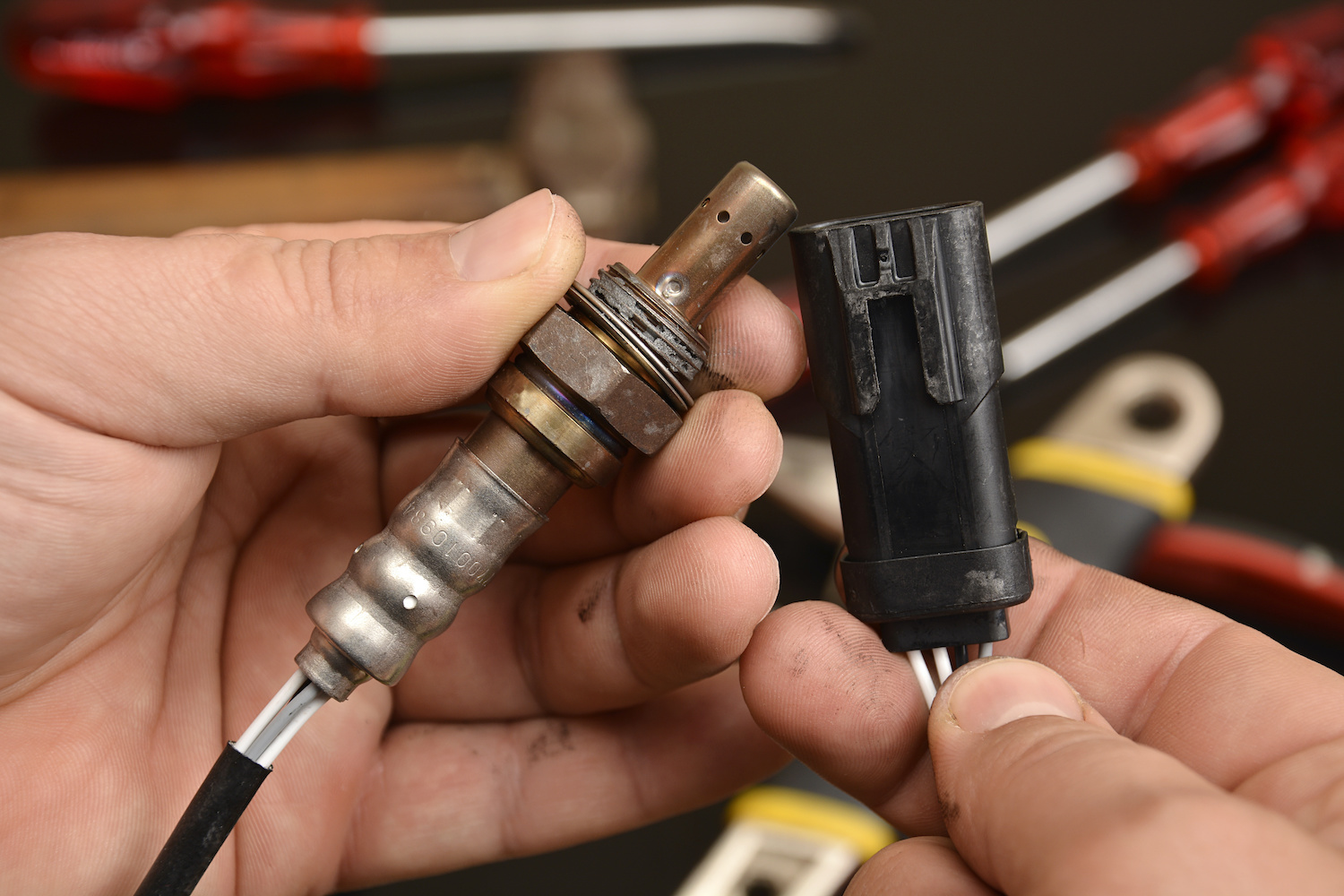
When the Check Engine light illuminates on the dashboard and the scanner shows code P0130, many immediately think: “oxygen sensor problem.” But this is just the tip of the iceberg. DTC P0130 is a signal from the PCM indicating a malfunction in the electrical circuit of the first oxygen sensor (Bank 1 Sensor 1) upstream of the catalytic converter. The issue may lie with the sensor itself, the wiring, exhaust leaks, or even how the PCM processes the signal.
This code is not just a “lit warning that doesn’t interfere” — it directly affects engine performance, fuel consumption, and catalytic converter life. Let’s explore what actually happens when the PCM sets P0130 and how to identify the cause without replacing parts blindly.
“When the ECU detects P0130, it loses communication with one of the most critical sensors for mixture control. From that point, it operates blindly—using averaged maps without considering the actual exhaust condition. This is not a death sentence for the sensor but a prompt to check the entire circuit and operating conditions. In many cases, the problem is not the sensor itself but what it sees or how it transmits the signal.” – Daniel Brooks, DecodeAuto.
Page contents
Error P0130: what the oxygen sensor fault code means
P0130 stands for “O2 Sensor Circuit Malfunction (Bank 1, Sensor 1)”—an electrical circuit fault in the oxygen sensor located in the first cylinder bank, first in the exhaust flow (before the catalytic converter). When the PCM sets this code, it indicates: “I am not receiving a correct signal from the sensor monitoring the mixture before the catalytic converter.” This can mean an open circuit, short circuit, poor contact, low voltage, or an incorrect signal from the sensor itself.
It is important to understand: P0130 is a sensor circuit code, not always a direct fault code for the oxygen sensor itself. The PCM detects a problem when:
- the signal voltage is stuck outside the acceptable range,
- the sensor does not switch between lean and rich mixtures (no “sawtooth” pattern on the oscilloscope),
- there is no signal activity for a specified time while the engine is running and coolant temperature is above 176°F (80°C).
The code does not activate instantly—the PCM waits for confirmation over several driving cycles (typically 2–3 consecutive drive cycles). Therefore, if P0130 is recorded, the problem is persistent, not intermittent.
Unlike codes P0131–P0135, which indicate specific deviations (low/high voltage, slow response, heater malfunction), P0130 is a general circuit malfunction code. It appears when the PCM cannot classify the problem more precisely or when multiple conditions are violated simultaneously.
Typical scenarios triggering P0130:
- sensor signal stuck at 0.45 V (no switching) with a warmed-up engine,
- voltage drops below 0.1 V or rises above 0.9 V and remains there,
- no sensor activity during a commanded fuel-control test.
Why this matters: the first oxygen sensor (Bank 1 Sensor 1) is the primary controller of the air-fuel mixture. It transmits to the PCM information about how much oxygen remains in the exhaust after combustion. Based on this signal, the PCM adjusts fuel delivery to keep the mixture close to stoichiometric (λ ≈ 1, air-fuel ratio ~14.7:1 for gasoline). If the signal is lost or distorted, the PCM switches to open-loop mode, using averaged map values without feedback correction. This leads to increased fuel consumption, power loss, and accelerated catalytic converter wear.
Related codes that may appear alongside P0130:
| Code | Description | Meaning |
|---|---|---|
| P0131 | O2 Sensor Circuit Low Voltage (Bank 1 Sensor 1) | Signal voltage constantly below threshold – lean mixture or open circuit. |
| P0132 | O2 Sensor Circuit High Voltage (Bank 1 Sensor 1) | Signal voltage constantly above threshold – rich mixture or short circuit. |
| P0133 | O2 Sensor Circuit Slow Response (Bank 1 Sensor 1) | Sensor switches too slowly – element degradation. |
| P0134 | O2 Sensor Circuit No Activity Detected (Bank 1 Sensor 1) | Complete absence of signal – open circuit, faulty sensor, or heater power loss. |
| P0135 | O2 Sensor Heater Circuit Malfunction (Bank 1 Sensor 1) | Heater circuit fault – sensor does not reach operating temperature. |
| P0171 | System Too Lean (Bank 1) | Lean mixture – PCM detects excess oxygen and adjusts LTFT positive. |
| P0172 | System Too Rich (Bank 1) | Rich mixture – low oxygen, LTFT negative. |
When P0130 appears together with P0171 or P0172, it indicates that the problem is not only with the sensor signal but also with the mixture itself. If P0133 and P0130 appear simultaneously, the sensor has likely degraded and cannot keep up with exhaust composition changes.
Decoding P0130 and the location of “Bank 1, Sensor 1”
Technical decoding: O2 Sensor Circuit Malfunction (Bank 1, Sensor 1)
P0130 (O2 Sensor Circuit Malfunction, Bank 1, Sensor 1) is a fault code for the electrical circuit of the primary oxygen sensor installed before the catalytic converter in the cylinder bank containing cylinder one. This sensor is called the upstream oxygen sensor (pre-cat O2 sensor). It is the first to “see” the exhaust after combustion and sends a signal to the PCM for fuel delivery correction in closed-loop mode.
What “circuit malfunction” means:
- Open circuit (signal wire, ground, heater power).
- Short circuit to ground or 12 V.
- Oxidation/corrosion of the sensor connector.
- Damage to the wiring harness from vibration, heat, or mechanical impact.
- Sensor malfunction itself (stuck signal, no response).
Activation conditions: battery voltage 9–16 V, engine temperature above 176°F (80°C), absence of a correct sensor signal for a specified time. The PCM expects a functioning sensor to switch quickly between voltages of ~0.1 V (lean mixture) and ~0.9 V (rich mixture) at a frequency of at least 1 Hz at idle. If there are no switches or voltage is stuck outside the range, P0130 is recorded.
What is “Bank 1”
Bank 1 is the cylinder bank containing cylinder number one. For inline engines (I4, I6), this is the only bank. For V-type (V6, V8) and boxer engines, it is one of two banks.
How to identify Bank 1:
- Inline engine (I4, I6): the entire engine is Bank 1; Bank 2 does not exist.
- V-type engine (V6, V8): Bank 1 is the side of the V where cylinder #1 is located. Bank 2 is the opposite side.
- Boxer engine (Subaru, Porsche): Bank 1 and Bank 2 identification depends on the manufacturer—always confirm cylinder numbering in the service manual.
Cylinder numbering depends on the engine design and manufacturer, not just engine orientation. For longitudinal V6 engines (for example, Toyota 1GR-FE), Bank 1 is the bank containing cylinder 1. For transverse FWD V6 engines (many Honda and Nissan applications), Bank 1 is the bank containing cylinder 1; verify with the service manual.
Common mistakes in identifying Bank 1:
- Confusing Bank 1 and Bank 2 on V engines by driver’s side rather than cylinder numbering.
- Not considering engine orientation (longitudinal/transverse).
- On some vehicles, numbering may differ—always check the service manual.
What is “Sensor 1” and its role
Sensor 1 is the first oxygen sensor in the exhaust flow, located before the catalytic converter (upstream O2 sensor, pre-cat sensor). It measures oxygen content in the exhaust immediately after the exhaust manifold and sends data to the PCM for fuel mixture correction in closed-loop mode.
Purpose of Sensor 1:
- Fuel trim control. The PCM uses its signal for fine fuel delivery adjustment. The goal is to maintain λ ≈ 1 (stoichiometric ratio ~14.7:1 for gasoline), where the catalytic converter operates most efficiently.
- Fast response to exhaust composition changes. A functioning narrowband sensor switches between lean and rich mixtures at 1–2 Hz at idle, creating a characteristic “sawtooth” voltage pattern from ~0.1 V to ~0.9 V.
Sensor 2 (downstream, post-cat) is the second sensor located after the catalytic converter. Its task is to monitor catalytic converter efficiency, not to adjust the mixture. Sensor 2’s signal is typically smoother and more stable than Sensor 1’s because the catalyst smooths exhaust composition fluctuations.
| Parameter | Sensor 1 (pre-cat) | Sensor 2 (post-cat) |
|---|---|---|
| Location | After exhaust manifold, before catalytic converter | After catalytic converter |
| Purpose | Fuel mixture control (fuel trim) | Monitoring catalytic converter efficiency |
| Signal type | High activity (fast switching 1–2 Hz), sawtooth 0.1–0.9 V | Lower activity than Sensor 1 on a properly functioning catalyst |
| Effect on mixture | Direct (PCM adjusts STFT/LTFT based on this sensor) | Indirect (sensor does not affect fuel trim) |
| Switching frequency | >1 Hz at idle | Typically lower than Sensor 1 |
Why Sensor 1 is critical: if it fails or responds slowly, the PCM loses feedback and switches to open-loop mode. In this mode, it uses averaged fuel maps without considering actual exhaust conditions. This leads to:
- increased fuel consumption,
- loss of power and throttle response,
- increased emissions (vehicle may fail an emissions test),
- accelerated catalytic converter wear due to incorrect mixture.
How the oxygen sensor works and its role in the system
The oxygen sensor (O2 sensor) is an electrochemical sensor that measures oxygen concentration in exhaust gases and generates voltage depending on the air-fuel ratio. The name “lambda” comes from the Greek letter λ, representing the air excess coefficient: λ = 1 is stoichiometric mixture (14.7:1 for gasoline), λ > 1 is lean, λ < 1 is rich.
How a zirconia (narrowband) oxygen sensor works:
The core of the narrowband sensor is a solid electrolyte made of zirconium dioxide (ZrO₂), stabilized with yttria, placed between two electrodes coated with porous platinum. The inner ceramic part contacts atmospheric air, and the outer part contacts exhaust gases.
Signal generation mechanism:
- The oxygen concentration difference between outside air (~21% O₂) and exhaust causes oxygen ions to move through the ceramic element from high to low concentration.
- The ion movement generates an electrical voltage at the electrodes (Nernst effect).
- Voltage range:
- Rich mixture (low oxygen in exhaust, λ < 1) → maximum voltage ~0.9 V.
- Lean mixture (high oxygen, λ > 1) → minimum voltage ~0.1 V.
- Stoichiometric (λ ≈ 1) → rapid switching around ~0.45 V.
Important operating conditions:
- Operating temperature: the zirconia element becomes conductive and starts generating a signal only after heating to about 572°F (300°C). Therefore, modern sensors have built-in heaters that warm the ceramic within about 20–60 seconds after engine start.
- Detection range: the narrowband sensor detects deviations from stoichiometry in a narrow range around 14.7:1 air-fuel ratio. Outside this range, the signal “sticks” at the limits (0.1 V or 0.9 V).
- Switching frequency: a functioning sensor should change signal at least once per second at idle, creating a characteristic “sawtooth” on the oscilloscope.
Role of the oxygen sensor in the system:
Bank 1 Sensor 1 is the primary feedback sensor for mixture control. The PCM constantly compares the sensor signal to the target (~0.45 V for stoichiometry) and adjusts fuel delivery via short-term fuel trim (STFT) and long-term fuel trim (LTFT):
- If the signal is below 0.45 V (lean mixture, excess oxygen) → PCM increases fuel injection (positive STFT correction).
- If the signal is above 0.45 V (rich mixture, low oxygen) → PCM reduces injection (negative correction).
This process occurs continuously, creating micro-oscillations of the mixture around λ = 1. Without a correct signal from Sensor 1, the PCM cannot precisely regulate the mixture and switches to open-loop mode, using fixed map values. This is safe for the engine but inefficient: fuel consumption rises, power drops, emissions increase.
Wideband sensors (A/F sensors):
Some vehicles (Toyota, Honda, Subaru after the 2000s) use wideband sensors instead of narrowband zirconia ones. They operate differently:
- Measure the exact air-fuel ratio across the full range (from rich to very lean mixtures).
- Output current or linear voltage proportional to λ, not a step signal.
- The PCM interprets this signal as an exact λ value (e.g., λ = 0.98 or λ = 1.05).
Important: diagnostics of wideband sensors differ from narrowband. A multimeter will show different nominal values, and P0130 on such vehicles may indicate calibration or pump-cell circuit issues. Always consult the specific model’s service manual.
Symptoms of error P0130
Main symptoms and signs of P0130 code appearance
When the PCM sets P0130, it loses feedback from oxygen sensor Bank 1 Sensor 1 and switches to open-loop mode. This immediately affects engine operation and emissions control. Here is what you may notice:
1. Check Engine light on
This is the first and mandatory sign. The MIL (Malfunction Indicator Lamp) lights up when the PCM confirms the code over 2–3 drive cycles. If the lamp flashes, it indicates a critical problem (for example, misfires) requiring immediate attention.
2. Increased fuel consumption
In open-loop mode, the PCM does not adjust the mixture based on sensor signal but uses averaged maps. These maps are usually tuned with slight enrichment for engine safety. Result: fuel consumption increases. If the vehicle consumed 29 mpg (8 L/100 km) before, it may drop to about 26–24 mpg (9–10 L/100 km) after the fault appears.
3. Unstable engine operation, fluctuating idle
Without precise feedback, the PCM cannot finely regulate idle speed. RPM may fluctuate between 600–900 rpm, the engine may run rough or stall at traffic lights. This is especially noticeable after warming up when the PCM should switch to closed-loop.
4. Power loss, hesitation during acceleration
At high RPM and load (passing, climbing), the engine may not develop full power. Hesitation may occur when pressing the accelerator—the PCM cannot adjust the mixture quickly without sensor signal. This is particularly noticeable during passing maneuvers.
5. Gasoline smell, rich exhaust gases
If the PCM over-enriches the mixture in open-loop, a raw-fuel smell may come from the exhaust pipe. This means some gasoline does not burn and is released into the atmosphere.
6. Black smoke from the exhaust pipe
With significant over-enrichment (for example, combined with MAF or injector issues), black smoke (unburned soot) may come from the tailpipe. This is not only a sign of P0130 but may also indicate the catalytic converter is being damaged by excess carbon.
Less obvious symptoms:
- Hard starting (engine starts on second or third attempt) – PCM cannot quickly adjust mixture during warm-up.
- Vehicle fails emissions test – without a working Sensor 1, CO and HC emissions rise sharply.
- Related codes P0171 (lean mixture) or P0172 (rich mixture) – if the sensor “sees” a distorted picture, the PCM tries to compensate and records mixture codes.
Important: symptoms may not appear immediately or all at once. For example, increased fuel consumption may be unnoticed during short city trips but becomes obvious on the highway. If the Check Engine light is on but the car “drives normally,” it does not mean there is no problem. The catalytic converter and spark plugs may degrade unnoticed.
Main causes of error P0130
When the PCM sets P0130, it indicates: “I am not receiving a correct signal from Bank 1 Sensor 1.” But the cause may not be the sensor itself—the problem may lie in wiring, leaks, or even the fuel system. Let’s review the main cause groups by frequency.
1. Faulty oxygen sensor
The most common cause is sensor degradation. Over time, the sensing element becomes contaminated or loses sensitivity:
- Poisoning by sulfur and phosphorus from fuel. Poor-quality fuel leaves deposits on platinum electrodes, slowing sensor response. Symptom: slow response (code P0133) or complete lack of switching.
- Aging of the ceramic element. After 62,000–93,000 miles (100,000–150,000 km) or 8–10 years, zirconia ceramic may lose conductivity. The sensor stops generating stable voltage.
- Contamination by oil or coolant. If the engine consumes oil or coolant enters the combustion chamber (blown head gasket), combustion products settle on the sensor and block oxygen access.
- Stuck voltage. The sensor “freezes” at one value (~0.45 V) and does not respond to mixture changes.
2. Electrical circuit problems
If the sensor itself is functional but the PCM does not receive a signal, check the wiring:
- Open circuit. Most often the signal wire breaks due to vibration or bending. The sensor physically works, but the signal does not reach the PCM.
- Short circuit to ground. If wire insulation rubs against a hot manifold or body, the signal wire shorts to ground. The PCM sees constant ~0 V.
- Short circuit to 12 V. Rare but possible if the harness near the power wire is damaged. The PCM sees constant high voltage.
- Low circuit voltage. If system voltage drops below 11 V (weak battery, alternator issues), the sensor heater may not reach operating temperature. The sensor may not generate a correct signal.
- Corroded connector. Moisture and salt (in winter) cause contact corrosion. The connector may look normal visually, but contact resistance increases, and the signal disappears.
- Poor ground contact. If the sensor ground has poor contact with the body or engine block, the signal circuit malfunctions.
3. Exhaust leaks before the sensor and intake air leaks
The sensor measures oxygen in the exhaust, but if outside air enters the exhaust (or extra air enters the intake), the picture is distorted:
- Exhaust leak before the sensor. A crack in the exhaust manifold, burned gasket, or loose connection between manifold and downpipe. Outside air (~21% O₂) is drawn into the exhaust, and the sensor “sees” excess oxygen even with a correct mixture. The PCM adds fuel, and code P0171 may appear alongside P0130.
- Intake air leak. A crack in the hose between MAF and throttle body, intake manifold gasket leak, or a faulty brake booster diaphragm. The engine receives more air than the MAF measures. The mixture goes lean, the sensor shows low voltage, and the PCM may record P0130/P0171.
4. Sensor power and heater
Modern sensors have built-in heaters that warm the ceramic to operating temperature within 20–60 seconds. If the heater fails:
- Heater open or burnout. Checked with a multimeter: resistance between heater terminals should be 3–15 Ω (model-dependent). If resistance is OL (open) or 0 Ω (short), the heater is faulty. The PCM records code P0135.
- Blown fuse or faulty heater relay. Some vehicles have a separate fuse for sensor heaters. If blown, the sensor will not heat up.
5. Fuel system
If fuel pressure or mixture quality is disturbed, the sensor sees an incorrect picture:
- Low fuel pressure. Weak fuel pump, clogged filter, or faulty fuel pressure regulator (FPR) can cause a lean mixture. The sensor shows low voltage; the PCM tries to compensate but fails and may record P0130/P0171.
- Dirty injectors. Injectors spray fuel unevenly; the mixture fluctuates between lean and rich. The sensor reacts erratically; the PCM cannot stabilize the signal.
- Stuck fuel pressure regulator. If pressure is too high, the mixture becomes rich. The sensor shows high voltage; code P0132 may appear.
6. Software and PCM malfunction
A rare but possible cause is signal processing failure in the PCM itself:
- Signal processing errors in outdated PCM software. Some older models are known for false P0130 codes due to calibration issues. PCM software updates may resolve the issue.
- Corrosion of PCM connectors or board. If the PCM is in a leak-prone area, moisture can cause oxidation of traces. The PCM stops correctly interpreting sensor signals.
- Non-standard firmware (tuning). After PCM remapping for increased power, code thresholds or sensor calibration may change. P0130 may appear without a real fault.
Step-by-step diagnosis for accurate P0130 cause identification
This information is general and does not replace professional consultation.
When the Check Engine light comes on with code P0130, the first step is not to rush to replace the sensor. The code indicates a circuit fault, not necessarily the oxygen sensor itself. Proper diagnosis starts with data, not part replacement. Here is a step-by-step procedure to avoid false leads and save money.
Step 1. Read codes and Freeze Frame data
Connect an OBD2 scanner and read active and stored codes. Pay attention to related codes:
- P0131–P0135 (Bank 1 Sensor 1 sensor issues: low/high voltage, slow response, heater fault) indicate specific anomalies.
- P0171 (lean mixture Bank 1) or P0172 (rich mixture Bank 1) indicate mixture problems that may cause or result from P0130.
- P0420 (catalyst efficiency low) may appear after P0130 if the incorrect mixture has damaged the catalyst.
Freeze Frame is a snapshot of engine parameters at the moment the code was recorded. Note:
- Coolant temperature (ECT) – code generally appears at temperatures above 176°F (80°C). If lower, sensor warm-up issues are possible.
- Engine RPM and load – was the code recorded at idle or during acceleration?
- O2 sensor voltage B1S1 at code trigger – if stuck at 0.45 V, the sensor is not switching.
Step 2. Check live data
Switch the scanner to Live Data mode and run the engine to operating temperature (above 176°F/80°C). Observe:
- O2 Bank 1 Sensor 1 voltage – a good narrowband sensor should switch quickly between ~0.1 V (lean) and ~0.9 V (rich) at least 1 Hz at idle. If the signal is stuck at 0.45 V, changes slowly, or goes out of range, the sensor is faulty or the mixture is problematic.
- STFT and LTFT Bank 1 – show how the PCM adjusts the mixture. Normal values: about ±10%. If STFT/LTFT > +10% (positive correction), the mixture is lean and the PCM adds fuel. If < −10% (negative correction), the mixture is rich and the PCM reduces fuel. Values above about ±20% indicate a severe mixture problem that may contribute to P0130.
- O2 sensor temperature (if available) – sensor should warm to about 572°F (300°C) or higher for correct operation. If low, check the heater.
Step 3. Measure sensor voltage with a multimeter
If the scanner shows suspicious or missing values, check the sensor signal with a multimeter:
- Start the engine and warm it to operating temperature (≥176°F / 80°C).
- Connect the multimeter to the sensor signal wire (wire colors vary by application; refer to the wiring diagram) and ground to chassis or battery negative.
- Set the multimeter to DC voltage mode (0–2 V range).
- Observe readings at idle:
- Good sensor: voltage rapidly fluctuates between ~0.1 V and ~0.9 V (visible as flickering numbers on the meter).
- Faulty sensor: voltage fixed (~0.45 V), changes slowly (<0.5 Hz), or out of range (<0.1 V or >0.9 V).
- Perform a snap-throttle test: quickly press the accelerator. A good sensor will instantly jump to ~0.9 V (enrichment), then return to oscillations.
Step 4. Check sensor circuit
If the multimeter shows no signal or constant 0 V / 12 V, the wiring is faulty:
- Check wiring continuity from sensor to PCM:
- Disconnect the sensor connector.
- Measure resistance between the sensor signal wire at the connector and the corresponding PCM pin.
- Normal resistance: ≤ 1 Ω. Higher resistance indicates an open or high-resistance circuit.
- Measure resistance between signal wire and ground: should be infinite (OL). Continuity indicates a short to ground.
- Check heater resistance:
- Measure resistance between heater terminals (usually two of 3–4 wires).
- Normal: 3–15 Ω (model-dependent; check service manual).
- 0 Ω indicates heater short circuit.
- OL (infinite) indicates an open heater circuit.
- Inspect sensor connector:
- Disconnect and inspect contacts for corrosion, oxidation, or melting.
- Clean contacts with electrical contact cleaner and, if needed, a suitable contact-cleaning tool.
- Blow out connector with compressed air.
- Apply dielectric grease to the connector seal area as needed for moisture protection. Do not coat terminal contact surfaces unless the manufacturer specifies it.
Step 5. Check for air intake leaks and exhaust leaks
If sensor and wiring are good but the code persists, check for leaks:
- Intake air leaks:
- Use a smoke machine to test intake tract sealing.
- Connect the smoke machine to the intake manifold (via a vacuum line or removed hose) and introduce smoke. Smoke escaping from cracks, gaskets, or joints indicates leaks.
- Check the intake manifold gasket, hoses between the MAF and throttle body, brake booster diaphragm, and PCV valve.
- Exhaust leaks before the sensor:
- Start the engine and listen for exhaust noise near the manifold and downpipe (pipe from manifold to catalytic converter). Hissing or ticking indicates leaks.
- Visually inspect the gasket between manifold and cylinder head, manifold-to-downpipe connection, and sensor threads.
- If uncertain, use a smoke machine: block the exhaust downstream and introduce smoke into the manifold. Smoke will escape through cracks.
Step 6. Use an oscilloscope if necessary
For in-depth diagnosis (especially with slow sensor response, code P0133), use an oscilloscope:
- Connect the oscilloscope to the sensor signal wire.
- Run the engine to operating temperature and observe the signal waveform at idle.
- Good sensor: clear sawtooth with amplitude 0.1–0.9 V and switching frequency generally above 1 Hz at idle.
- Faulty sensor:
- Slow sawtooth (frequency <1 Hz) – ceramic element degradation.
- Flat line (~0.45 V) – sensor does not respond to mixture changes.
- Distorted waveform (spikes, noise) – wiring or ground issues.
- Perform a snap-throttle test on the oscilloscope: quickly press the accelerator. A good sensor will instantly spike to ~0.9 V, then return to oscillations. A noticeable delay may indicate a slow sensor.
| Parameter | Normal values | Abnormal values |
|---|---|---|
| O2 signal voltage (V) | 0.1–0.9 V (fast switching at idle, ~0.45 V average) | Fixed <0.1 V, >0.9 V, or constant ~0.45 V (no switching) |
| Switching frequency (Hz) | >1 Hz (at least 1 full cycle per second) | <0.5 Hz (slow response, code P0133) |
| Heater resistance (Ω) | 3–15 Ω (model-dependent) | 0 Ω (short) or OL (open) |
| STFT/LTFT (%) | About ±10% (acceptable fuel trim deviation) | >+10% (lean mixture, air leak); <−10% (rich mixture, injector leak) |
| Sensor power voltage (V) | 12–14 V (heater terminals with engine running) | <11 V (weak battery/alternator) or 0 V (power circuit fault) |
Notes on the table:
- Signal voltage 0.1–0.9 V applies to narrowband zirconia sensors. Wideband A/F sensors operate differently: signal is interpreted as current or linear voltage; a multimeter may show different values. Always consult the service manual.
- Switching frequency >1 Hz is a general rule of thumb. Slower switching may indicate sensor degradation.
- STFT/LTFT within about ±10% is generally considered normal. Exact acceptable values vary by manufacturer.
How the PCM sets P0130: conditions and thresholds
The PCM does not set P0130 immediately at the first signal failure—it waits for confirmation under several conditions. Typical thresholds vary by manufacturer.
Activation conditions:
| Condition | Description | Confirmation time |
|---|---|---|
| Engine temperature >176°F (80°C) | Engine warmed to operating temperature | – |
| System voltage 9–16 V | Battery and alternator functional | – |
| Engine operating in closed-loop mode | PCM switched to mixture correction based on O2 sensor | Usually 2–5 minutes after start |
| No O2 signal switching | Sensor voltage stuck at one level (~0.45 V) or out of range (<0.1 V, >0.9 V) | Model-dependent |
| Sensor voltage outside acceptable window | Signal stays outside expected range under monitored conditions | Model-dependent |
| Commanded fuel-control test | PCM temporarily changes fuel delivery; a good sensor should respond with a voltage change | If no response, code may be recorded after repeated failures |
Number of confirmation cycles: usually 2–3 consecutive drive cycles. A drive cycle includes engine start, warm-up, driving until closed-loop is reached, then stop and cooldown. If conditions repeat each cycle, the code is stored in PCM memory and the Check Engine light turns on.
Important: if P0130 is recorded, the problem is stable and requires repair. Clearing the code without fixing the issue will cause it to reappear.
O2 sensor reading standards: quick reference
Narrowband zirconia sensor (most vehicles before the 2010s):
- Signal voltage at idle (warmed engine): 0.1–0.9 V, fast switching around ~0.45 V.
- Switching frequency: minimum 1 Hz (1 full lean→rich cycle per second).
- Snap-throttle response: instant jump to ~0.9 V, then return to oscillations.
- Heater resistance: 3–15 Ω (model-dependent; check service manual).
Wideband sensor (A/F sensor, Toyota/Honda/Subaru after the 2000s):
- Voltage/current interpreted by PCM as exact λ value. Multimeter readings vary by design. Diagnostics differ from narrowband—always consult documentation.
- Calibration: wideband sensors are factory calibrated; replacement may require relearn or adaptation on some vehicles.
- Switching frequency: not applicable—sensor outputs a linear signal, not a sawtooth pattern.
| Sensor type | Signal | Interpretation | Multimeter diagnostics |
|---|---|---|---|
| Narrowband O2 | Voltage 0.1–0.9 V (stepped) | Lean mixture ~0.1 V, rich ~0.9 V | Measure DC voltage, observe sawtooth |
| Wideband A/F | Current or linear voltage | PCM interprets as exact λ value | Requires model-specific test procedure or scanner with Live Data; multimeter readings alone are often not useful |
To avoid misdiagnosis: if your vehicle has a wideband A/F sensor instead of a narrowband O2 sensor (check by VIN or service manual), do not use narrowband criteria. P0130 on such vehicles may indicate pump-cell calibration or power circuit issues, not a simple voltage-signal fault.
How to fix error P0130: repair methods
This information is general and does not replace professional consultation.
After diagnosis and cause identification, the fault must be repaired. Important: repair starts with the most probable cause identified during diagnosis, not with sensor replacement “just in case.” Here are step-by-step repair methods for each scenario.
Oxygen sensor replacement
If diagnosis confirms the sensor is faulty (slow response, stuck voltage, ceramic degradation), it must be replaced.
Step-by-step replacement procedure:
- Select the correct sensor:
- OEM (original) – recommended for long-term use. OEM sensors are calibrated for specific engine models and often last longer.
- Aftermarket – cheaper but may have a shorter service life or different calibration. Choose reputable brands: Bosch, Denso, NGK, Walker.
- Universal sensor – requires wire cutting and splicing. Not recommended for beginners: wiring errors can cause shorts or malfunction.
- Preparation:
- Warm the engine, then shut it off and let it cool enough to work safely. Warm threads are often easier to loosen.
- Disconnect the battery negative terminal for safety if required by the service procedure.
- Remove the old sensor:
- Disconnect the sensor connector. If the clip is rusted, use a suitable penetrant as needed.
- Use a special O2 sensor wrench (slotted wrench for wires, usually 22 mm or 7/8″) or a 22 mm socket with extension.
- Unscrew the sensor counterclockwise. If threads are seized, apply penetrating oil and wait 10–15 minutes. Do not apply excessive force to avoid thread damage.
- Prepare the installation site:
- Clean threads in the manifold with a wire brush to remove carbon and corrosion.
- Apply high-temperature anti-seize compound to the new sensor threads only if the new sensor manufacturer does not already provide thread coating. Do not apply it to the sensor tip.
- Install the new sensor:
- Thread the sensor by hand several turns to ensure no cross-threading.
- Tighten the sensor to the manufacturer’s specified torque. Check the exact specification in the service manual. Do not overtighten to avoid thread or sensor body damage.
- Connect the sensor connector and secure the cable to prevent contact with the hot manifold.
- Check:
- Reconnect the battery negative terminal if it was disconnected.
- Start the engine and warm it to operating temperature.
- Connect an OBD2 scanner and monitor Live Data: O2 B1S1 voltage should start switching once the sensor heats up and the PCM enters closed loop.
Common replacement mistakes:
- Touching or contaminating the sensor tip.
- Using anti-seize when the sensor already has a factory-applied thread coating.
- Using silicone sealant on threads – silicone can damage the sensor.
Wiring and connector repair
If diagnosis shows opens, shorts, or connector corrosion, wiring must be restored.
Step-by-step procedure:
- Repair opens:
- Locate the break (usually at harness bends near the manifold).
- Cut out the damaged wire section.
- Use copper multi-strand wire of the same gauge.
- Repair the wire using an OEM-style method suitable for underhood wiring.
- Insulate with heat-shrink tubing with adhesive lining. Regular electrical tape will not withstand heat and vibration.
- Fix shorts:
- Find damaged insulation (usually from contact with a hot manifold or sharp body edges).
- Replace the damaged wire section or restore insulation with heat-shrink tubing.
- Route the harness away from hot or moving parts. Use high-temperature protective sleeves where needed.
- Clean connectors:
- Disconnect the sensor connector.
- Clean contacts with electrical contact cleaner and, if needed, a suitable contact-cleaning tool.
- Blow out the connector with compressed air.
- Apply dielectric grease to the connector seal area as needed for moisture protection.
- Check ground connection:
- Locate the sensor ground point if applicable.
- Clean the contact surface to bare metal.
- Tighten the fastener to the manufacturer’s specification.
Fixing leaks and maintenance
If the problem is intake or exhaust sealing, parts replacement alone will not help—system repair is required.
Fixing intake air leaks:
- Replace the intake manifold gasket if a smoke test shows leaks.
- Replace damaged hoses between the MAF and throttle body.
- Replace the brake booster diaphragm if leaking.
- Clean or replace the PCV valve if stuck.
Fixing exhaust leaks before the sensor:
- Replace the gasket between the exhaust manifold and cylinder head.
- Replace the gasket between the manifold and downpipe.
- Repair cracks in the manifold as appropriate or replace the manifold.
- Check sensor thread condition—if damaged, thread repair may be needed.
Fuel system service:
- Check fuel pressure with a gauge. Refer to the service manual for the correct specification. If pressure is low, inspect the fuel filter, pump, and regulator as applicable.
- Clean injectors using an appropriate service method or replace them if worn.
- Check the fuel pressure regulator (FPR)—replace if faulty.
Error reset and verification
After fixing the cause, be sure to clear the code and verify the problem is resolved:
- Clear Check Engine light with an OBD2 scanner:
- Connect the scanner and select the “Clear DTCs” function.
- The PCM clears memory and turns off the MIL.
- Perform a test drive:
- Warm the engine to operating temperature (above 176°F / 80°C).
- Drive 20–30 minutes in various conditions: idle, steady 35–40 mph (60 km/h), acceleration to about 60 mph (100 km/h), and deceleration.
- The PCM should switch to closed-loop and start using the sensor signal.
- Check codes after the test drive:
- Reconnect the scanner and read codes.
- If P0130 does not return and O2 B1S1 and STFT/LTFT parameters are normal, the repair was successful.
- If the code returns, repeat diagnosis—possibly the root cause was not fixed.
Consequences of ignoring the error: risk to catalytic converter and PCM
Driving with code P0130 without repair is not just a “lit warning light.” When the PCM loses the signal from Bank 1 Sensor 1, it switches to open-loop mode and uses averaged fuel maps without feedback correction. This leads to incorrect air-fuel mixture, directly threatening the catalytic converter and other components.
How incorrect mixture damages the catalytic converter:
- Lean mixture (λ > 1, excess oxygen):
- If the PCM delivers too little fuel (due to air leaks or faulty MAF), excess unburned oxygen enters the exhaust.
- This oxygen reacts with residual hydrocarbons (HC) and carbon monoxide (CO) inside the catalyst.
- The exothermic reaction raises catalyst temperature above normal.
- The ceramic substrate can melt, and honeycomb cells can deform and plug. The catalyst loses flow capacity, and the engine may lose power due to exhaust restriction.
- Rich mixture (λ < 1, excess fuel):
- If the PCM delivers too much fuel (due to leaking injectors or high fuel pressure), some fuel does not burn in the cylinders and enters the exhaust.
- Unburned hydrocarbons (HC) and carbon monoxide (CO) reach the catalyst and burn there.
- This also causes catalyst overheating and accelerated active-layer degradation.
- Carbon deposits (soot) can form on ceramic cells, clogging passages. The catalyst loses efficiency, and code P0420 may appear.
Timeframe for damage:
- Damage can occur more quickly if the vehicle is driven hard, runs rich for extended periods, or has other faults such as misfires.
- If misfires occur simultaneously, the catalyst may overheat severely or, in rare cases, ignite surrounding materials.
Additional risks:
- Increased fuel consumption and emissions: without O2 correction, fuel consumption may rise, and CO and HC emissions increase significantly. The vehicle may fail emissions testing.
- Unstable operation of other systems: if the PCM cannot stabilize the mixture, idle quality and overall drivability may be affected.
Cost of catalytic converter repair:
- New OEM catalytic converter: cost varies widely depending on vehicle model.
- Aftermarket catalytic converter: cost varies by application and emissions requirements.
- Replacement labor: depends on vehicle design and local labor rates.
Conclusion: P0130 should be addressed promptly. Short trips to a repair shop may be acceptable if there is no knocking or flashing Check Engine light, but prolonged operation is not recommended.
How serious is the error and can you drive with it?
This information is general and does not replace professional consultation.
Code P0130 is not a critical failure that will immediately disable the engine, but it is not a “cosmetic” issue to ignore for months. Severity depends on how long you drive with the code and under what conditions.
Short trips to a repair shop (12–31 miles / 20–50 km):
- May be acceptable if there are no obvious power losses, knocking, or flashing Check Engine light.
- The engine operates in open-loop mode, using averaged fuel maps. This is generally safe for the engine in the short term but inefficient.
- Risk: if misfires occur simultaneously, unburned fuel may reach the catalyst and cause overheating even during short trips.
Long-term operation (weeks, months):
- Not recommended. Without mixture correction based on sensor signal, the catalyst may be exposed to prolonged overheating (lean mixture) or carbon loading (rich mixture).
- Extended driving with active P0130 can contribute to catalyst failure and increased repair cost.
- Risk of damage to spark plugs, injectors, and other components also increases depending on the underlying cause.
Flashing Check Engine:
- Stop driving as soon as it is safe to do so and have the vehicle towed. A flashing MIL usually indicates misfires, meaning unburned fuel can enter the catalyst and cause rapid overheating.
Recommendations:
- If P0130 appears but symptoms are mild (Check Engine on but car drives normally), have the vehicle checked within 1–2 days.
- If obvious symptoms occur (unstable operation, power loss, black smoke, fuel smell), do not delay repairs.
- If the lamp flashes, stop and call a tow truck.
Disclaimer: This information is for educational purposes only and does not replace professional diagnosis, inspection, and repair. Before performing any work on your vehicle, consult a qualified technician or authorized dealer. DecodeAuto is not responsible for damage resulting from self-repair.
Frequently asked questions
1. Is it possible to drive with error P0130?
Short trips to a repair shop (12–31 miles / 20–50 km) may be acceptable if there are no obvious power losses or a flashing Check Engine light. Long-term operation is not recommended because an incorrect mixture can damage the catalytic converter. If the lamp is flashing, stop driving as soon as it is safe and call a tow truck.
2. Which oxygen sensor should I choose for replacement: universal or OEM?
OEM (original) is recommended for long-term use because it is calibrated for the specific engine. Aftermarket parts can be less expensive, but quality varies, so choose trusted brands such as Bosch, Denso, or NGK. Universal sensors require wire cutting and splicing and are not recommended for beginners. Important: on some Toyota, Honda, and similar applications from the 2000s and newer, wideband A/F sensors may be used and cannot be replaced with a universal narrowband O2 sensor. Check the sensor type by VIN or service information before purchase.
3. Will cleaning the sensor help?
Usually no. The ceramic element of an oxygen sensor generally cannot be restored by cleaning. If the sensor is contaminated with oil or coolant, find and fix the source of the problem first, then replace the sensor if needed.
4. Is PCM reprogramming required after sensor replacement?
Usually no. The PCM typically adapts to the new sensor after several drive cycles. After sensor replacement: 1. Clear codes with an OBD2 scanner. 2. Warm up the engine to operating temperature (above 176°F / 80°C). 3. Drive for 20–30 minutes in various modes (idle, steady driving, acceleration). 4. The PCM will enter closed loop and start using the sensor signal. Exception: some vehicles with wideband A/F sensors may require a relearn or calibration procedure, depending on the model and year. Check the service manual.
5. How to distinguish P0130 from mixture problems unrelated to O2?
Key point: P0130 is a sensor circuit code, not a direct mixture code. If P0130 appears with P0171 (lean) or P0172 (rich), the problem may be an air leak, exhaust leak, fuel pressure issue, leaking injectors, or a dirty MAF rather than the sensor itself. Diagnosis: connect a scanner and check STFT/LTFT and the B1S1 signal. Fuel trims near normal with an abnormal or fixed sensor signal point more toward a sensor or wiring issue. Large fuel-trim corrections point more toward an actual mixture problem.