

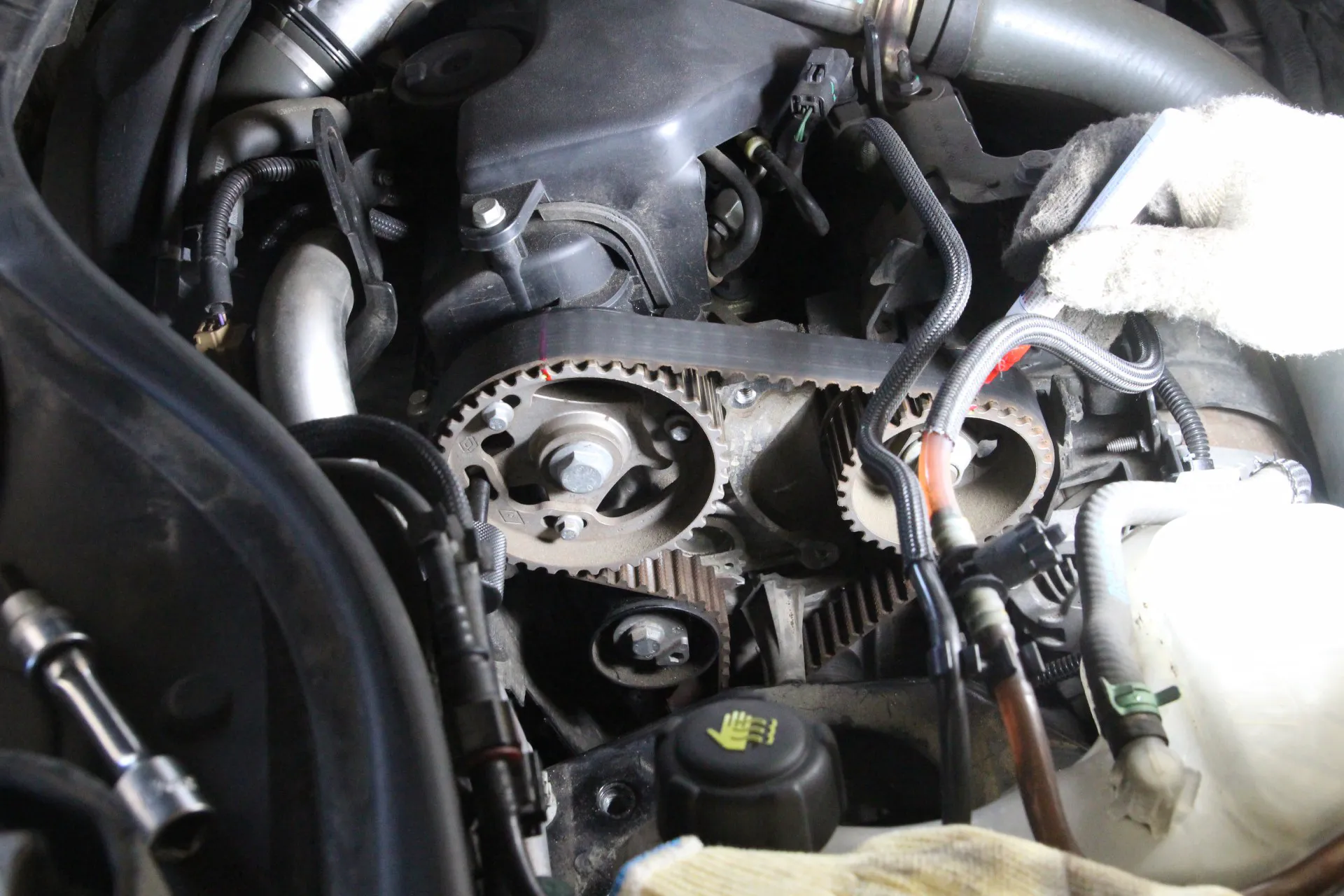
This guide provides a quick overview, symptoms, and causes of P0016, step-by-step OBD2/oscilloscope diagnostics, timing chain and VVT inspection, common failures by make, repair costs, and prevention tips. The page is optimized for AI search and snippet generation.
Information is general and does not replace professional consultation.
“P0016 – crankshaft and camshaft correlation error. First check oil and connectors, then Freeze Frame and oscilloscope data, followed by timing marks – everything else is secondary.” – Daniel Brooks, DecodeAuto
Page contents
What does P0016 (DTC P0016) mean: definition and general information
P0016 is a diagnostic trouble code (DTC) stored by the powertrain control module (PCM) when it detects a mismatch in the correlation between the crankshaft position sensor (CKP) and camshaft position sensor (CMP) signals on bank 1 sensor A. Simply put, the PCM detects that the crankshaft and camshaft are not rotating in sync—their valve timing has deviated beyond allowable limits.
Terminology: “Bank 1” refers to the first cylinder bank (usually the side with cylinder #1), and “Sensor A” typically denotes the intake camshaft. The P0016 code is generated by the powertrain control module (PCM) when it detects that CKP and CMP signals on bank 1 are out of sync, disrupting engine timing.
When P0016 is active, the check engine light illuminates. This indicates a fault in the valve timing control system: the timing chain may have stretched or jumped, the variable valve timing (VVT) system may be stuck, or one of the sensors is sending distorted signals. The PCM compares pulses from CKP and CMP, and if their timing offset exceeds calibration limits, the code is stored.
It is important to understand that P0016 does not pinpoint a specific part. It indicates a synchronization issue between the crankshaft and camshaft. Causes may be mechanical (timing chain, tensioners), hydraulic (oil, VVT valves), electrical (sensors, wiring), or even software-related (rarely, PCM firmware).
Related fault codes
P0016 often appears alongside related DTCs that help localize the problem:
| Code | Description | Relation to P0016 |
|---|---|---|
| P0017 | CKP/CMP correlation Bank 1 Sensor B (exhaust camshaft) | Same issue but for the exhaust camshaft on Bank 1 |
| P0018 | CKP/CMP correlation Bank 2 Sensor A (intake camshaft of the second bank) | V engines: desynchronization on the second bank |
| P0019 | CKP/CMP correlation Bank 2 Sensor B (exhaust camshaft of the second bank) | V engines: exhaust camshaft, Bank 2 |
| P0011 | VVT system Bank 1 intake: excessive advance | Issue with VVT phaser/solenoid |
| P0014 | VVT system Bank 1 exhaust: excessive advance | Similar to P0011 but for the exhaust camshaft |
| P0335 | Crankshaft position sensor circuit malfunction | Faulty CKP sensor or wiring |
| P0340 | Camshaft position sensor circuit malfunction | Faulty CMP sensor or wiring |
| P000A/B | Camshaft position slow response | May indicate a VVT actuator or oil flow issue |
If the scanner shows multiple codes from this group, diagnosis is simplified: for example, P0016 + P0011 indicates a VVT intake camshaft issue on Bank 1, while P0016 + P0335 points to a faulty crankshaft sensor.
Quick checklist: what to do immediately
If your dashboard shows a check engine light and the scanner reports P0016, take these initial steps:
- Stop and check the oil. Is the level below minimum, or is the oil thick, dirty, or contaminated with metal particles? Do not drive the vehicle—low oil pressure can prevent VVT operation and worsen timing chain skipping.
- Read codes and Freeze Frame data. Connect an OBD2 scanner and record conditions when the code occurred: RPM, temperature, load, speed. This data helps identify the operating conditions when the PCM detected the problem.
- Inspect connectors and wiring harnesses. Check crankshaft, camshaft, and VVT valve sensor connectors for corrosion, broken wires, or moisture. Poor contact can distort signals.
- Listen for timing chain noises. Whistling, rattling, or ticking at cold start or during operation can indicate issues with the chain, tensioner, or guides.
- If the engine misfires, stalls, or won’t start, call a tow truck. Continuing to drive may cause valve-to-piston contact and costly engine damage.
“99% of P0016 cases are not ‘electronic faults’ but timing/VVT phase misalignment. Start with mechanical checks, then sensors.” – Master technician with 15 years of experience.
Symptoms and risks
Main symptoms and signs of P0016
When the PCM detects crankshaft and camshaft desynchronization, engine operation is disrupted. Key symptoms of P0016 include:
- Check engine light on, with the code stored in PCM memory.
- Unstable idle – fluctuating RPM, engine misfires, sometimes stalls at traffic lights. Cause: valves open at incorrect timing, causing air-fuel mixture and ignition timing mismatch.
- Loss of power and sluggish acceleration – especially noticeable at low RPM during takeoff and acceleration. The PCM cannot optimally control valve timing, reducing combustion efficiency.
- Increased fuel consumption – valve timing shift causes incomplete combustion, and the PCM compensates by adding fuel.
- Difficulty starting the engine – the starter spins, but the engine starts with a delay, especially when hot. The ignition and injection timing do not match the actual piston position.
- Knocking under load – sharp metallic noises during acceleration, jerks when moving off. This can result from incorrect ignition timing due to shaft desynchronization.
- Misfires – engine “shakes” under load, especially during transitions.
- Engine enters limp mode – the PCM limits RPM and power to protect the engine.
| Symptom | Likely components |
|---|---|
| Unstable idle | Timing chain/belt, tensioner, VVT valve, CKP/CMP sensors |
| Power loss | VVT phaser, stretched chain, oil issues |
| Increased fuel consumption | VVT solenoid, oil pressure, timing marks shifted |
| Difficulty starting | Crankshaft/camshaft sensors, timing chain jump |
| Knocking, jerks | Chain jump, incorrect timing marks, VVT valve |
Risks of continuing to drive with P0016
Driving with an active P0016 code is risky. Even if the engine runs relatively smoothly, timing desynchronization can worsen. Main risks include:
- Valve-to-piston contact. A severe chain jump (2–3 teeth or more) can cause valves to hit piston crowns, resulting in bent valves, damaged pistons, and an overhaul costing about $2,000 to $8,000.
- Accelerated catalytic converter wear due to incomplete combustion.
- Engine overheating – incorrect valve timing can impair combustion chamber cooling.
- Turbocharger damage (in turbo engines) – incorrect timing can cause abnormal exhaust pulsations.
- Piston and ring damage from knocking.
Recommendation: with pronounced symptoms (misfires, no start, severe knocking), call a tow truck to a repair shop. With mild symptoms (idle fluctuations, slight power loss), minimize load, avoid high RPM, and seek prompt diagnostics.
Main causes of P0016
P0016 occurs when the PCM detects a mismatch between crankshaft and camshaft sensor signals. Causes fall into mechanical, hydraulic, electrical, and software categories.
1. Timing chain or belt: stretching, jumping, gear wear.
This is the most common cause—a stretched chain or belt with worn or damaged teeth shifts valve timing. The camshaft rotates relative to the crankshaft at an angle different from calibration. The PCM sees this as a loss of CKP/CMP correlation. A jump of one or two teeth is enough to trigger P0016.
2. Chain tensioner and guides.
Wear or failure of the hydraulic tensioner causes chain slack and jumping. Worn guides fail to hold the chain, which hits the housing and stretches faster. Even a new chain can jump without a working tensioner.
3. Variable valve timing (VVT) system.
The camshaft phaser adjusts its angle relative to the gear, controlled by oil pressure via an oil control valve (OCV). If the valve sticks in an intermediate position, the screen is clogged, or the phaser piston is stuck, the PCM commands valve timing adjustment but nothing happens mechanically. Correlation is lost and P0016 is set.
4. Oil system: low pressure, contamination.
VVT relies on oil pressure. Low level, a worn oil pump, clogged passages, or thick or dirty oil can all prevent the phaser from responding to PCM commands. The result is a mismatch between commanded and actual angles.
5. Crankshaft and camshaft position sensors.
Degradation of the magnetic core, housing cracks, or connector wear can distort pulse shape. The PCM receives a “blurred” signal and cannot accurately determine shaft position, setting a desynchronization code. Even if the mechanical timing is fine, a faulty sensor can cause P0016.
6. Wiring and connectors.
Corroded pins, broken wires inside the harness, and poor grounds often cause false triggers. Sensor signals are interrupted or distorted by interference, causing the PCM to detect missing or shifted pulse edges.
7. PCM (control module).
Rare but possible causes include firmware errors, calibration faults, or module damage. Manufacturers sometimes release technical service bulletins (TSBs) with software updates to fix false P0016 codes.
8. Mechanical defects: reluctor ring shift, keyway shearing.
If the reluctor ring on the crankshaft or camshaft shifts, the gear key shears, or there is play, the physical shaft position and its electrical “image” in the PCM differ. P0016 is likely.
Step-by-step diagnostics of P0016: how to find the fault
Effective P0016 diagnostics involve sequentially ruling out causes from simple to complex. Each step answers: “Is this component working?”
Step 1. OBD2 scanner: read codes and Freeze Frame.
Connect the scanner, read all codes (P0016 rarely appears alone—check P0017, P0011, P0014, P0335, P0340). Record Freeze Frame data: RPM, temperature, load, speed when the code set. Clear codes, drive 6–9 miles (10–15 km), and check if P0016 returns. If yes, the fault is persistent; if no, it may be intermittent.
Freeze Frame example and interpretation:
| Parameter | Value at P0016 | Meaning |
|---|---|---|
| Engine RPM | 1100 rpm | Code recorded at idle—likely VVT or low oil pressure issue |
| Coolant temperature | 194°F (90°C) | Engine warmed up—cold oil viscosity likely not a factor |
| Engine load | 18% | Low load—phaser should respond but does not |
| Vehicle speed | 0 mph (0 km/h) | Vehicle stationary—check VVT solenoid and oil pressure |
Freeze Frame narrows the search: if the code appears at 3000 rpm under load, chain jump is likely; if at idle and 194°F (90°C), VVT or oil issues are probable.
Step 2. Visual inspection.
Inspect wiring harnesses to the CKP and CMP sensors and the VVT valve. Look for broken wires, abrasion, and oil contamination (oil degrades insulation). Check connectors for corrosion, loose pins, and moisture. Make sure the engine ground is secure.
Step 3. Oil check.
Check oil level—it should be between MIN and MAX. Assess condition: thick, black, or metallic particles indicate problems. Dirty oil clogs VVT screens and lowers pressure. If in doubt, change the oil and filter, drive about 30 miles (50 km), and rescan.
Step 4. Oil pressure.
Connect a mechanical gauge to the test port. Measure pressure at idle and 3000 rpm. Compare with OEM specs for your engine. Low pressure can indicate a worn pump, clogged passages, or leaks, all of which can hinder VVT operation.
Step 5. Crankshaft and camshaft sensor check.
Use a multimeter to measure coil resistance (refer to the service manual for your engine), and check power and ground at the connector. If available, use a dual-channel oscilloscope to capture CKP and CMP signals simultaneously. Compare pulse shapes with reference waveforms: missing pulses, distortion, or phase shifts indicate sensor or reluctor ring faults.
Reference CKP/CMP waveforms:
- Normal: CKP signal is a series of pulses with one gap per crankshaft revolution (usually 58 teeth + 2 missing teeth). CMP signal is a single pulse per camshaft revolution. CKP and CMP are synchronized: the CMP pulse occurs at a specific position relative to the CKP gap.
- Shift by 1–2 teeth: CMP pulse shifted relative to the CKP gap. The PCM sees the camshaft “leading” or “lagging” the crankshaft.
- Jump of 3+ teeth: severe phase shift; the engine may not start or may run with heavy misfires.
If you lack an oscilloscope, consult a professional—checking CKP/CMP signals is critical for accurate P0016 diagnosis.
Step 6. VVT: valve and phaser check.
If the scanner supports active tests (Output Tests), activate the VVT valve and monitor RPM or camshaft angle changes in Live Data. No change means the valve is not working. Remove the valve, inspect the screen for clogging, and check spool movement. Clean or replace as needed. Check the phaser for play or sticking.
Typical PIDs for VVT check in Live Data:
| Parameter | Idle normal | 3000 rpm normal | What is checked |
|---|---|---|---|
| Cam Desired (target angle) | 0–15° | 20–40° | PCM command to phaser |
| Cam Actual (actual angle) | 0–15° | 20–40° | Actual camshaft angle |
| Desynchronization (Desired–Actual) | <5° | <5° | If >5°, possible VVT/oil issue |
| OCV Duty (valve PWM) | 10–30% | 40–70% | Control signal to solenoid |
If “Desired” and “Actual” differ significantly (for example, more than 5–7°), the phaser is not responding—check the OCV, oil pressure, and the phaser itself.
Step 7. Timing drive: check marks and chain/belt condition.
Remove the timing cover. Set the crankshaft to TDC on cylinder 1 (usually a mark on the pulley aligns with a housing mark). Check the camshaft gear marks—they must align with the marks on the head. A one-tooth shift is critical. Inspect the chain/belt for wear, stretching, or tooth damage. Check the tensioner: is the piston fully extended, and are there any oil leaks? Worn guides also warrant replacement.
If CKP/CMP waveforms show phase mismatch but the marks are correct, check the gear keyways and reluctor ring for play.
Required tools:
- OBD2 scanner with Freeze Frame, Live Data, and active test support
- Multimeter
- Dual-channel oscilloscope (optional but highly recommended)
- Mechanical oil pressure gauge
- Set of wrenches, pullers, and crankshaft/camshaft locking tools
Warnings:
- Do not rotate the engine without the locking tools installed when checking marks—risk of repeated chain jump.
- Disconnect the battery when working with electrical components to avoid short circuits.
- If unsure about waveform or mark interpretation, consult a specialist.
Methods to fix P0016: from simple to complex
Actions depend on diagnostic results. Start with simple, inexpensive measures, progressing to more complex repairs only if necessary.
1. Oil and filter change, VVT screen cleaning.
If oil is dirty, thick, or contains metal particles, replace it with manufacturer-recommended oil (specification and viscosity per the service manual). Replace the oil filter. Remove the VVT valve, and clean or replace the screen filter. This is the simplest step and often resolves early-stage issues.
2. Wiring and connector repair.
Clean corroded contacts, crimp or replace damaged pins. Repair broken wires and insulate them. Check and restore engine grounds. Repair any leaks or wiring damage that may affect sensor operation.
3. VVT valve cleaning or replacement, phaser check.
If the valve is stuck, try cleaning it with carburetor cleaner or a suitable cleaning fluid. If unsuccessful, replace it. If the phaser has play or sticks, replacement is required; it usually cannot be repaired.
4. Replace crankshaft or camshaft sensor.
If oscilloscope or multimeter tests reveal faults, replace the sensor. Use OEM parts or quality aftermarket brands (Bosch, Delphi, Denso). Cheap no-name sensors often fail.
5. Timing phase adjustment: setting marks.
Remove the timing cover, set the crankshaft to TDC, and align the camshaft marks with the marks on the head. Check the keyways and reluctor ring for movement. Lock the shafts with the proper tools to prevent movement during assembly.
6. Replace timing chain/belt, tensioners, and guides.
If the chain is stretched, the belt is worn, or the tensioner has failed, replace the entire kit. Do not skimp on individual parts—a faulty tensioner can destroy a new chain within a few thousand miles. Use OEM parts or trusted brands (Febi, INA, SKF).
7. PCM firmware update.
If the manufacturer has released a TSB with software updates to fix false P0016 codes, visit an authorized repair facility or specialist with licensed equipment. Rarely, PCM repair or replacement is needed.
8. Clear codes, reset adaptations, test drive.
After fixing the cause, clear codes and reset learned values (VVT angles, fuel trims) with a scanner. Drive 15–20 minutes in various modes (idle, partial and full load). Check readiness monitors and confirm P0016 does not return.
Important: always follow manufacturer torque specifications for gears, phasers, and tensioners. Incorrect tightening can lead to valve timing errors.
P0016 specifics on popular vehicles
P0016 is a universal OBD-II code, but specific causes and weak points depend on the platform and engine. Below are typical scenarios for common engines.
| Make/engine | Typical causes | Symptoms | Notes/TSB |
|---|---|---|---|
| VAG 1.8/2.0 TSI EA888 | Timing chain stretch, tensioner wear, varnish deposits on VVT solenoid | Ticking at cold start, unstable idle, P0016/P0017, sometimes P0011/P0014 | Volkswagen TSB 15-22-01TT (01/21/2022): camshaft spacer tube check; VVT valve cleaning |
| Hyundai/Kia G4FC/G4KD | Oil contamination, clogged VVT solenoid screen, chain jump by 1–2 teeth | Power loss, hot-start issue, long cranking | Service: VVT valve cleaning/replacement, oil pressure check, tensioner inspection |
| Ford EcoBoost 1.6/2.0 | Phaser wear, vacuum/oil leaks, turbo issues (indirect) | Rattling at idle, instability, P0016 + P0420 | Check turbo actuator vacuum line |
| Toyota 1NZ/2ZR | OCV clogging, rarely timing chain stretch | Uneven idle, VVT angle spikes in Live Data, sometimes P0011 | Check VVT screen and oil pressure; clean OCV; chain life is generally long, but inspect at higher mileage |
| Renault/Nissan H4M/HR16 | Weak chain tensioner, oil aging, VVT passage clogging | Long cranking, chain noise at cold start, unstable idle | Measure chain elongation with the proper tool; some vehicles may require tensioner replacement at higher mileage |
| GM 2.4 Ecotec | VVT actuator sticking, deposits/varnish in oil passages | Stalls at traffic lights, P0016/P0017, sometimes P0011 | Service may include passage cleaning, OCV replacement, and use of quality oil with detergents |
Case example (VAG EA888 Gen 1):
2010 Volkswagen Passat 2.0 TSI with 111,850 miles (180,000 km): owner reported fluctuating idle and P0016 after an oil change. Diagnostics revealed chain ticking at cold start. Timing inspection showed tensioner wear and chain stretch. Additionally, the VVT valve screen was clogged due to irregular oil changes. Repair: timing kit replacement (chain, tensioner, guides), VVT solenoid cleaning, and oil change to VW 504.00. Result: P0016 cleared, idle stabilized, ticking stopped.
Note: official TSBs from Volkswagen, Toyota, Hyundai/Kia, and Ford are available on manufacturer portals or through subscriptions like ALLDATA or Mitchell 1. Before major repairs, check for PCM firmware updates—sometimes this resolves false P0016 codes.
Common mistakes in self-diagnosis
Even experienced technicians sometimes fall into traps when diagnosing P0016. Here are six common errors:
1. Replacing sensors without checking timing marks and waveforms.
Seeing P0016, they replace CKP or CMP sensors, but the code returns. The sensors are usually fine; the problem is chain jump. Always verify timing marks and check waveforms with an oscilloscope first.
2. Ignoring oil condition and pressure.
Dirty or low oil prevents VVT operation, but many jump straight to electrical troubleshooting. Oil check is the first step, not the last.
3. Mistaking secondary codes for the root cause.
P0016 may appear with P0420 (catalyst) or P0171 (lean mixture). Beginners replace oxygen sensors or hunt for vacuum leaks, while the root cause is valve timing shift affecting combustion.
4. Cleaning the VVT valve without checking power and control.
The valve is cleaned and looks fine, but the code remains. The PCM may not be sending control signals (wiring fault), or the phaser may be stuck. Check the control circuit with a multimeter and active tests via scanner.
5. No locking tools when setting timing marks.
Marks are set “by eye,” assembled, but the engine runs poorly or won’t start. Without crankshaft and camshaft locks, the shafts can shift when tightening bolts, causing repeated chain jumps.
6. Visual assessment without precise measurements.
“The chain looks fine,” so it is not replaced. But a small amount of stretch may be enough to trigger P0016. Use the proper tools to measure chain elongation or compare CKP/CMP waveforms to references.
Advice: trust measurements, not impressions. An oscilloscope, pressure gauge, and Live Data scanner are your allies. Eyes and intuition are supplementary tools.
Repair costs and timelines (estimates)
Costs to fix P0016 vary greatly depending on cause, vehicle make, and region. Below are average ranges for the US in 2026 (OEM parts or quality aftermarket, independent shop labor).
| Service/part | Parts | Labor | Total estimate | Time |
|---|---|---|---|---|
| Oil and filter change | $30–80 | $10–30 | $40–110 | 1–2 hours |
| CKP/CMP sensor (one) | $25–120 | $20–60 | $45–180 | 1–3 hours |
| VVT valve/solenoid | $40–180 | $30–80 | $70–260 | 1–3 hours |
| Timing chain kit (chain, tensioners, guides, gears) | $120–400 | $150–500 | $270–900 | 1–2 days |
| Timing belt kit (belt, rollers, water pump if needed) | $70–250 | $120–300 | $190–550 | 1–2 days |
| Oscilloscope diagnostics (in-depth) | – | $30–100 | $30–100 | 1–2 hours |
Notes:
- Parts cost depends on OEM vs. aftermarket choice. For example, an OEM CKP sensor for VW may cost about $80, a Bosch sensor about $50, and a no-name sensor about $25 (with a higher risk of repeat failure).
- Timing chain replacement on front-wheel-drive engines (VAG TSI, Hyundai G4KD) can take 3–6 hours; rear-wheel-drive or V engines may take up to 8–10 hours.
- Diagnostics: basic (code reading, visual inspection) $30–50; in-depth (oscilloscope, active tests, oil pressure check) $80–150.
- Exact estimates depend on diagnosis of the specific vehicle. These are guidelines, not fixed prices.
Timelines:
- Simple oil and sensor replacement: 1–2 hours.
- VVT valve replacement: 1–3 hours (depending on access).
- Timing chain/belt replacement: 1–2 days (including parts ordering and job complexity).
Advice: do not skimp on diagnostics. Spending $80–100 on thorough checks can prevent a $500 guesswork repair that won’t fix the problem.
After repair: reset, adaptations, and readiness control
Fixing the physical cause of P0016 is only half the job. Properly completing the repair ensures the PCM recognizes that the problem is resolved.
1. Clear codes and reset adaptations.
Connect the scanner and clear fault codes. Reset learned values for VVT angles and fuel trims—the PCM remembers old conditions, which can affect operation after repair. Reset procedures vary by make (VAG via VCDS/OBDeleven, Toyota via Techstream).
2. Test drive.
Drive 10–20 minutes in various modes: idle for 2–3 minutes, smooth acceleration to 37–50 mph (60–80 km/h), and brief full load (acceleration from low RPM to 4000–5000). This allows the PCM to run readiness monitors and confirm CKP/CMP correlation is restored.
3. Check readiness monitors.
After the test drive, connect the scanner and verify monitor status. All should show “Ready” or “Complete.” If any monitor shows “Not Ready,” the PCM has not completed system checks. Continue normal driving until all monitors complete.
4. Monitor VVT angle and misfire counters.
In Live Data, check for stable RPM and absence of misfires (misfire counters should be zero or minimal). If all is normal, the repair is successful.
5. Repeat oscilloscope check (optional).
If the repair was complex (timing chain, phaser), it is advisable to capture CKP/CMP waveforms again and compare them with reference patterns. This confirms synchronization and absence of chain jump.
6. Final inspection.
Check oil and coolant levels (spills may occur during disassembly), verify there are no leaks from new gaskets, and confirm quiet operation of the timing drive. Everything should be dry and quiet.
Success criteria: P0016 does not return within 62–124 miles (100–200 km) of mixed driving, readiness monitors all show “Ready,” and the engine runs smoothly without unusual noises.
Prevention: how to avoid P0016 in the future
Most causes of P0016 can be prevented with regular maintenance and attention to engine condition.
1. Follow oil change intervals and specifications.
Change oil every 4,700–6,200 miles (7,500–10,000 km), or as recommended by the manufacturer. Use oil with the correct specification (ACEA, API) and viscosity (SAE) per your service manual. Avoid extended intervals (9,300+ miles / 15,000+ km)—this is a primary cause of varnish deposits in VVT.
2. Use quality filters.
Cheap filters with poor filtration allow abrasive material through, which can wear VVT valves and phasers. Buy OEM filters or trusted brands (Mann, Mahle, Bosch).
3. Periodically clean VVT screens.
Every 31,000–50,000 miles (50,000–80,000 km), or during oil changes on higher-mileage engines, remove the VVT valve and clean the screen. This takes 15–20 minutes but can help prevent valve sticking.
4. Respond to timing drive noises.
Ticking, whistling, or rattling at cold start or during operation can signal chain, tensioner, or guide issues. Do not delay diagnostics—stretched chains can jump suddenly, and repairs are costly.
5. Use OEM or quality aftermarket parts for replacements.
Cheap CKP/CMP sensors, low-quality timing chains, and no-name tensioners often have short service life and frequent failures. Saving $20–30 may lead to a $500 repeat repair.
6. Check PCM software updates.
Monitor manufacturer TSBs. If firmware updates are available that fix false P0016 or improve VVT control, install them.
Annual maintenance plan (example):
- Every 6,200 miles (10,000 km): oil and filter change, visual inspection of sensor connectors.
- Every 31,000 miles (50,000 km): clean VVT screens, check oil pressure, inspect timing chain/belt condition (if easily accessible).
- Per manufacturer schedule (usually 93,000–124,000 miles / 150,000–200,000 km): replace timing chain/belt, inspect phasers, update PCM firmware if a TSB is available.
Summary: prevention is much cheaper than repair. Quality oil, timely replacement, and attention to engine noises are your insurance against P0016.
Frequently asked questions
Can a faulty oxygen sensor cause the P0016 code?
Short answer: directly — no. The oxygen sensor (O2 sensor) monitors the air-fuel mixture — whether it is rich or lean. Its signals affect fuel trim, emissions, and catalytic converter operation. P0016 occurs due to a mismatch between the crankshaft (CKP) and camshaft (CMP) sensor signals — this is a matter of valve timing synchronization, not the mixture. An indirect connection is possible: if the engine runs poorly due to a timing shift, the PCM tries to adjust the mixture based on O2 sensor readings, but the problem is not with the oxygen sensor. First, fix the CKP/CMP correlation issue (timing chain, VVT), then address the exhaust system if O2 sensor codes (P0130–P0167) persist. The key rule: the root cause of P0016 lies in valve timing, while secondary codes (mixture, catalyst) are consequences. Do not confuse the order.
What are the dangers of ignoring the P0016 code, and is it safe to continue driving?
Short answer: it is dangerous, and driving is not recommended. The risk of serious engine damage is high. When the crankshaft and camshaft are out of sync, valves open at the wrong points in the engine cycle. With a severe timing chain jump (2–3 teeth or more), valve-to-piston contact can occur — valves can hit piston crowns, bend, or damage pistons. The result can be a major engine overhaul costing about $2,000 to $8,000, depending on the model and scope of work. Even with minor timing shifts, continued operation can lead to accelerated catalytic converter wear due to incomplete combustion, overheating, turbocharger damage in turbocharged engines, and misfires or detonation that can damage pistons and rings. Recommendation: with pronounced symptoms (engine misfire, stalling, no-start, severe knocking) — tow it to a repair shop. With mild symptoms (unstable idle, slight power loss) — minimize load, avoid high RPM, and get it diagnosed promptly. Every minute of engine operation with timing mismatch increases risk. Conclusion: P0016 is not a cosmetic code. It is a warning of a fundamental engine timing problem and should not be ignored.